March 8 is International Women’s Day. The UN theme is “Rights. Justice. Action. For All Women and Girls.”
At a time when men in high places intentionally or carelessly blurt out misogynistic remarks in congress halls, it is a must to proclaim the dignity and power of women today.
The women’s movement emerged from the 20th‑century labor movements in Europe and America calling for better working conditions and the right to vote. International Women’s Day aims to highlight greater equality and opportunity for women in the fields of education, work, politics, and other professional sectors.
But long before the women’s movement took shape in secular fields, our Founder and Patron Saint, Vincent de Paul, already championed the cause of women in the Church. In front of the famous and great women of his time — the Ladies of Charity at the Hôtel‑Dieu in Paris — Vincent gave this powerful talk:
“For the last eight hundred years or so, women have had no public employment in the Church. Formerly, there were some called deaconesses whose duty it was to allot women their places in church and to instruct them in the ceremonies then in vogue.”
“But about Charlemagne’s time, by a secret dispensation of divine providence, this custom ceased and your gender has been deprived of all such employment and, ever since then, it had none. And now, observe how the same Providence turns to some of you today to supply all that the sick poor in Hôtel‑Dieu stand in need of.”
Vincent de Paul’s mission to take care of the poor was first given to women — to the Confraternities of Charity, originally with male members who did not survive, now composed entirely of women, called the Ladies of Charity, with 150,000 to 200,000 volunteers worldwide.
“Just consider,” Vincent continued his speech with candor and passion, “the collation and the religious instruction of the poor in the Hôtel‑Dieu, the board, lodging, and education of abandoned children, the contributions to the missions in the East, in the North, and in the South. These, Ladies, are the regular occupations of your company. What? Ladies doing all that? Yes! God has given you the grace to undertake and carry them on for the last twenty years.”
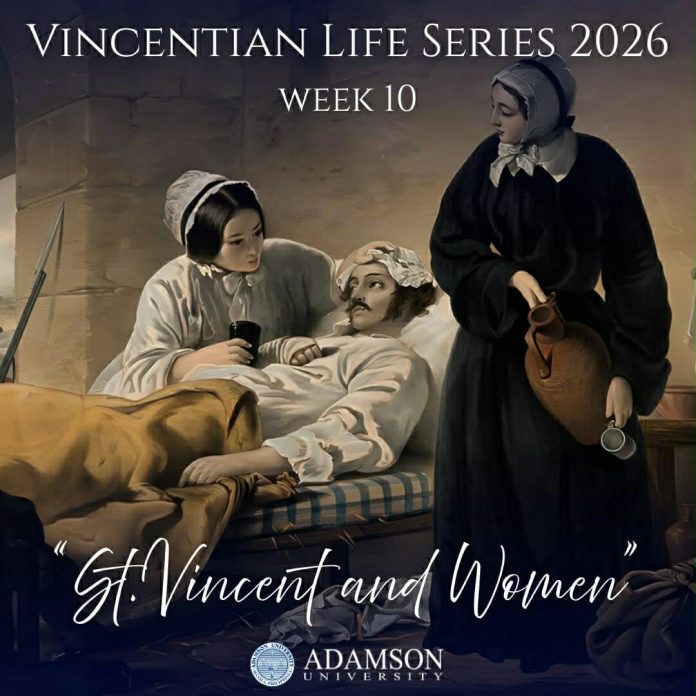
When these women of occupation were busy with their jobs and could not take on the challenge of everyday care for the poor, Vincent also organized the Daughters of Charity, with a present membership of 19,000 spread across 97 countries. This is a strong women’s force in the mission of caring for persons whom society has excluded.
Against the religious policies of the time, these women were nuns but did not live secluded in cloisters. Vincent instructed: “Your cloister will be the houses of the sick and the home of the superior, your cell a rented room, your chapel the parish church, your cloister the streets of the city or hospital wards.”
They had to wear clothes like ordinary simple women. Their way of life should make them mobile, agile, and fast in responding to the needs of the poor. Vincent said: “We need to run to the poor as we run to put off a fire.” Where the poor are, there we should be — right away.
Adamson University promotes the equal voices of women, men, and other genders. It supports diversity, inclusion, and equality in all fields of professional and administrative endeavors.
Like Vincent de Paul, to respect the dignity of women in our times is to challenge the prevalent gender bias and chauvinism in our sexist societies, and to promote inclusive and safe spaces for women in the academe, the Church, and professional fields.
We need to promote diverse and equal representation of all genders in all professional fields. We need to create safe spaces for women free from discrimination and harassment. We can also highlight the stories of women trailblazers in high places, but also the struggles and resistance of poor women in grassroots communities. We appreciate the original perspectives women contribute to our workplaces, offices, and churches.
In Fratelli Tutti, Pope Francis wrote: “The organization of societies worldwide is still far from reflecting clearly that women possess the same dignity and identical rights as men. We say one thing with words, but our decisions and reality tell another story. Indeed, doubly poor are those women who endure situations of exclusion, mistreatment, and violence, since they are frequently less able to defend their rights.”
Father Daniel Franklin Pilario, C.M., is the President of Adamson University in Manila. He is a theologian, professor, and pastor of an urban poor community on the outskirts of the Philippine capital. He is also the Vincentian Chair for Social Justice at St. John’s University in New York.