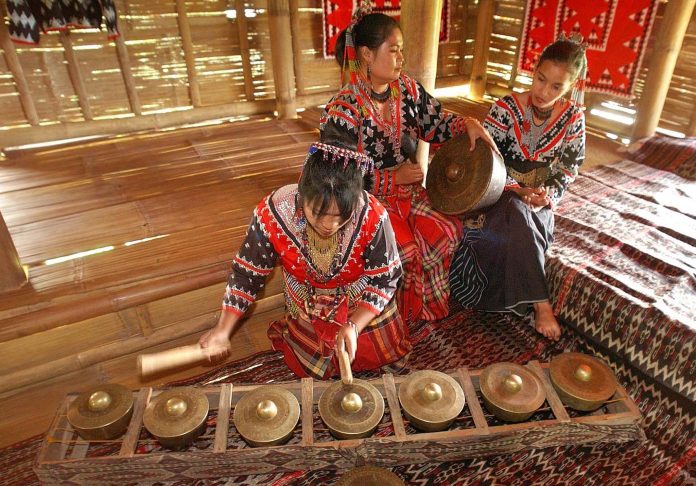
As T’boli bells are believed to turn away misfortune, negative energy, and malevolent entities, every Filipino should have at least one piece in their possession to protect them from the evil effects of corruption.
The sounds of T’boli bells, or tungkaling, consistently reverberate during the annual Pasinaya Open House Festival at the Cultural Center of the Philippines (CCP) complex.
Tungkaling bells are integral to T’boli identity. They believe that a spirit or force resides in all objects, both animate and inanimate.
The distinct sound produced by the brass bells worn on belts and bangles is believed to protect the wearer by warding off evil spirits and signaling a person’s approach.
The T’boli people are known for their artful t’nalak weaves and other textiles made on their weaving looms, as well as exquisite accessories and objects made of brass, such as bells, rings, necklaces, belts, and bangles.
Like other Indigenous peoples, T’boli culture is rich, diverse, and deeply rooted in animistic beliefs, honoring nature and spirits through tribal songs, music, dances, and daily life.
Through delicate swaying movements using intricate hand-loomed cloth, accompanied by the resonant drumming of gongs, dancers imitate the graceful movements of birds, fish, and boats. These dances are generally used for rituals to appease the gods, solicit a good harvest, seek deliverance from pestilence, prepare for war, celebrate victories, and mark births, weddings, and deaths.
These practices often blend cultural, religious, and spiritual traditions intended to safeguard personal space, body, and mind, as well as affirm social unity and identity.
The name T’boli is a combination of tau, meaning “people,” and bilil, meaning “hill” or “slope,” thus signifying “people living in the hills.”
Also known as T’boli, Tiboli, and Tagabili, they are an Indigenous people living in the southern part of Mindanao, particularly in the municipalities of T’boli, Surallah, Lake Sebu, and Polomolok in the province of South Cotabato, and in Maasim, Kiamba, and Maitum in Sarangani. They can also be found in the neighboring provinces of Sultan Kudarat, North Cotabato, and Davao del Sur.
One of the famous T’boli dances is “Kadal Heroyon,” or a “dance of flirtation,” performed by young T’boli women imitating the flight of birds to highlight grace and beauty.
In 2014, a film about the T’boli people, “K’na the Dreamweaver,” won Best Production Design (by UP College of Fine Arts dean Toym Imao) and the Special Jury Prize during the CCP’s 10th Cinemalaya Independent Film Festival.
It was the first feature film shot entirely in the T’boli language. The story follows K’na, a young woman trained to weave the sacred t’nalak cloth, who must choose between her love and her duty to end a clan war.
Pasinaya is an effective platform for showcasing various cultures in the Philippines that have been made more vibrant through folk dances and music.
T’boli culture has always been a favorite subject in Pasinaya. This year, two groups performed T’boli dances: the Ramon Obusan Folkloric Group (ROFG) and the UST Salinggawi.
For the past two decades, ROFG has documented and performed the rituals of more than 50 ethnolinguistic groups in the country.
With more than 20 outstanding full-length Filipino dance works, including memorable suites from the Cordillera, Bagobo, T’boli, Tausug, Maranao, Aeta, and Talaandig, the ROFG has highlighted the authenticity of tribal movements and costumes.
“Pasinaya” means an inauguration or grand opening of the many arts and cultural presentations offered by CCP.
Since 2004, Pasinaya has aimed to provide a platform for artists and cultural groups from different fields such as music, theater, dance, spoken word, and visual arts. It seeks to showcase talent while nurturing the broadest public and creating new audiences through interactions and performances.
Carrying the theme “Paglikha sa Kinabukasan,” Pasinaya 2026 highlighted the role of artists and audiences, especially the youth, in shaping the future of Philippine arts and culture.
In Metro Manila, the festival unfolded across multiple venues, including Tanghalang Ignacio Gimenez, the CCP front lawn, Aliw Theatre at the CCP complex, the Circuit Performing Arts Theater in Makati, the Metropolitan Theater in Manila, and Rizal Park in Luneta, as well as 19 museums and galleries across the cities. It was also held in Tagum City, Iloilo City, and, for the first time, in Roxas City, Capiz.
CCP Vice President and Artistic Director Dennis Marasigan said that 2,708 artists participated in 170 performances by 144 groups in the National Capital Region alone, drawing more than 13,000 attendees at the CCP complex under the “experience-all-you-can, pay-what-you-can” scheme.
“Through Pasinaya, CCP will not stop advancing our cause to grow appreciation for Filipino arts and culture, because we believe and will continue to strive so that arts and culture can be recognized as strong pillars and support for our future,” Marasigan said.
Atty. Dennis R. Gorecho heads the seafarers’ division of the Sapalo Velez Bundang Bulilan law offices. For comments, email [email protected], or call 09175025808 or 09088665786.