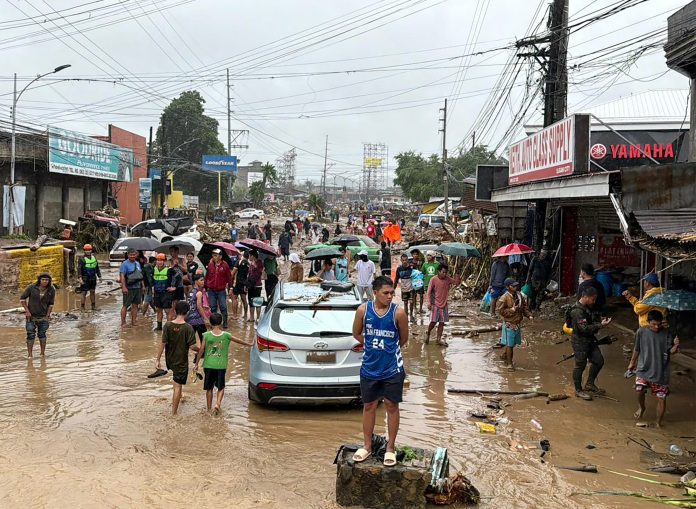
A leading church official in the southern Philippines said Tropical Storm Basyang exposed long-standing environmental neglect, warning that disasters linked to climate extremes are worsened by human actions and unresolved governance failures.
Bishop Jose R. Rapadas III of Iligan said the flooding caused by Basyang was “not caused by rain alone,” but was intensified by “denuded watersheds, silted and narrowed rivers, clogged drainage, and irresponsible waste disposal,” according to a pastoral letter dated Feb. 8.
While acknowledging that early warnings, pre-emptive evacuations, and rescue operations helped prevent loss of life, Rapadas said the storm revived painful memories of Tropical Storm Sendong in 2011 and underscored the city’s continuing vulnerability.
“For many Iliganons, the rising waters brought back painful memories of Tropical Storm Sendong in 2011,” he said. “While Basyang did not bring the same scale of casualty, it reminded us that our city remains vulnerable and that’s because, to be honest, we have not acted enough on the lessons we learned.”
The bishop said the impact of environmental degradation is borne “most heavily by the poor and vulnerable,” stressing that climate-related disasters are becoming “more frequent and less predictable.”
“Basyang showed us that even storms with weaker winds can become deadly when rainfall is intense and when our environment is already fragile,” Rapadas said.
Framing environmental protection as a moral responsibility, the bishop said care for creation is inseparable from Christian discipleship.
“Care for creation is not an optional concern; it is a moral obligation,” he said, adding that “protecting forests, rivers, and seas; practicing proper waste management; supporting just land-use policies; and respecting environmental laws are concrete ways of loving God and one another.”
Rapadas called on the Diocese of Iligan’s Integral Ecology Ministry, together with parishes, schools, basic ecclesial communities, youth groups, and social action partners, to intensify environmental education and work with local authorities on watershed protection, tree-growing initiatives, river and drainage cleanups, and waste management programs.
“These actions are not merely projects—they are expressions of faith, concrete ways of living out the call of the gospel in our time,” he said.
The bishop also appealed directly to local government leaders and agencies responsible for environmental protection and flood control, urging “decisive, transparent, and sustained action.”
He cited the need for watershed rehabilitation, enforcement of land-use and no-build-zone regulations, desilting and widening of critical river channels, improved drainage systems in vulnerable communities, and effective solid waste management.
“We ask you to work closely with civil society and church communities so that together, as ‘salt and light of the world’, we may build a safer, more resilient, and ecologically balanced Iligan for present and future generations,” Rapadas said.