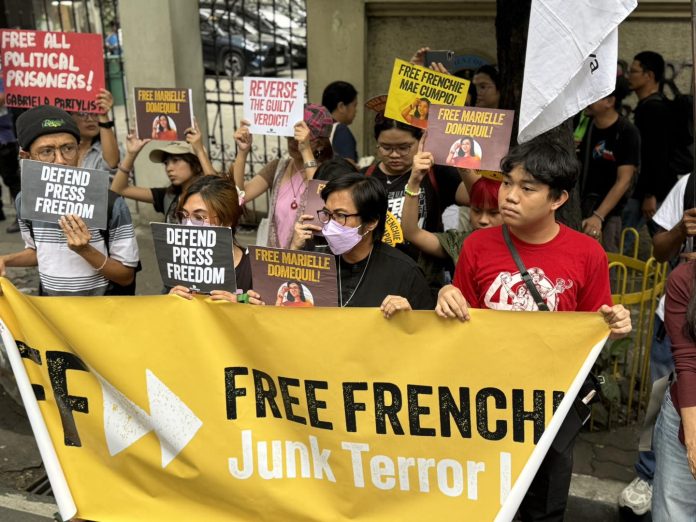
The conviction and prolonged detention of community journalist Frenchie Mae Cumpio have renewed concerns over the use of terrorism financing laws to criminalize journalism in the Philippines, media groups said.
Cumpio marked her sixth year in detention on Feb. 7 after her arrest during a police raid in Tacloban City in February 2020 and her subsequent conviction for financing terrorism.
She received a minimum sentence of 12 years in prison, with rights and media organizations maintaining that the charges stem from her work as a community journalist.
Before her arrest, Cumpio worked as a radio broadcaster in Eastern Visayas, reporting on farmers, urban poor communities, and disaster survivors, including stories rarely covered by national media outlets.
Cumpio reported being followed by unidentified men and receiving death threats months before her arrest, during intensified military operations in Eastern Visayas under Memorandum Order No. 32.
That order, issued during the administration of former President Rodrigo Duterte, expanded military deployment in several regions amid counterinsurgency operations.
Media organizations said Cumpio’s arrest, prolonged pretrial detention, and conviction reflect a broader pattern in which counterterrorism and terrorism financing laws blur distinctions between journalism and criminal activity.
They said the practice has persisted under President Ferdinand Marcos Jr., despite expectations that his administration would reverse policies associated with the previous government.
Meanwhile, on Feb. 6, lawyer Julianne Agpalo of the National Union of Peoples’ Lawyers filed a manifestation before the Court of Appeals in response to the government’s motion for reconsideration in the civil forfeiture case involving Cumpio and lay worker Marielle Domequil.
The forfeiture case sought more than ₱500,000 in cash seized during their arrest in Tacloban City in February 2020, following a petition earlier filed by the Anti-Money Laundering Council.
A Manila Regional Trial Court branch initially granted the forfeiture petition, but the Court of Appeals reversed the ruling in October, citing insufficient evidence and lack of legal basis.
The appellate court said there was no proof linking Cumpio and Domequil to the activities of the revolutionary movement, according to court records referenced in the filing.
Media groups warned that the case sets a precedent allowing reporting on militarization, development projects, or marginalized communities to be reinterpreted as terrorism-related activity.
They said the result has been a chilling effect on community journalism, particularly in provinces where reporters have limited institutional protection and legal resources.
International press freedom advocates have raised concerns, with Reporters Without Borders describing Cumpio’s prolonged detention as emblematic of terrorism-related charges used against community-based reporters.
Irene Khan, the UN special rapporteur on freedom of expression, has also flagged the case as raising serious concerns over due process and misuse of security legislation.
The pattern aligns with findings in Human Rights Watch’s World Report 2026, which said Philippine authorities continued to abuse terrorism financing provisions against activists and civil society groups.
Human Rights Watch said the laws allow asset freezes and prolonged detention using broad definitions and limited safeguards, contributing to repression and chilling freedom of expression and association.
The rights group urged reforms to counterterrorism policies, particularly as the Philippines prepares to chair the Association of Southeast Asian Nations in 2026.
The pooled editorial was issued by the Movement for Media Safety Philippines, a network of media organizations advocating for journalist safety and press freedom across the country.
Organizations endorsing the pooled editorial
- Altermidya – Alternative People’s Media Network
- Asian Institute for Journalism and Communication
- Center for Community Journalism and Development
- Center for Media Freedom and Responsibility
- Foreign Correspondents Association of the Philippines
- Mindanews
- National Union of Journalists of the Philippines
- Philippine Center for Investigative Journalism
- Philippine Press Institute
- Peace and Conflict Journalism Network (PECOJON)
- University of the Philippines College of Media and Communication
- VERA Files