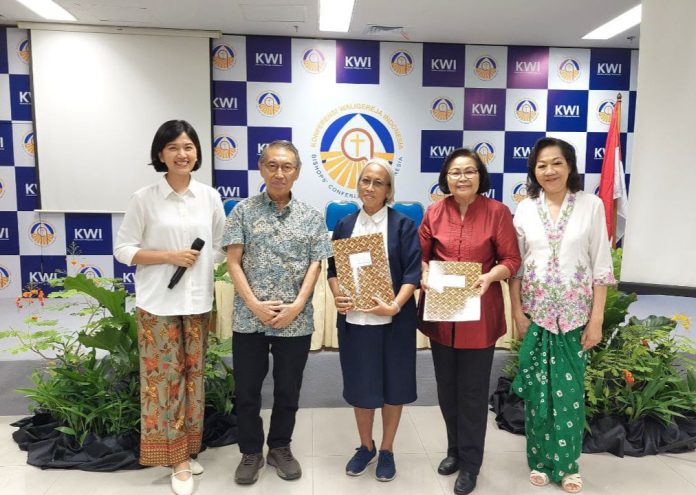
In late November 2025, church workers, medical professionals, and pro-life advocates from across Indonesia gathered in Jakarta and online for the 4th National Workshop of the Forum Komunikasi Penyayang Kehidupan (FKPK), a meeting that marked a turning point in how the Catholic Church in Indonesia seeks to respond to unwanted pregnancies.
Held on November 29–30 at the Indonesian Bishops’ Conference (KWI) headquarters and via Zoom, the workshop carried the theme, “You Knit Me Together in My Mother’s Womb; Protect and Safeguard Me.” It was designed not as a stand-alone event but as a continuation of commitments made four years earlier.
The gathering followed the 3rd FKPK National Workshop in 2021, which had recommended the creation of pastoral services for Unwanted Pregnancies, locally known as Kehamilan Tak Diinginkan (KTD), as a concrete response to abortion and related social challenges. By 2025, the focus had shifted from recommendation to implementation.
Organizers said the workshop concentrated on forming and strengthening networks of KTD services across dioceses, linking pastoral care with medical, psychological, and social support. The goal was to help dioceses understand existing models and to encourage the development of similar programs at the local level.
Participants came from a wide range of church and social institutions. They included representatives of dioceses throughout Indonesia, particularly diocesan Family Commissions, FKPK members, Catholic hospitals and clinics, shelters and safe houses, Catholic orphanages, and pro-life advocacy groups.
Attendance reflected sustained interest in the issue. On the first day, 49 participants joined onsite and about 130 online. On the second day, 38 attended in person, and roughly 50 participated virtually.
From teaching to practice
The workshop opened with keynote inputs that set the tone for the two-day discussions. Dr. Felix Gunawan, chair of FKPK, drew attention to the scale of abortion cases in Indonesia and underscored the need for counseling and comprehensive care for women experiencing unwanted pregnancies. He called for the establishment of KTD service teams in every diocese.
Bishop Yanuarius Yan Olla MSF, chair of the KWI Family Commission and bishop of the Diocese of Tanjung Selor in North Kalimantan, reiterated the Catholic Church’s teaching that human life begins at conception and ends with natural death. Referring to Psalm 139:13, he emphasized that God knows each person even before birth and pointed to network-based pastoral services as a way to broaden and strengthen assistance, citing FKPK’s experience.
Father Budiyono MSF, who heads the Family Apostolate Commission of the Archdiocese of Jakarta, reflected on the Church’s teaching on human dignity as God’s creation. He also addressed contemporary challenges and violations of that dignity and outlined the Church’s pastoral responses.
A series of technical and pastoral sessions followed, bringing together medical and social perspectives. Topics ranged from comprehensive sexuality education and health services for unwanted pregnancies to counseling, accompaniment, shelter services for women, and care arrangements for babies born from KTD cases. These sessions were moderated by dr. Priska Worotikan, with Anastasia Heni serving as master of ceremonies.
Mapping realities, planning responses
The second day moved from inputs to application. Participants joined regional group discussions, both onsite and online, facilitated by members of the organizing committee. Professional psychologist Agnes Dosorini moderated the discussions, with Cicilia Vonny as MC.
In these sessions, participants were asked to map cases of unwanted pregnancies in their respective regions, identify existing resources, and assess gaps in services. The discussions also focused on how dioceses could build or strengthen local networks linking pastoral care, health services, shelters, and child-care institutions.
The workshop concluded with a Eucharistic celebration presided over by Bishop Yan Olla. During the Mass, a summary of the workshop’s outcomes was presented as a symbolic offering, entrusting ongoing pro-life efforts to God’s guidance.
As a concrete follow-up, participants were invited to join the Forum Pro-Life WhatsApp Group, intended to support coordination and the exchange of information on preventing and responding to unwanted pregnancies across Indonesia.
While the workshop itself took place in 2025, organizers and participants described it as part of a longer process. The emphasis on networks, shared responsibility, and practical collaboration continues to shape how dioceses and Catholic institutions in Indonesia approach pastoral care for women facing unwanted pregnancies.