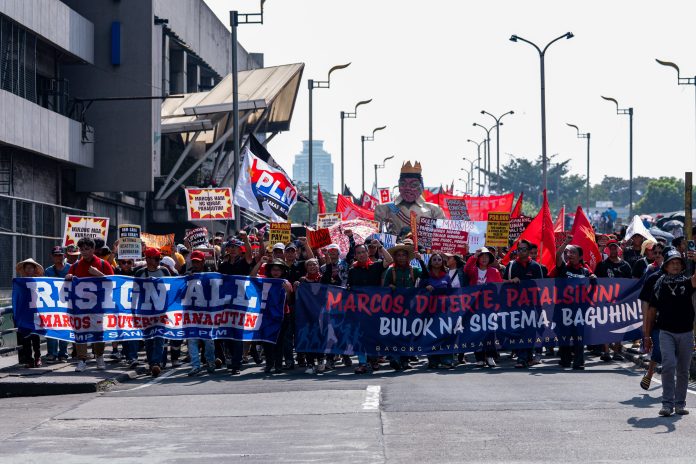
Tens of thousands of Filipinos marched on Bonifacio Day to demand accountability for what they called entrenched government corruption that has worsened poverty and disaster risks.
The demonstrations, held in Luzon, Visayas, and Mindanao, expanded the momentum of the September 21 rallies that first erupted after alleged irregularities in flood-control spending surfaced five months ago.
Mobilizations converged in Luneta, where progressive groups accused the administration of trying to obstruct the protest by directing police to disrupt early preparations.
Bayan said police officers attempted to halt the setup of the stage and sound system before demonstrators intervened.
In its statement, Bayan condemned the government’s “attempt to sabotage the Luneta rally using the police to harass and obstruct the peaceful assembly.”
The group said more than a hundred thousand people joined actions nationwide to “demand full accountability without exception against all those involved, primarily the masterminds of the systematic corruption in government.”
Progressive formations centered their calls on President Ferdinand Marcos Jr. and Vice President Sara Duterte, accusing both of benefiting from and enabling the misuse of public funds.
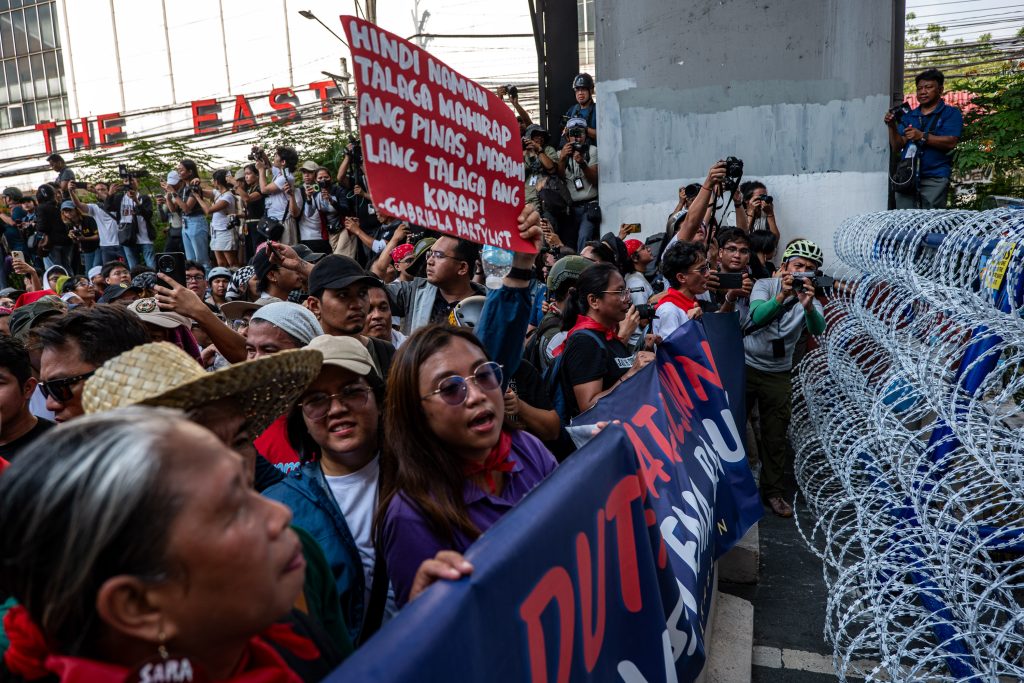
“The November 30 protest reiterated the demand to hold the country’s top two officials – Marcos Jr and Sara Duterte – accountable for abusing their power to commit plunder and then cover it up,” Bayan said.
The group added that Marcos “should be investigated for his key role in the budget insertion and release of funds for the pork barrel projects that caused the loss of hundreds of billions of pesos of public funds.”
It said Duterte’s “culpability has been proven, rightfully leading to her impeachment.”
The group criticized what it described as government attempts to frame the protests as destabilization efforts, saying officials “maliciously tried to denigrate these demands by dismissing them as unconstitutional while falsely accusing the Luneta protest of promoting destabilization and military adventurism.”
Speakers at the rally underscored the absence of prosecutions despite the scale of the alleged corruption.
David Michael San Juan, a De La Salle University professor and convener of the Taumbayan Ayaw sa Magnanakaw at Abusado Network Alliance (TAMA NA), said no official has faced charges since the scandal broke.
He described how many Filipinos can barely cover hospitalization or medicine, struggle to pull together school expenses, and sink deeper into debt despite exhausting work, while those involved in corruption continue to live off billions of pesos.
“They say a P57 billion kickback was delivered to Marcos and Romualdez, while we earn so little because of high taxes—and the government still tells us to make do with P500 for Noche Buena. Is P500 enough for Noche Buena? No!” he said.
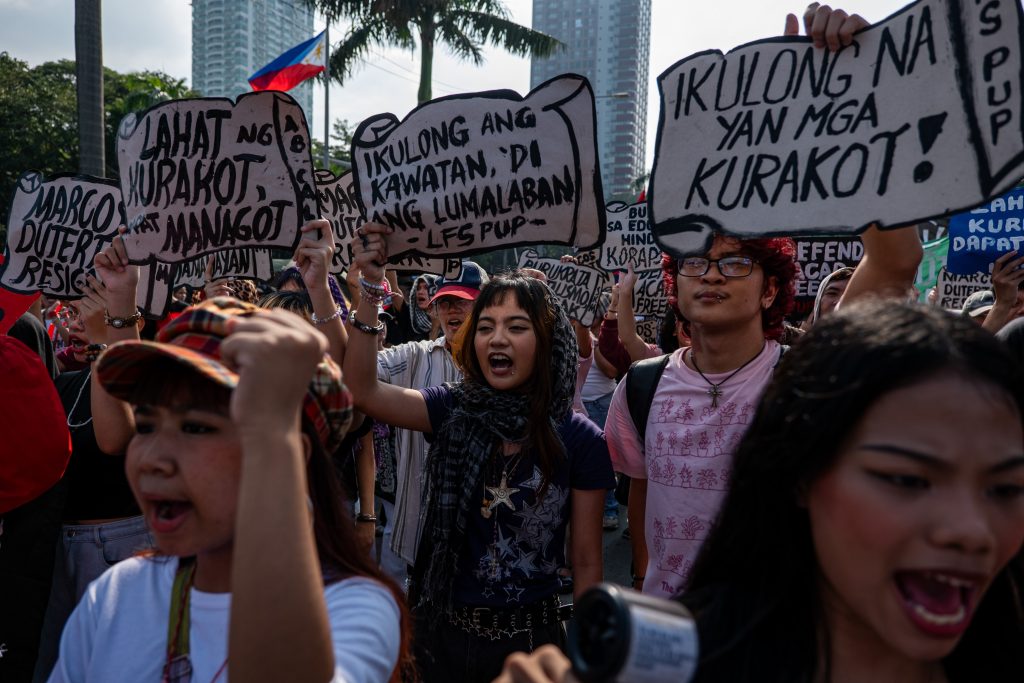
Workers’ groups echoed the demand for leadership change. Jerome Adonis of Kilusang Mayo Uno said Filipinos should not be forced into choosing between two leaders facing corruption allegations.
“For workers, the first step to accountability is to oust both Marcos Jr. and Sara Duterte from their position by the Filipinos,” he said.
Farmers raised similar concerns. KMP chairperson Danilo Ramos described the impact of corruption on rural communities.
“Although the [recent] typhoons have gone away, corruption is still lingering in Filipinos’ lives that worsens poverty,” said Ramos.
Groups behind the protests revived calls for a People’s Transition Council should both officials resign. Advocates argue that a temporary civilian-led governing body is necessary to oversee reforms and restore public trust.
“Calls for resignation and transition are not destabilization. They are the people’s safeguard against entrenched corruption, dynastic rule, and systemic decay,” Bayan said.
The coalition said representatives from marginalized sectors must lead such a council.
In its statement,the group stressed that Marcos has “to step down to allow an independent, thoroughgoing anti-corruption investigation, and face accountability for his crimes against the Filipino people.”
It also said Duterte “must also be held accountable for large-scale corruption, abuse of her office and her role in the extrajudicial killings and other crimes against humanity perpetrated by the murderous regime of her father, former President Rodrigo Duterte.”
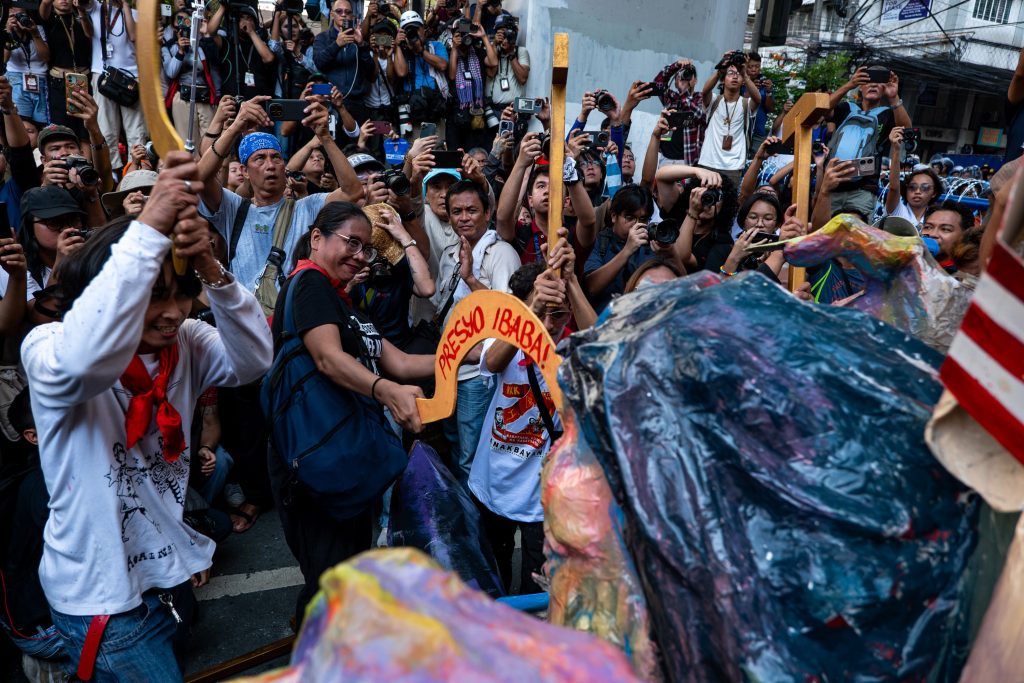
Greenpeace Philippines joined the Luneta protest, linking corruption to climate vulnerability. The group cited the impacts of Typhoons Tino and Uwan, which caused ₱2.68 billion in combined losses.
“People are in the streets today because corruption is costing lives. Typhoons Tino and Uwan proved that when funds meant for safety are stolen, Filipino communities pay the price. This outrage is justified, necessary, and long overdue,” said Lea Guerrero, Greenpeace Philippines Country Director.
Guerrero added that accountability must extend beyond state officials.
“Accountability must extend from corrupt officials and complicit contractors to the fossil fuel companies which continue to profit from the climate crisis,” she said.
“Every recovered peso strengthens our defenses, and every step toward transparency brings us closer to a fairer and safer future,” she added.
Greenpeace called on the administration to ensure “full accountability for corrupt officials and contractors who stole climate funds,” guarantee public access to environmental and budget documents, and protect policy spaces from “corruption and corporate influence.”
Bayan said the September 21 and November 30 demonstrations reveal a growing public demand for truth, justice, and systemic reform. The group expects more actions in the coming weeks as Congress enters the bicameral budget session. – with reports from Bulatlat.com