Civil groups in the Philippines criticized the government’s failure to protect citizens from worsening climate impacts as the country again ranked among the world’s most vulnerable nations.
According to the Germanwatch Global Climate Risk Index, the Philippines ranked seventh globally, while the World Risk Index again placed the country first, underscoring the worsening threats from stronger typhoons, floods, and other hazards.
The reports noted that human-induced climate change has intensified storms by an average of 7.2 km/h, increased their frequency by 30 percent, and raised heat wave intensity by about 1.2°C.
‘Resilience has become the excuse for inaction’
“Year after year, the Philippines lands on the top of global climate risk lists. And year after year, nothing changes,” said Greenpeace Philippines Senior Campaigner Virginia Benosa-Llorin.
“‘Resilience’ has become the excuse for inaction. Our people have paid with their homes, their health, and their lives, while those most responsible for the crisis profit and pollute with impunity,” she added.
Benosa-Llorin said the country recorded USD 35 billion in documented economic losses between 1995 and 2024, but added that this figure “does not even capture the non-economic losses Filipino communities have endured for decades.”
“These are the invisible costs that never make it to official reports: the pain of losing a loved one, a livelihood, or a future,” she said.
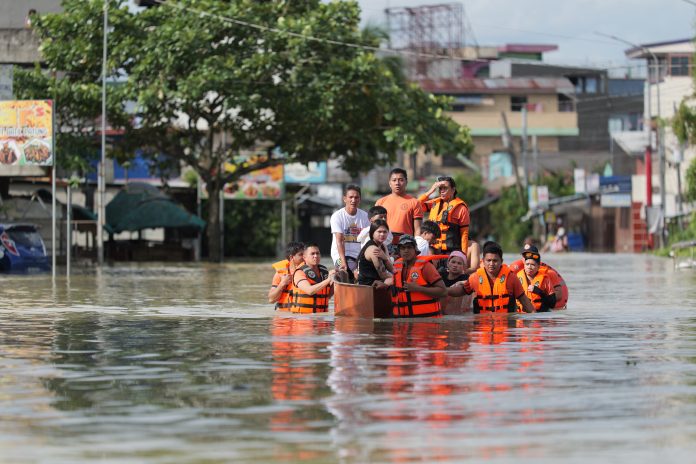
Referring to the devastation caused by Typhoon Tino and Super Typhoon Uwan, which have claimed more than 220 lives, Benosa-Llorin warned that the cycle of destruction and slow recovery continues to repeat.
“It’s getting worse. In the span of days, Tino and Uwan’s recent casualties show the same disturbing pattern: disaster, loss and damage, a long recovery, then disaster again. And all this while billions meant for flood control and climate protections are lost to corruption,” she said.
Benosa-Llorin urged world leaders at COP30 to ensure that the Loss and Damage Fund is fully financed through grants that directly support affected communities.
She also pressed for holding major carbon-emitting corporations accountable, saying decades of unchecked pollution have pushed vulnerable nations like the Philippines to the edge.
‘Begin atoning for climate sins’
As the COP30 climate talks opened in Belém, Brazil, Church and environmental leaders echoed Greenpeace’s call, urging the Philippine delegation to bring justice to communities devastated by recent storms and by corruption in climate-related projects.
“It was not just the floods or strong winds—it was years of greed and corruption that robbed many fellow Filipinos their lives and homes,” said Bishop Gerry Alminaza of San Carlos, lead convenor of the Laudato Si’ Convergence.
“Billions in public funds that should have gone to protecting vulnerable communities instead lined the pockets of corrupt politicians and their contractors,” he added.
He lamented that “after all the talk and finger-pointing within the Marcos administration, the only thing that’s clear today is that no cent has been returned, and no offender has been sent behind bars.”
Bishop Alminaza also criticized the Philippine delegation for failing to bring a new Nationally Determined Contribution (NDC) to the talks.
“Members of the Philippine government landed in Belem carrying no new NDC, and not having consulted extensively with constituents, as they should have to even produce one. How, indeed, can Filipinos be assured that the delegation intends to adequately represent their plight?” he said.
He said the Philippine government should use COP30 as a chance to make amends for its failures on climate action. While other nations are calling for a just global shift away from fossil fuels and demanding reparations from major polluters, he questioned why the Philippines has yet to do the same.
‘A climate betrayal after betrayal’
Gerry Arances, convenor of the Power for People Coalition (P4P), said the government has taken “a dangerous step backward” by loosening restrictions on fossil fuels.
“It’s a climate betrayal after betrayal,” he said. “The Department of Energy, under the guidance of President Marcos himself, issued an advisory that spells as a de facto cancellation of the 2020 moratorium on new coal-fired power plant projects, just weeks before COP30.”
He warned that the government’s push for more coal and gas projects endangers vulnerable Filipinos and communities near fossil fuel sites, serving only the interests of energy corporations and their political allies.
Arances said Filipinos have every right to demand that public officials at COP30 represent their interests. “Surely it’s not unreasonable for Filipinos to demand that the delegation—whose attendance at COP30 our people’s hard-earned taxes enabled—defend our rights and climate survival,” he said.