The fragile ceasefire in the Gaza Strip has again highlighted the continued suffering of more than two million Palestinian civilians.
Since Israel’s military campaign in the territory began in October 2023, over 68,000 Palestinians have been killed — most of them women and children — and Israeli attacks have left as many as 170,000 wounded.
These figures are supported by the United Nations, which reports that at least 30,000 children suffer from acute malnutrition due to Israel’s weaponization of food. Today, the country is still not fulfilling its part under the ceasefire agreement to allow 600 trucks of aid into Gaza; it only allows an average of 89 a day.
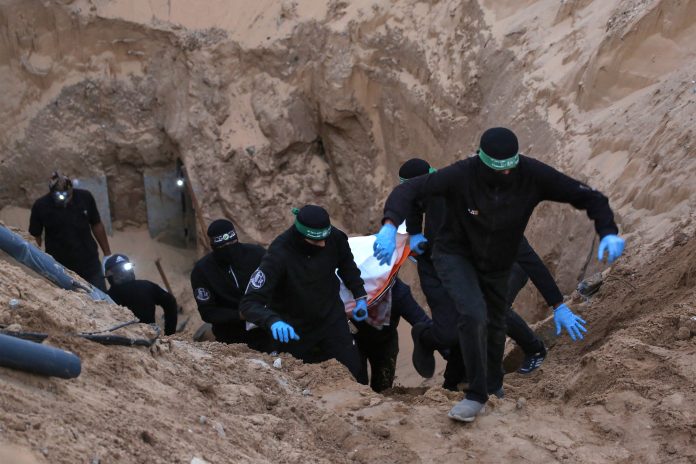
Israel has received all 20 living hostages taken during Hamas’ attacks on Oct. 7, 2023, but the bodies of 15 others have yet to be found — likely buried under the rubble of buildings destroyed by Israeli forces. Israel will not even allow Hamas to bring in heavy equipment to recover those bodies.
Israeli forces have already violated the ceasefire. The most recent bombing in Gaza killed about 60 Palestinians after Israel claimed that two of its troops were killed by Hamas fighters. However, the United States and independent journalists said the explosion was caused by a bulldozer hitting an unexploded ordnance — not by a Hamas attack. Top U.S. officials, including Vice President JD Vance, recently visited Israel to ensure the truce holds.
A UN Mine Action Service report in May 2024 said approximately 7,500 tons of unexploded ordnance were buried across Gaza. Bombs supplied by the U.S. to Israel include 14,000 MK-84 2,000-lb bombs, 6,500 500-lb bombs, and 3,000 Hellfire precision-guided missiles. Israeli forces have used these to reduce Gaza to rubble, burying in the process more than a thousand bodies — mostly women and children.
Israeli Prime Minister Benjamin Netanyahu reportedly wants to resume the war to postpone his trial for corruption. A multinational task force made up of troops from Egypt, Qatar, Turkey, and the United Arab Emirates is being formed to monitor the ceasefire, while the U.S. Central Command will remain in Israel to oversee developments in Gaza.
During the 80th UN General Assembly in September, 157 out of 193 nations recognized Palestine as an independent state. The UN and its judicial body, the International Court of Justice, have declared Israel’s prolonged occupation of Palestinian territory illegal under international law.
Palestine has been a UN observer since November 2012. Its efforts to become a full member have been continually blocked by the U.S. On Sept. 26, 2024, Saudi Foreign Minister Prince Faisal bin Farhan Al Saud and Norway’s Foreign Minister Espen Barth Eide co-led a meeting of representatives from about 90 countries, held on the sidelines of that year’s UN General Assembly, to launch a global alliance for a two-state solution.
Since the Arab Summit in 1982, the Palestine Liberation Organization has accepted the concept of a two-state solution based in the West Bank, Gaza, and East Jerusalem. Hamas, which has been declared a terrorist organization, made a new policy statement in 2017 saying it would accept the idea of a Palestinian state defined by the 1967 borders, though it does not formally recognize the State of Israel.
There is growing global support for a two-state solution. Surveys show that 33 percent of Palestinians, 34 percent of Israeli Jews, and 60 percent of Israeli Arabs support the idea. But fanatical Israeli leaders have rejected it, declaring that Israel has a historical right to own all of Palestine as its sovereign territory. “Between the sea and Jordan, there will only be Israeli sovereignty,” Netanyahu and his right-wing allies declared on Jan. 18, 2024.
A more politically progressive Israel will have to emerge if a two-state solution is to be realized. The country’s next general elections are scheduled for Oct. 27, 2026, but the government’s instability could prompt a snap election — which Netanyahu might use to remain in power.
The integrity of the West Bank — home to 3.4 million Palestinians — is central to the two-state solution. Another 7.8 million Palestinians live abroad, most in other Arab countries. However, Israel is working to make the two-state solution impossible by advancing its E-1 plan to expand Israeli settlements in the West Bank — a “divide and conquer” strategy that would cement its illegal occupation of the territory under international law.
There are already 160 settlements with around 200,000 Israeli Jews living there. Palestinians continue to resist the often violent land-grabbing and the destruction of their olive groves by Israeli settlers, who are supported by the army. The settlers attack Palestinians on their own land to drive them away. A draft Israeli law proposes annexing the West Bank, but the U.S. opposes the move.
Breaking up the West Bank undermines the possibility of a contiguous Palestinian state. That possibility is further jeopardized by the expansion of settlements and the proliferation of Israeli checkpoints and roadblocks across Palestinian territories — measures that divide communities, restrict travel, harass civilians, and weaken the Palestinian economy.
Israel recently announced plans to formally occupy a 12-square-kilometer (4.6-square-mile) section of land east of Jerusalem for new settlement expansion, where 3,400 new homes will be built for Israeli settlers. The project will cut off much of the occupied West Bank from occupied East Jerusalem while linking thousands of illegal Israeli settlements in the area — a prelude to annexation.
The U.S. has condemned any annexation move, as President Donald Trump promised Arab states that such actions would not take place. East Jerusalem is envisioned as the future capital of a Palestinian state.
The UN, the European Union, and 21 countries have condemned Israel’s plan, saying it makes a two-state solution impossible. “We condemn this decision and call for its immediate reversal in the strongest terms,” they said, describing Israel’s construction plans as a “violation of international law.”
Palestinians are gaining growing international recognition and support — but the question remains: will it translate into action that curbs their oppression and helps set them free?
Note: Any original information, stories, or news articles posted on this site that are authored by the Preda Foundation and Father Shay Cullen may be shared, copied, or reproduced without further permission, in support of truth, freedom of expression, and the public’s right to know.
LiCAS News was granted permission to republish and adapt this article by Father Shay Cullen in the spirit of truth-telling and the pursuit of justice.
Irish missionary Father Shay Cullen, SSC, founded the Preda Foundation in Olongapo City in 1974 to promote human rights and the rights of children, especially victims of sexual abuse.
The views expressed in this article are those of the author and do not necessarily reflect the editorial stance of LiCAS News.