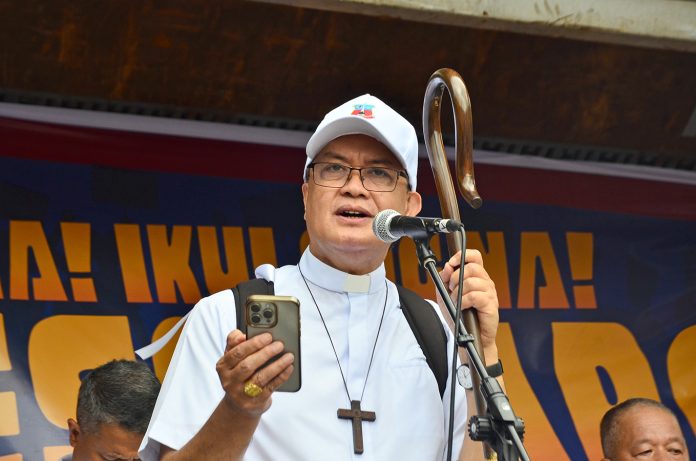
Cardinal Pablo Virgilio David of Kalookan urged Filipinos to confront corruption without dismantling democratic institutions, describing the nation’s political crisis as a “moral crossroads” that demands reform rather than revolt.
In a reflection titled “Saving the House, Not Burning It Down: A Moral Call Amid a Political Crisis,” the prelate said the turmoil — triggered by President Ferdinand Marcos Jr.’s own anti-corruption drive — has exposed “both the fragility and the resilience of our democratic institutions.”
“We do not need to burn the house down to get rid of the rats. It would be folly to throw the baby out with the bath water,” Cardinal David wrote, stressing that calls to dismantle government should target “the corrupt networks that have captured and crippled it,” not the state itself.
A moral and spiritual crisis
From the Church’s standpoint, David said corruption “is not merely a political sin—it is a spiritual sickness” that “erodes trust, breeds cynicism, and kills the soul of the nation.”
“The Gospel warns us that one cannot serve both God and mammon,” he said, adding that the Church’s mission is to “provide a moral compass in public life, not by claiming political power but by forming consciences, awakening moral courage, and calling people to conversion.”
He cautioned against abandoning democracy for “shortcuts” such as “a revolutionary government or a civilian-military junta,” reminding Filipinos that after the 1986 People Power Revolution, “the Church and the people did not abolish the state; they reclaimed it.”
Reform through redemption
Cardinal David underscored that “institutions can be redeemed” through justice and mercy, which he described as “two sides of the same redemptive love that calls sinners to conversion and nations to renewal.”
“Reconciliation, which aims at liberation of conscience, is possible only with confession (the humble admission of truth), contrition (the sincere resolve to make amends), and penance (the readiness to make concrete acts of reparation and restitution),” he said.
Role of schools, businesses, and civil society
The cardinal called on universities to “enlighten public consciousness” and teach discernment and historical memory, warning that ignorance and despair make citizens “vulnerable to authoritarian nostalgia and populist deception.”
He also urged the business sector to “take a stand, not as partisans but as stewards of the common good,” saying “true economic progress cannot coexist with systemic plunder.”
“The legitimate private sector has no business partnering with political syndicates that turn public funds into private wealth,” he said. “To defend the integrity of markets, we must first defend the integrity of the nation.”
Meanwhile, he called civil society “the vigilant conscience of the nation,” warning against “opportunists” who call for a junta or revolutionary government under the guise of reform.
“When crooks quarrel with crooks, it is not justice but survival they seek,” he said, describing the political divisions as “an unholy union of political dynasties now turning against each other for power.”
A call to moral reconstruction
Cardinal David concluded his reflection with a call for “a revolution of integrity” — not rage — to restore moral order and public trust.
“The challenge before us is clear: to dismantle, not our democratic institutions, but the corruption that corrodes them,” he said. “We must resist both apathy and anarchy.”
He urged Filipinos to “restore the systems of checks and balances, counteract disinformation, reform the electoral process, end patronage politics and political dynasties, and renew the moral foundations of public service.”
“We owe it to those who once filled EDSA with candles and prayers, to the young who still believe that decency in governance is possible, and to the God who continues to call this nation to conversion,” he said. “We do not burn down the house to rid it of rats; we cleanse it, guard it, and make it worthy again of the people it shelters.”