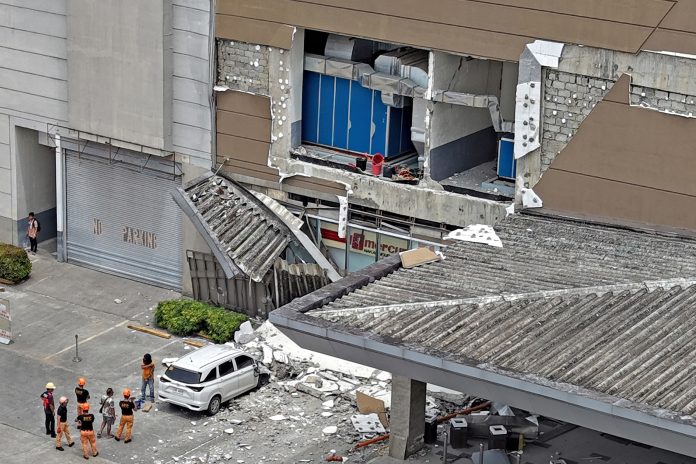
Churches in the Philippines have appealed for prayer and solidarity after a powerful magnitude-7.4 earthquake struck off Davao Oriental on Friday morning.
Caritas Philippines expressed sympathy with the affected communities and said it is closely monitoring the situation in coordination with local dioceses.
The social action arm of the Catholic Church “expresses its solidarity with the communities affected by the recent earthquake” that killed at least three people and triggered widespread panic across Mindanao.
“Our national team is closely monitoring the situation and coordinating with our partner dioceses in the affected areas to assess immediate needs and potential support interventions,” it said.
Caritas also urged the faithful “to remain alert, prioritize safety, and join us in praying for the protection and resilience of our brothers and sisters during this time.”
The United Church of Christ in the Philippines (UCCP) likewise called for collective prayer and compassion through a special invocation for those affected by the tremor.
In a prayer for the safety and recovery of those affected by the earthquake, the Protestant Church said: “O God of Life, in these moments of fear and uncertainty, we turn to You in prayer. We lift up to You our brothers and sisters in Davao Oriental and all other affected areas—grant them safety, courage, and strength.”
The prayer also urged government agencies and humanitarian organizations “to bring timely assistance to those who are most in need,” while reminding communities of their moral duty toward creation.
“Amid these disasters, remind us that Your creation is sacred. Teach us to be responsible stewards of the earth, to stop harmful practices, and to work for justice for both creation and our neighbors,” it added.
The earthquake struck about 20 kilometers off the coast of Manay in Davao Oriental at 9:43 a.m., sending strong tremors that caused walls to collapse and people to flee from schools, malls, and offices.
Authorities confirmed that one person died when a wall collapsed in Mati City and another suffered a fatal heart attack during the quake. Another person was killed in Davao City, more than 100 kilometres west of the epicenter.
A tsunami warning was issued but later lifted after only a minor wave was detected. Some areas in Davao Oriental lost power and communication lines, prompting the suspension of classes “until further notice.”
While the Mindanao quake was stronger in magnitude, experts said it was less destructive than the recent earthquake that hit the central Philippines.
Philippine Institute of Volcanology and Seismology (Phivolcs) director Teresito Bacolcol explained that the September 30 magnitude-6.9 earthquake in northern Cebu caused greater damage because of its shallow depth and proximity to populated areas.
“The Cebu tremor’s epicenter was shallower and closer to populated areas,” Bacolcol said during a press briefing.
He noted that the quake’s depth was about five kilometers, with the fault line cutting through land in Bogo City, while the Davao tremor occurred at a depth of 23 kilometers along the Philippine Trench.
Shallow epicenters, he explained, “cause more intense and widespread shaking because they are closer to the earth’s surface.”