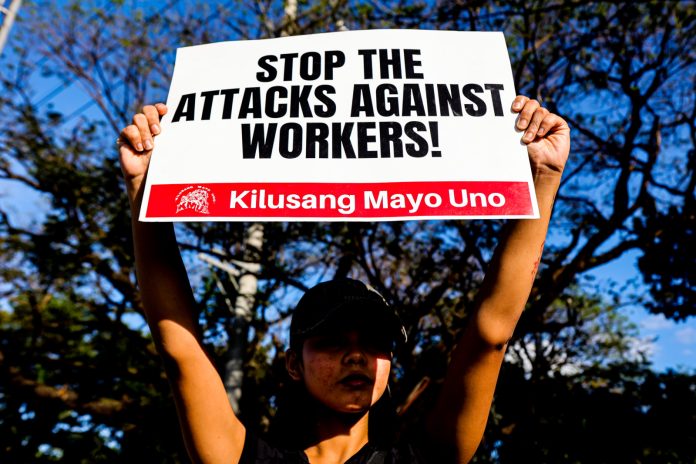
An ecumenical labor group has warned that President Ferdinand Marcos Jr.’s new executive order could undermine workers’ right to organize.
The Ecumenical Institute for Labor Education and Research (EILER) said Executive Order No. 97, signed recently, was introduced as the government’s response to workers’ recommendations during the International Labour Organization (ILO) High-Level Tripartite Mission last year.
The recommendations called for the protection of workers’ rights, stronger collective bargaining, living wages, and the right to strike.
While acknowledging the recognition of unionization as a fundamental right, EILER cautioned against a “deeply dangerous provision” that allows security forces to interfere in labor activity.
“We laud the hard work of the trade union centers and labor rights defenders that led to the explicit recognition that unionization must be protected as a fundamental labor right,” said Renan Ortiz, Chairperson of EILER.
Ortiz warned that vigilance is still necessary, pointing to the section that states: “the PNP, in coordination with DOLE, may request the assistance of the AFP to help restore and protect public order and security.”
He said this provision “widens the Assumption of Jurisdiction, a mechanism of the state long criticized by labor rights defenders for violently dispersing workers’ strikes in the name of ‘national interest.’”
The EO mandates a “whole-of-nation approach” involving several government agencies and security forces—including the Armed Forces of the Philippines, Philippine National Police, National Security Council, and the government’s anti-communist task force NTF-ELCAC—to implement the Omnibus Guidelines on the Exercise of Freedom of Association and Civil Liberties.
EILER stressed that these provisions run contrary to the Philippines’ obligations under ILO Conventions 87 and 98, which safeguard workers’ rights to organize.
“These deeply dangerous provisions heighten the risks of violence, intimidation, or even extrajudicial attacks against workers,” Ortiz said.
The group pointed to data from the Philippine Statistics Authority (PSA) showing a decline in unionization in recent years. Union density fell from 7 percent in 2018 to 6 percent in 2020, and only rose slightly to 6.5 percent by August 2022—figures that EILER said reflect systemic barriers and persistent attacks on unionists.
“Informal workers and public sector employees must also be able to exercise their right to form organizations, bargain collectively to employers’ associations or to local governments and agencies concerned, and demand transformative social protection, likewise, free from any retribution, harassment or intimidation,” Ortiz explained.
EILER also highlighted that since the Workers’ Report was submitted to the ILO in 2023, many cases of harassment and intimidation remain unresolved, with at least 105 cases of extrajudicial killings of trade unionists and workers recorded.
“We sincerely hope that pro-worker solons in Congress immediately propose and pass an Act that genuinely protects all rights of workers and penalizes interference of employers and public authorities in workers activities,” Ortiz said.
He stressed that monitoring workers’ rights should be entrusted to worker-led groups and civil society organizations, which he said are more credible than state security forces in ensuring transparency and enforcement.
According to him, guaranteeing freedom of association also requires ending the culture of impunity and reversing the shrinking civic space.