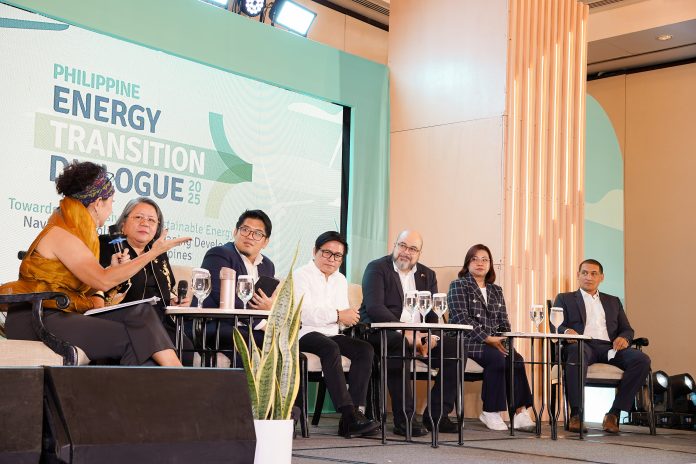
Policymakers, energy officials, and civil society groups pledged to speed up the Philippines’ transition to renewable energy during the Philippine Energy Transition Dialogue 2025 in September.
Department of Energy Secretary Sharon Garin, speaking on behalf of President Ferdinand Marcos Jr., underscored the administration’s push for solar, wind, and hydropower.
“By shifting to renewable energy (RE) sources such as solar, wind, and hydropower, we can aim for a more stable and affordable power supply, and a more sustainable future for all Filipinos,” she said.
Garin added that the government is “acting swiftly to meet the targets and transition to a greener future.”
The dialogue, organized by Clean, Affordable, and Secure Energy for Southeast Asia (CASE), brought together government officials, industry leaders, and local executives.
Participants signed a declaration envisioning an energy system that is “flexible, decentralized, and renewable-powered.”
It imagined modern transport systems cutting oil dependence, energy-efficient industries staying competitive, and solar-powered irrigation, hospitals, and schools serving communities while lowering costs.
DOE Undersecretary Rowena Cristina Guevara said the Philippines must accelerate the use of indigenous and renewable resources.
She emphasized that a resilient and reliable energy system is “essential to… a firmly rooted, affordable, and secure life for Filipinos.”
Angelo Kairos dela Cruz, executive director of the Institute for Climate and Sustainable Cities (ICSC), said renewables could save lives, reduce air pollution, and create nearly a million green jobs.
“It will lessen the stress on the much already stressed health services in the country,” he said, stressing the potential of RE to reach underserved areas.
Local leaders shared how solar power changed communities. Paranas Vice Mayor Eunice Babalcon said projects improved local services, from classrooms and health centers to markets and evacuation sites.
“A successful solar project changes more than the electricity bill,” she said.
The dialogue also presented CASE’s Long-Term Energy Scenarios, outlining possible pathways for the Philippines.
A “clean energy scenario” projects 57 percent of the power mix from renewables by 2040, while an “ambitious scenario” envisions 70 percent energy self-sufficiency by 2050.
Dela Cruz said progress depends on collaboration across sectors, from private investors to local governments.
“We need local executives becoming RE champions, we need kids — our kids — at the heart of what we do. We need everyone to make this work,” he said.