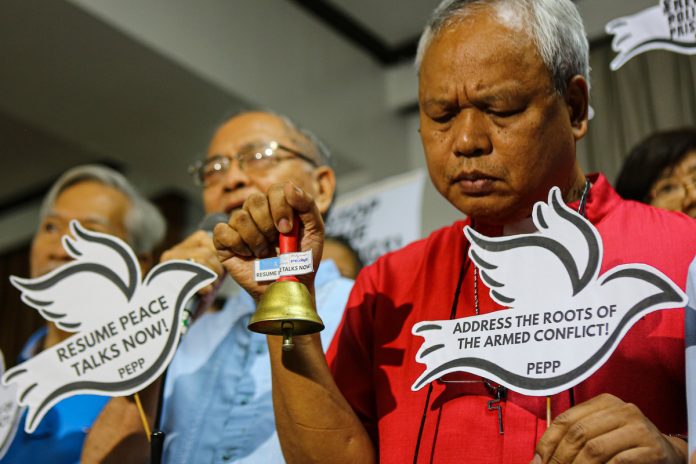
Church leaders and peace advocates marked the 33rd anniversary of the Hague Joint Declaration on Monday by urging the Philippine government and the National Democratic Front of the Philippines (NDFP) to resume peace negotiations.
The Philippine Ecumenical Peace Platform (PEPP) said it stands with “other churches, faith-based groups, and civil society organizations” in commemorating the 1992 accord, which laid out the framework for formal peace talks.
The declaration set four agenda items: respect for human rights and international humanitarian law, socio-economic reforms, political and constitutional reforms, and the end of hostilities.
“For more than five decades, armed conflict—rooted in poverty, joblessness, landlessness, environmental degradation, human rights violations, and systemic corruption—has caused untold suffering, and for PEPP, the GRP-NDFP peace negotiations is a viable and less costly path to resolve it,” the group said.
The ecumenical coalition urged the public to mark Peace Month with a “Day of Prayer for Just Peace” at any time in September.
The group appealed to the government “to prioritize resolving the root causes of the conflict and finally engage in formal talks,” adding, “We urge the NDFP to show readiness for meaningful dialogue, guided by sincerity and openness to the people’s welfare.”
PEPP pressed both sides to uphold past agreements that can pave the way for renewed dialogue. It described the Joint Agreement on Security and Immunity Guarantees (JASIG) and the Comprehensive Agreement on Respect for Human Rights and International Humanitarian Law (CARHRIHL) as “vital in preparing a space for dialogue that is inclusive, reconciliatory, and collaborative.”
Pilgrims for Peace, another ecumenical network, voiced concern that nearly two years have passed since the November 28, 2023, Oslo Joint Statement, when the parties pledged to move toward formal negotiations.
“There are indeed obstacles to resuming the talks, and these must be overcome,” it said, pointing to “widespread violations of human rights and international humanitarian law and the ‘weaponization of the law’ under terrorism legislation.”
The group added that the government’s “whole-of-nation approach” has undermined peacebuilding. It said the strategy has “led to deplorable red-tagging, terrorist-labeling, and criminalization of dissent with military operations that blur the lines between civilian governance and military objectives.”
Pilgrims for Peace said the Hague Joint Declaration remains “a worthy framework for addressing the root causes of the armed conflict,” noting that it paved the way for CARHRIHL, JASIG, and the near-finalization of the Comprehensive Agreement on Socio-Economic Reforms (CASER).
“Pilgrims for Peace keeps hope that together we can traverse the road to a just and lasting peace for the Filipino people,” the group added.