
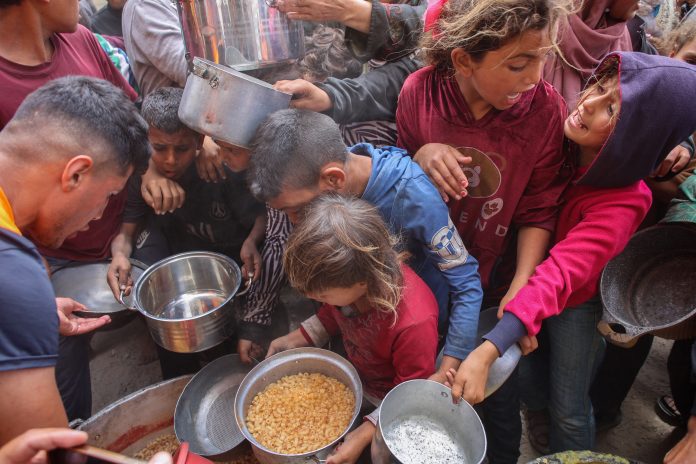
The United Nations has warned that acute malnutrition among children in Gaza has reached unprecedented levels as hunger deepens across the enclave.
In a report on Thursday, the UN Office for the Coordination of Humanitarian Affairs (OCHA) said that in July alone, nearly 12,000 children under five were identified as acutely malnourished out of 136,000 screened by aid providers.
Of these, more than 2,500 were suffering from severe acute malnutrition, the most life-threatening form, while 40 had to be hospitalized in stabilization centers.
OCHA noted that the proportion of children with severe acute malnutrition is rising — 18 per cent of all acutely malnourished children in June and July, compared with 12 per cent between March and May.
Humanitarian access restrictions are compounding the crisis, OCHA lamented. Last month, aid providers were only able to reach 8,700 of the 290,000 children under five who require feeding and nutrition supplements due to the severe shortage of lipid-based nutrient supplements entering Gaza.
The UN agency said the development “marks a dramatic collapse in the malnutrition prevention programme,” pointing out that between April and June, an average of 76,000 children — or a quarter of those in need — were reached each month.
Distribution of other key nutrition supplies has also dropped sharply, affecting children, pregnant women, and breastfeeding mothers.
Shelter crisis deepens
No shelter materials have entered Gaza since 2 March, OCHA reported. More than one million shelter items, and 2.3 million items such as tents, tarps, and sealing-off materials, are stuck in Jordan and Egypt awaiting Israeli approval for entry.
The agency said the shelter crisis is worsening, with most families living in overcrowded and unsafe conditions, and some without any shelter at all. Assessments in July across 44 displacement sites found that 43 had families without shelter.
Bombardment and displacement continue
OCHA said ongoing bombardment, displacement orders, and insecurity continue to drive families from their homes and disrupt humanitarian operations.
It noted that “realities on the ground remain largely the same” since Israel announced a “tactical pause” in military operations to allow safe passage of aid. Supplies that have entered remain “insufficient given the immense needs,” and UN convoys still face significant delivery challenges.
While fewer humanitarian missions are being denied outright, approved operations can still take hours — some more than 18 — to complete.
On Wednesday, five out of 11 missions requiring coordination with Israeli authorities were facilitated, including food collection from the Kerem Shalom and Zikim crossings. Four other missions were impeded but later completed, including the transfer of fuel to northern Gaza.
Medical evacuations and urgent needs
One mission saw the evacuation of 15 children to Jordan for medical care, accompanied by 42 relatives, with support from the World Health Organization. However, OCHA said more than 14,800 patients in Gaza still urgently need specialized medical treatment.
The agency also reported that several trucks carrying food items have entered the Strip in recent days.
Humanitarians reiterated the urgent need for “unimpeded and predictable humanitarian access into and within Gaza,” warning that “without it, time and resources are wasted, lives are lost, and the response cannot match the scale of the needs.”