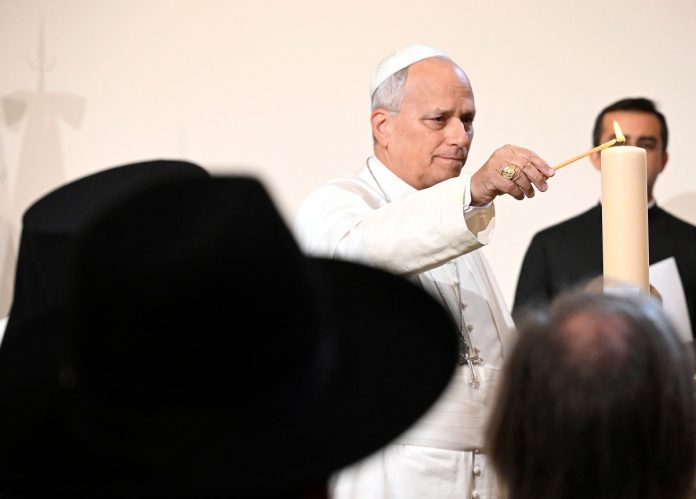
Pope Leo XIV underscored the importance of upholding human dignity during his address to social movements and the world of work at the Catholic University of Buenos Aires in Argentina on Monday.
In his remarks, the Holy Father reflected on the principles of the Church’s Social Doctrine, emphasizing that the “first and most fundamental” of these is “the dignity of the human person.”
The Pope highlighted the importance of promoting the common good, insisting that it “requires us to overcome sterile individualism and corporatist utilitarianism.”
The Holy Father also reflected on the principle of the universal destination of goods.
Businesses must not lose sight of human dignity
“Although the Church recognizes and defends the right to private property, this right is always subject to a social mortgage: the earth and its fruits have been given by God for the sustenance of all humanity,” Pope Leo explained.
He also discussed the principle of solidarity, which makes solidarity “a force capable of building a social structure that can redefine market needs and labor relations according to criteria of justice and the logic of reciprocity.”
The Holy Father highlighted the principle of the social function of property and capital.
“When economic profit is established as the sole criterion of success, a business becomes dehumanized and turns into a structure of sin that generates exclusion,” he said.
Pope Leo pointed to the life of Venerable Enrique Shaw, a Catholic entrepreneur who underwent a conversion after discovering the beauty of the Gospel as expressed in the Church’s Social Doctrine.
“The future Blessed, with his Christian understanding of the human person, ‘understood that industry was not just a productive mechanism or a means of accumulating capital, but a true community of people called to grow together’,” he said.
Technology must be subject to ethics
The Pope called for building a united Argentina, grounded in an authentic “social friendship” that overcomes dialectical polarization and shapes an architecture of peace founded on justice and dialogue.
He emphasized that “the challenges posed by artificial intelligence and unregulated automation can put countless jobs at risk and become a real threat to proper integral human development.”
He stressed that “technology must always be subject to ethics,” adding that an algorithm cannot replace human discernment or the intrinsic value of a worker’s physical presence and effort.
The Holy Father also reminded those present that God calls each person to be attentive to the needs of others, serving them through their work.
He invited everyone not to “shy away from our daily encounter with Christ in the tasks of each day, however banal and insignificant they may seem to us.”
“No work is trivial in the eyes of God: the greatness of a task lies not in what is done, but in the love invested in every gesture, every word and every thought.”
God at the forefront of our actions, and the human person at the center of our choices
Pope Leo said that, in a world undergoing profound change, he wished to leave those present with the principles that gave rise to the Church’s Social Doctrine as a task to be undertaken.
Accordingly, he urged them to “defend the dignity of the human person, promote the common good, recognize the universal destination of goods, practice effective solidarity and responsible subsidiarity, so that together we may build the civilization of love.”
“Let us work perseveringly, placing God at the forefront of our actions and the human person at the center of our choices,” he said.
“Only in this way,” he continued, “can we be sure that we are following on earth the path that God has prepared for us in heaven. Indeed, only in this way can our work bear fruit, fruit that will last.”
This article was originally published on Vatican News. All copyrights reserved to the Dicastery for Communication – Vatican News. Unauthorized republication by third parties is not permitted.