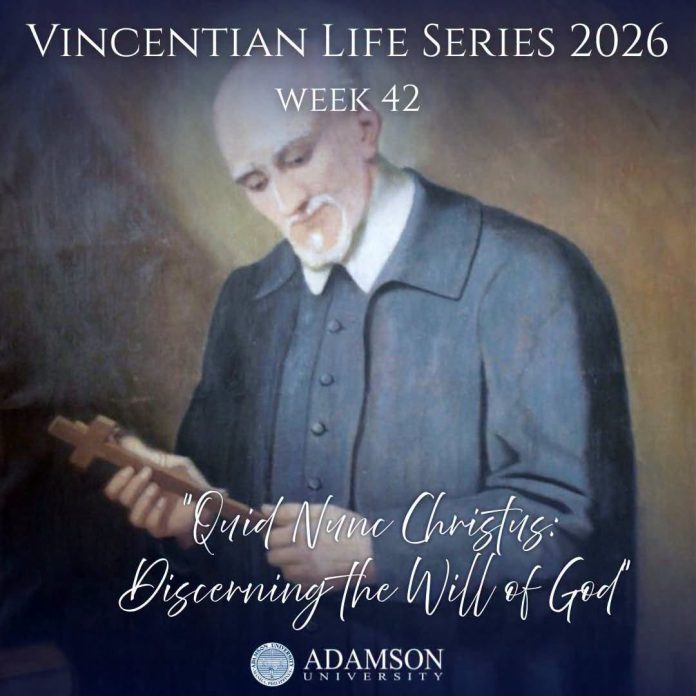
“Quid nunc Christus?” is a Latin phrase often used by St. Vincent de Paul which literally means, “What now, Christ?”
What would Christ do now if he were in my situation? This is the main question when we want to discern God’s will for us: What does God want of me now?
When we speak of discernment today, spiritual writers make a direct reference to St. Ignatius of Loyola, whose special charism in the Church was to synthesize and put into writing the basic principles of discernment practiced by Christians throughout the history of spirituality.
Hardly do we refer to St. Vincent, whose gift to the Christian community is the “mysticism of action” rather than that of contemplation or spiritual direction. However, mysticism of action is mysticism just the same.
And any mysticism involves discernment of the movements of the Spirit, in the case of St. Vincent, within the complex situation of the world of action.
In this context, Vincent must have said something on the “how” of discerning the will of God in our lives. He must have taught his followers this art, which must guide their apostolic ministry and life of prayer. In the story of Abelly, “conformity to the will of God” is one of the greatest virtues of St. Vincent de Paul.
During the last years of Vincent’s life, he endeavored to explain to the missionaries, article by article, the Common Rules of the Congregation of the Mission. Two conferences are crucial to our present topic: (1) “On the Conformity to the Will of God.” This was given by St. Vincent on March 7, 1659, while commenting on the CM Common Rules, Chapter II, Article 3; (2) “On True Lights and Illusions.” This conference was delivered by St. Vincent on October 17, 1659, while explaining the CM Common Rules, Chapter II, Article 16.2.
MOMENTS OF DISCERNMENT
There is a long quotation from the CM Common Rules that directly refers to the discernment process. In the many writings of St. Vincent, this is the part that directly attempts to answer the question: When, where and how is the will of God made known?
We will try to dissect it one by one for our own guidance in spiritual life. St. Vincent writes:
“A sure way for a Christian to grow rapidly in holiness is a conscientious effort to carry out God’s will in all circumstances and at all times. Each one of us, then, should try to integrate into his life, as far as possible, these four principles:
“First, we should conscientiously carry out what is ordered and avoid what is forbidden, when these orders or prohibitions come from God, from the Church, from our superiors or from the Rules or Constitutions of our Congregation;
“Second, when there is choice open to us in matters neither ordered nor forbidden, we should choose the less palatable rather than the more pleasing. This does not apply, of course, if the more pleasing things, being in some sense necessary, have to be chosen. Still, though, in such cases our motivation ought not to be that we like them, but simply that they are more pleasing to God. Finally, if when faced with a choice between things neither ordered nor forbidden there is no real element of personal preference between the options available, then any one of them may be chosen at random as coming from God’s providence;
“Third, when something unexpected happens to us in body or mind, good or bad, we are to accept it without fuss as from God’s loving hand. Our motive for putting the above three principles into practice is that they are God’s will. It is in this way that we can imitate Christ, the Lord. Christ always lived by these principles, and for that very motive. He tells us this himself: I always do what pleases the Father.” (CM Common Rules, II, 3).
St. Vincent later explained this Rule to the Vincentian confreres in two conferences: first, on March 7, 1659 (“On the Conformity to the Will of God”); and on October 17, 1659 (“On True Lights and Illusions”).
If we analyze more deeply the conferences quoted above, there are five instances where the Lord makes his will manifest. If the attitude of any Vincentian is to conform himself to the will of God, these five rules may guide him or her to look at those “moments” where God may be speaking: (1) on what is commanded and forbidden; (2) on indifferent acts; (3) on unexpected things and events. But in subsequent explanations, St. Vincent talks about two more instances where the will of God shows itself: (4) in moments of inspiration; (5) in what is reasonable.
In this article, let me elaborate only on the first: “on what is commanded and forbidden.” The rest of the moments will be reflected on in the next articles.
THE WILL OF GOD IN THE AUTHORITIES
“What is commanded and forbidden” refers to the role of authorities in the determination of God’s will in our lives.
St. Vincent lived in a time when people believed that “the voice of the superior is the voice of God.” The superior, they say, is given a special grace — called the “grace of office” — to be able to lead and discern God’s voice for his community. Beyond one’s natural talents or personal charism, this distinct spiritual strength and capacity is given by God and linked to one’s office in order to bear the responsibilities of leading God’s people.
Thus, in consonance with the theology of his times, on the things commanded and forbidden by God, moral law and authorities of the Church, Vincent calls us to obey. Obedience occupies a prominent place in any discussion of discernment.
Even during these times when we emphasize personal responsibility and autonomy, authentic discernment is still recognized in our docility to authority. This could mean a lot of things.
First, this rule only emphasizes the fact that all alternative choices for discernment should be “morally good acts” because they are willed and commanded by God and the moral law. Any act forbidden by moral law is automatically out of the question. In such cases, there is no need for discernment. I could not discern, for example, whether to cheat or not to cheat during the elections, or whether to support extrajudicial killings or not. Options for discernment should be morally good options.
We acknowledge, however, that some moral options are hard to discern. There are moral choices that give us no black-and-white answers due to the complexity of the situation. These are “gray areas” where the Church and the moral law leave us to look deeper into.
One concrete and contemporary example is the Church’s involvement in politics. How far can we go? As a priest, for example, where is the limit of my involvement? It may be true that clerics — as canon law suggests — are prohibited from entering partisan politics. But there could be circumstances when they are also permitted. Which circumstances? These are “gray” areas where even experts disagree.
Here, personal discernment in the context of prayer and direction is much more necessary. Mere obedience to the letter of the law does not suffice. The bottom line, therefore, is not obedience to the law alone, but obedience to the will of God expressed even beyond the confines of the law.
What St. Vincent is trying to say in this rule, however, is this: any alternative for discernment should be an act in consonance with the natural moral law and Christian morality. It should be a “good” act or at least morally “indifferent” (in the Scholastic category of actions). Any option outside it is an invalid matter for discernment.
Second, St. Vincent mentions the authority of our Rules and Constitutions, our ecclesiastical and spiritual superiors, and state authorities (king, judges, governors, officers and judges). It is the will of God, says St. Vincent, that we obey them.
In our times, we hear less of authority directing every move of each person. Much emphasis is placed on personal decision and autonomy. It seems easy to live a Christian life where everything is prescribed for you. But this is no longer the time for “blind obedience.” There is little talk of “black-and-white” lines of action binding on all.
Church law before had complete prescriptions on how many grams of bread to eat or when to eat them so as not to violate the commandment on fasting. We are told how long one should talk to a man or woman without succumbing to the danger of unchastity. These sound funny today. Our Constitutions, for example, give us principles for action and leave us to figure out for ourselves what to do in our particular situations.
Compared with the times of St. Vincent, there is less opportunity to shun responsibility and hide behind the blanket of the superior’s authority. Any real Christian today, lay and religious, should be capable of mature decisions. This makes the art of discernment more relevant and necessary.
If obedience to authorities is important today, it first means to listen — for us to listen to the superiors and for the superiors to listen to us. Listening is not binding on the subjects alone but on all. Obedience comes from two Latin words, “ob” + “audire” (to hear thoroughly). Obedience means listening thoroughly to the word of God expressed in our lives.
In concrete terms, obedience means concrete ways of being and acting: openness to others’ experiences, open and responsible dialogue, attending meetings and consultations, respectful and critical collaboration, consensus building, working toward unity of mind and action, respect for superiors who are given responsibility for the care of the community, and respect for all members regardless of their roles and functions.
All these attitudes are part of communal discernment in the search for the will of God. We are then back to the first question St. Vincent posed to himself: “Quid nunc Christus?”
Father Daniel Franklin Pilario, C.M., is the President of Adamson University in Manila. He is a theologian, professor, and pastor of an urban poor community on the outskirts of the Philippine capital. He is also the Vincentian Chair for Social Justice at St. John’s University in New York.