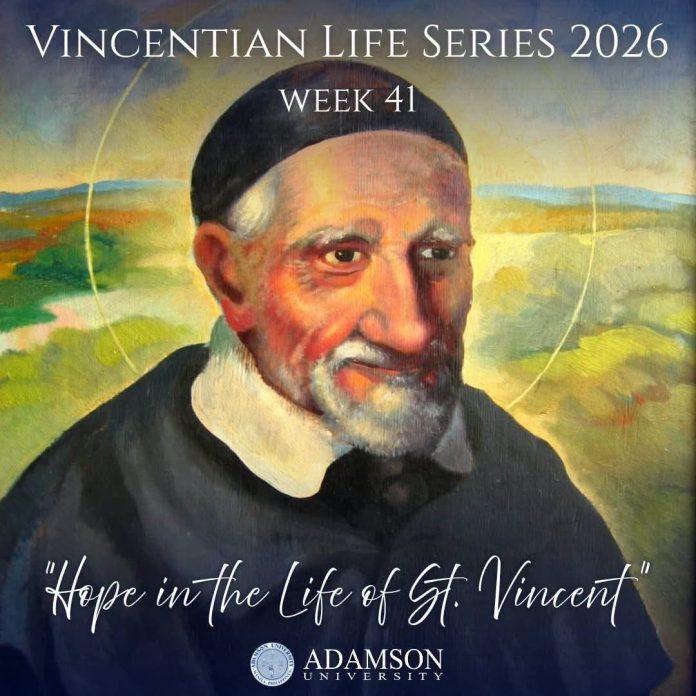
The virtue of hope has recently occupied the Church’s theological landscape. The Jubilee Year 2025 has as its theme “Pilgrims of Hope.”
Pope Francis published a collection of his talks, Hope Is a Light in the Night (2025). He wrote in the introduction:
“I said that hoping is a gift from God and a task for Christians. And to live hope requires a ‘mysticism with open eyes’, as the great theologian Johann-Baptist Metz called it: knowing how to discern, everywhere, evidence of hope, the breaking through of the possible into the impossible, of grace where it would seem that sin has eroded all trust.”
Pope Leo XIV tells us: “To hope is not to know. We do not already have the answers to all the questions. But we have Jesus. We follow Jesus. And so we hope for what we do not yet see.”
Hope is also central to the life of St. Vincent de Paul.
This is seen in his conferences and everyday reactions to the events surrounding his life and his followers. Following Louise Abelly, his first biographer, I would like to mention some concrete events in St. Vincent’s life and his reactions to them, which showed his hope, trust and full confidence in God.
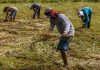
In order to feed the thousands of poor people under his care, his community relied on the produce of the farms they cultivated. One year, there was a really bad harvest.
“You have lacked nothing up to now, so why do you fear? Does he not take care of the sparrows, who neither sow nor reap? How much greater will his goodness be toward his servants.
“Let us leave that to our Lord for it is his work. It pleased him to begin it, so we must be sure that he will bring it to fruition in the way he deems it best.”
He was once informed by the treasurer of the Mother House that there was almost nothing left in the house budget. He responded:
“What good news! Praise the Lord. Fine, now we will see if we have confidence in God… When we have spent all we have for our Lord and nothing remains, then we will leave the key under the door and go.”
He was once advised that they needed to curtail his charitable activities and expenses in the apostolate because of diminishing supplies. He said:
“The treasures of God’s Providence are inexhaustible, and our distrust of God does not give him honor.”
The next sentence rings true for all of us: “If our Congregation of the Mission is destroyed, it will not be by poverty but by wealth.”
There was a member of the Parlement who saw the many people in the dining room beyond the actual number who lived there. He wondered how they were all fed. St. Vincent told him:
“The treasury of God’s Providence is large. We must put our cares and concerns into his hands, for he will never fail to provide our food, as he promised.”
Yet St. Vincent’s hope was also realistic. While he trusted God for their needs, he also recognized the need to take care of their finances. This balanced reflection on the Scriptures is found in St. Vincent. While the Lord takes care of the sparrows and Jesus sent his disciples without money, St. Vincent also said that the Lord realized he needed provisions for his group and the poor.
“We are obliged to own some things to take care of the needs of all,” St. Vincent said. “There was a time when the Son of God sent his disciples out without money or provisions. But he later found it helpful to have something to maintain his group and to help the poor. The apostles continued this practice, and St. Paul tells us how he worked to gather money that could then be distributed to other Christians.”
But while others are frantic about taking care of their own futures, calculating all possible risks and preventing them from happening, St. Vincent trusted in God’s Providence. For him, this was all that mattered. He lived in complete peace of mind, for the outcome was in God’s hands.
“A true missionary ought never to be concerned about material things,” he said. “He should cast all his cares upon the Providence of the Lord, being entirely convinced that if he is moved by charity and is steadfast in his confidence he will always be under the protection of God.”
In another instance, he said: “Put out of your mind all that can cause you pain, for God will take care of you… Please trust him and you shall see the fulfillment of all your heart desires.”
Beyond our apostolates, hope also needs to rule our personal lives. His advice to his missionaries who were beset by depression and self-doubt was: “We have the seed of the all-powerful God within us. This should be the source of our hope, encouraging us to place all our confidence in him, despite our poverty.”
Our fidelity to the ministry to the poor should give us hope.
One day in 1646, a Daughter of Charity was serving the poor in the district of Faubourg Saint-Germain. She was climbing the stairs of a relatively new house with a big pot of soup to serve the poor there. When the building started to collapse, she found a safe corner while the whole house was falling down, killing 40 people staying there. When the dust cleared, the Sister was left standing there, still holding on to her pot of soup. People came to rescue her. She still did not let go of her pot of soup. Instead, she continued to serve the victims.
St. Vincent frequently mentioned this incident to demonstrate hope in the servant of the poor.
“Still clutching the heavy pot in her hand,” St. Vincent narrated, “she found a corner of a room which did not fall, though all the rest tumbled around her, beams and heavy stones, desks, tables and other furnitures, but she remained unharmed.”
“My daughters,” he continued, “what reasons we have for confidence in God. We have read about a man walking in the open fields who was killed by a turtle dropped on his head by an eagle. And we saw today how a Daughter of Charity walked out of the ruins of a house, safe and sound. What do you make of this? Is this not a sign of God’s affection for you as the pupil of his eye? O my daughters, if if you have this confidence in your hearts, God will preserve you no matter where you shall be.”
“God will see to your safety because you serve the poor,” St. Vincent tells us.
Father Daniel Franklin Pilario, C.M., is the President of Adamson University in Manila. He is a theologian, professor, and pastor of an urban poor community on the outskirts of the Philippine capital. He is also the Vincentian Chair for Social Justice at St. John’s University in New York.