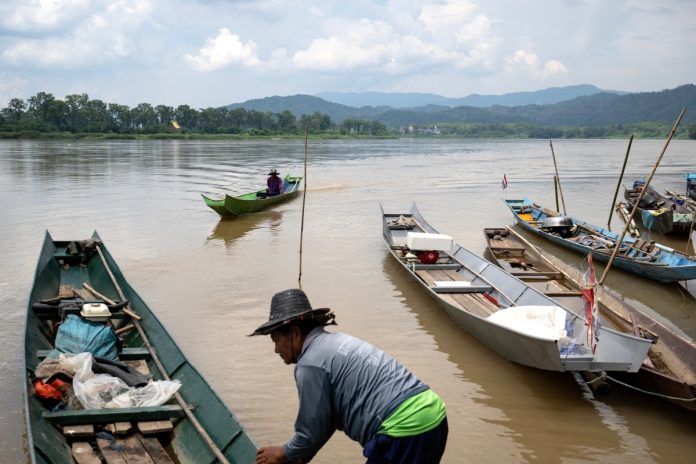
A Filipino bishop urged the Catholic Church in Asia to put Indigenous communities, small-scale fishers, farmers, displaced people and future generations at the center of its response to the climate, biodiversity and energy crises affecting the Mekong region.
Bishop Gerry Alminaza of San Carlos, president of Caritas Philippines, made the call Oct. 7 during the opening Mass of “Let Noah’s Ark into the Mekong Delta: An Initial Convening of the Catholic Church on Mekong,” a two-day gathering at the Camillian Pastoral Care Center in Bangkok.
The meeting was organized by the Federation of Asian Bishops’ Conferences in partnership with Caritas Asia and the Center for Energy, Ecology and Development.
“The climate crisis, the loss of biodiversity and the choices we make about energy are not three separate subjects,” Alminaza said.
He said the three concerns converge in their effects on food, livelihoods, health, homes and the future of communities.
“As we speak about these three pillars—climate, biodiversity and energy—let us remember that behind every theme are people and places we are called to love,” he said.
The prelate asked participants to imagine three empty chairs in the chapel as they considered the Church’s response to the challenges facing the Mekong.
The first represented those most affected — Indigenous communities, small-scale fishers and farmers, poor families and people forced from their homes.
“They may not all be physically present in this room. Will we make space for their experience and their voice?” he asked.
The second represented children and young people who will inherit “the Mekong and our common home.”
“What decisions would we make if they were sitting beside us, listening?” Alminaza said.
The third represented “the fish, forests, wetlands and the river itself.”
“They cannot speak in our meeting, but their lives are woven into ours. Who will remember them as we discern?” he said.
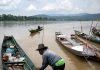
Alminaza said the Mekong’s movement across national borders shows how communities remain connected through shared waters.
“The life of one community is bound to the life of others,” he said. “Water can mark a boundary on a map—and still connect all who depend on it.”
He also drew from the seasonal reversal of the Tonle Sap River, where water flows into the lake during the rainy season before reversing in the dry season, to describe the kind of listening he said the Church must practice.
“Sometimes we must allow ourselves to be changed by what we hear. Sometimes the way forward begins by turning back toward those whose voices we have not heard,” Alminaza said.
He said a listening Church can receive people’s experiences, hold them with care and return them as “solidarity, courage and service.”
Using the gathering’s image of Noah’s Ark, Alminaza warned against approaching the Mekong and its communities as an outsider claiming to have all the answers.
“To let Noah’s Ark enter the Mekong Delta is to let the Church enter these waters—not as a vessel escaping from the world, and not as an outsider arriving with all the answers,” he said.
He described the Ark as “an image of protection, solidarity and covenant with creation” that must be built among rivers, wetlands and communities whose lives are bound to them.
Alminaza said the gathering was not expected to solve every problem confronting the Mekong but to begin a process of listening, learning and discernment.
“We come to ask: What is happening? Who is most affected? And what can the Church meaningfully contribute — together?” he said.
He described that approach as part of becoming a synodal Church that “walks together, listens together and discerns together.”
Alminaza closed by calling on participants to become “bridge-builders across borders and differences” and to carry “hope, protection and care into the Mekong Delta.”