Cardinal Charles Bo urged Myanmar to reject the pursuit of military victory and turn instead to dialogue and negotiation, saying the country’s priority should be protecting lives and building peace.
Reflecting on Pope Leo XIV’s appeals for peace, Bo said the pontiff’s rejection of military solutions carried particular urgency for Myanmar after years of conflict and displacement.
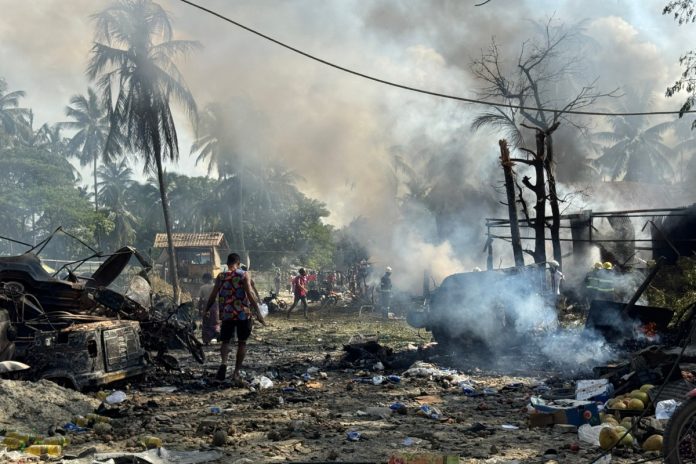
“These words are especially relevant to us in Myanmar. For many years, our people have suffered from conflict, violence, displacement, poverty, and immense human suffering,” Bo said.
He said the central question should not be which side prevails.
“In such a situation, we must ask not, ‘Who will win?’ but rather, ‘How can we save human lives? How can we build peace?’” he said.
Bo said Pope Leo had emphasized human dignity, dialogue, diplomacy, and peace while expressing concern over military spending and nuclear weapons.
“The Holy Father is reminding us that peace cannot be built by accumulating more weapons. The use of force, threats, and imposing our will upon others cannot truly resolve problems,” Bo said.
The prelate said war might temporarily halt violence but could not produce lasting peace, which he said must be built through dialogue, justice and respect for human dignity.
He recalled Pope Leo’s January 2026 address to the diplomatic corps, when the pontiff appealed for a path toward peace in response to Myanmar’s humanitarian and security crisis, inclusive dialogue and humanitarian assistance to reach those in need fairly and in a timely manner.
“I see the Holy Father’s voice as a voice of hope for the people of Myanmar,” Bo said.
The cardinal said the Church’s responsibility was not to seek political power but to protect life, defend human dignity and promote reconciliation.
“The responsibility of the Church is not to choose sides in order to seize political power. Our responsibility is to protect human life, defend human dignity, speak the truth, and build bridges of reconciliation and peace among people,” he said.
Bo said the Church must continue urging leaders of countries affected by conflict to meet, negotiate, and seek alternatives to war.
“Therefore, the Church has an important responsibility: to continue inviting the leaders of countries affected by conflict—including Russia and Ukraine—to come together, to sit at the same table, to speak with one another, to engage in dialogue and negotiation, and to seek solutions through means other than war,” he said.
He acknowledged that appeals for peace could appear to have little immediate effect but said the Church should continue speaking.
“As the Holy Father has said, sometimes our voice for peace may appear to have little effect. But the Church will not remain silent. We must continue to speak. We must continue to invite. We must continue to pray. And we must continue to encourage dialogue and negotiation,” Bo said.
Bo also said young people needed education, health care, employment, hope and a peaceful future rather than war and weapons.
“For young people especially, war and weapons cannot be their future. What they need are education, healthcare, employment, hope, and a peaceful future,” he said.
Bo said Pope Leo’s call to redirect resources being spent on weapons toward health care and education was “a very important reminder.”
He also rejected the idea that peace, dialogue, and reconciliation were signs of weakness.
“For this reason, I believe that we should listen carefully to the voice of Pope Leo XIV. Peace is not weakness. Dialogue is not surrender. Forgiveness and reconciliation are not the path of the weak; rather, they are the courageous path capable of saving the future of humanity,” Bo said.