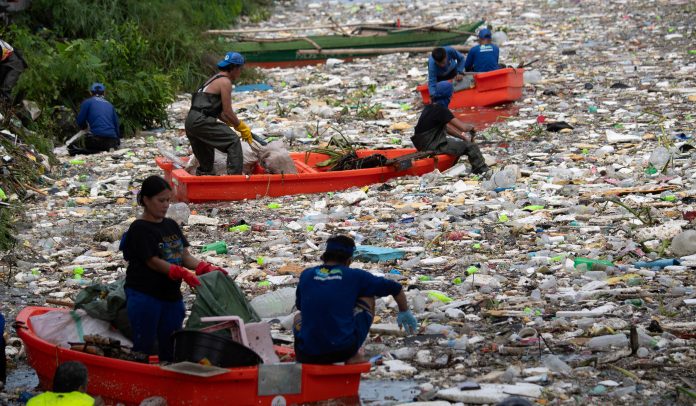
Greenpeace Philippines urged the government Aug. 13 to ban problematic single-use plastics and reject waste-to-energy incineration after a “sea of garbage” appeared along Manila Bay near Baclaran Church following days of monsoon rains.
Images of the waste went viral after several days of rains inundated parts of Metro Manila and nearby provinces.
Greenpeace Philippines campaigner Patrice Valero said the recurring buildup of garbage in waterways was a “predictable consequence of a throwaway economy,” arguing that cleanup operations alone could not address the country’s waste problem.
“While cleanups are necessary as an emergency response, they cannot be the government’s recurring strategy for this crisis,” Valero said.
“Dredging waterways and scooping trash out of the water will never fix a crisis fueled by corporations flooding our markets with unmanageable, single-use plastic products,” Valero added.
Greenpeace called on the government to immediately declare sachets and other problematic plastics as Non-Environmentally Acceptable Products under the Ecological Solid Waste Management Act, or Republic Act 9003.
Valero said the government must “tackle the crisis at its source” by placing sachets and other problematic plastics under the law’s Non-Environmentally Acceptable Products classification.
The group also called for affordable and accessible refill and reuse systems in public markets, sari-sari stores, supermarkets and government procurement.
Greenpeace opposed President Ferdinand Marcos Jr.’s push for waste-to-energy incinerators, which Valero described as a “dangerous, costly misstep.”
“WTE does nothing to stop plastic from choking our waterways; it simply burns waste after the damage is already done,” he said.
“Incineration releases carcinogenic dioxins, toxic ash, and greenhouse gases—all while creating an insatiable financial demand for the very disposable materials we need to eliminate,” he added.
Greenpeace also urged the government to strengthen the Extended Producer Responsibility Act by imposing mandatory plastic-reduction targets on corporations and ensuring that collection programs do not replace cuts in production.
“Corporate polluters must be held accountable,” Valero said, adding that collection schemes should not “substitute for actual production cuts.”
The group said local governments and communities should be supported through composting, fully functional materials recovery facilities, well-maintained trash traps, and fair wages and full protection for waste workers.
Valero said a flood-resilient Philippines would require the government to “turn off the plastic tap, hold producers accountable, and invest in real, community-centered solutions.”