
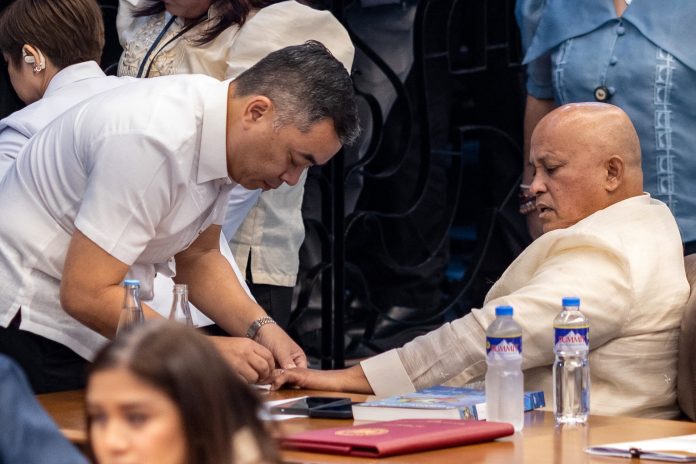
Sen. Ronald Dela Rosa sought refuge inside the Philippine Senate on Monday after the International Criminal Court (ICC) unsealed an arrest warrant accusing the former police chief of crimes against humanity linked to former President Rodrigo Duterte’s deadly anti-drug campaign.
The confrontation escalated as Senate leaders resisted attempts by government agents to arrest the sitting senator inside the chamber.
The Senate compound was placed on “lockdown,” with riot police and barbed wire deployed outside the building as members of the National Bureau of Investigation pursued Dela Rosa through Senate hallways.
Newly elected Senate President Alan Peter Cayetano, an ally of the Duterte family, said Dela Rosa was under Senate protection “in accordance with our rules and Philippine laws.”
“We will allow an arrest under the condition that it is a Philippine court,” Cayetano told reporters.
The ICC separately confirmed Monday that Pre-Trial Chamber I had unsealed an arrest warrant issued in secret on Nov. 6, 2025.
In a statement, the court said judges found “reasonable grounds to believe” that Dela Rosa was criminally responsible “as an indirect co-perpetrator” for the crime against humanity of murder.
The warrant alleges that “no less than 32 persons were killed” between July 2016 and April 2018 during Duterte’s anti-drug campaign.
According to the ICC, Dela Rosa was allegedly part of “a common plan” to kill people suspected of involvement in illegal drugs between Nov. 1, 2011, and March 16, 2019.
The court noted that Dela Rosa served as chief of the Philippine National Police from July 1, 2016, to April 19, 2018, during the height of the anti-drug operations.
Former senator Antonio Trillanes later faced reporters while holding a copy of the ICC warrant.
The unfolding confrontation came only hours after Dela Rosa appeared publicly to vote in the Senate leadership contest that installed Cayetano as Senate president, amid a separate political crisis involving the impeachment of Vice President Sara Duterte.
Under the Constitution, the Senate will convene as an impeachment court in any trial against the vice president. A conviction would remove Sara Duterte from office and permanently bar her from holding public office.
Cayetano denied any connection between the Senate leadership change and the House impeachment vote.
Dela Rosa later appealed for public support during a livestream hosted by fellow Duterte ally Sen. Robin Padilla, according to a report by Agence France-Presse.
“They want to fly me to The Hague, to be surrendered there. So please support me,” Dela Rosa said. “I became Philippine National Police chief to work, then this is what they will do to me?”
As debate intensified over whether authorities could arrest Dela Rosa inside the Senate premises, lawyer and former Far Eastern University law dean Melencio Sta. Maria Jr. said there is “no law expressly making the premises of the senate a safe haven for fugitives or those charged with the commission of a crime.”
“The Senate must NOT coddle and protect a fugitive. That is obstruction of justice,” Sta. Maria said in a public legal commentary posted on his social media account.
He also argued that Senate immunity from arrest does not apply in cases involving crimes punishable by more than six years imprisonment.
“According to Republic Act No. 9851, crime against humanity where death occurred is punishable by reclusion perpetua (40 years),” he said.
Sta. Maria further said Republic Act No. 9851 allows the Philippines to cooperate with international tribunals investigating crimes against humanity.
“Unless stopped by the Supreme Court, the enforcement of a valid arrest must proceed. No one is above the law,” he said.
In previously released court documents, ICC prosecutors identified Dela Rosa, Sen. Christopher Go, and six others as alleged “co-perpetrators” in the crimes against humanity case against Duterte.
“Duterte and his co-perpetrators shared a common plan or agreement to ‘neutralise’ alleged criminals in the Philippines,” prosecutors said, alleging that the campaign involved “violent crimes including murder.”
The ICC has charged former President Rodrigo Duterte with three counts of crimes against humanity tied to killings committed during the anti-drug campaign between 2013 and 2018.