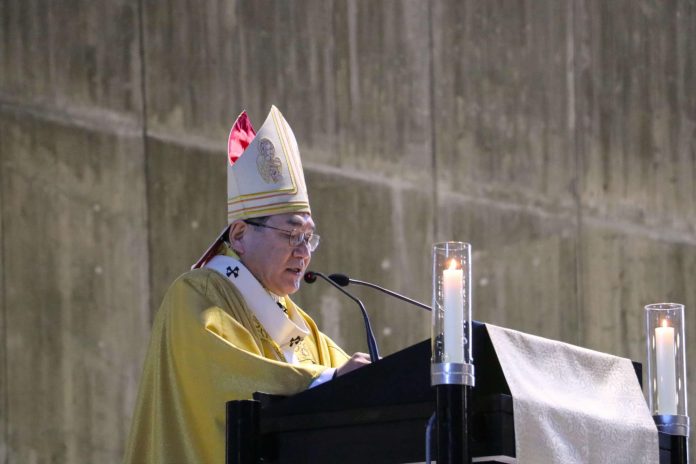
Cardinal Isao Kikuchi of Tokyo warned that rising global conflicts are fueling despair and fragmentation, urging the Church to reclaim its unity and moral voice for peace through synodal discernment.
In a reflection for the Third Sunday of Easter, Kikuchi said calls for peace from the Church continue to be dismissed as unrealistic, even as violence escalates.
“In recent weeks, in response to the situation in the Middle East, the Pope’s call for peace has been seen by the political world as a pipe dream that ignores reality,” he said, noting how opposing sides are increasingly portrayed in hardened conflict.
He stressed that the Church’s mission remains rooted in defending life and human dignity, insisting that “what we want to protect is life, a gift from God, and the dignity of human beings, created in God’s image.”
Kikuchi cautioned against the use of religion to legitimize violence, saying it “is not ethically appropriate; it only deepens the wounds of division and strife,” and added that “invoking faith to justify violence against life is not a testament to the faith of believers.”
Drawing on the Gospel account of the disciples on the road to Emmaus, the cardinal described a world gripped by fear and disillusionment.
Quoting the disciples’ words, “We had hoped that he would be the one to deliver Israel,” Kikuchi said they reflect communities “in the depths of despair,” where unity begins to break down.
“They represent the collapse of a community when the center that bound each individual together suddenly dies,” he said.
He underscored that the Church’s identity is not defined by physical gathering but by communion in the risen Christ, stressing that “the Church is not a community as a meeting place” but “a gathering of disciples united by the resurrected Jesus.”
At a time marked by confusion and anxiety, Kikuchi called for discernment grounded in reflection and faith. “When our hearts are tossed about by confusion, gripped by anxiety, and we lose hope, what we need is calm reflection,” he said, urging the faithful to reexamine Christ’s teachings and the meaning of present events.
“We must calmly re-examine these questions and seek a better path. This is precisely what the synodal church demands,” he added.
Kikuchi pointed to the Emmaus story as a model of synodality, where Christ walks with the disciples, listens, and leads them toward renewed understanding and unity. “This is truly a synodos-like progression,” he said.
He said such a journey remains essential for the Church today as it navigates global uncertainty, emphasizing that “we are God’s people, constantly moving forward, guided by the Holy Spirit.”
“We wish to remain a church community that continues its synodal journey with the resurrected Lord,” Kikuchi said.