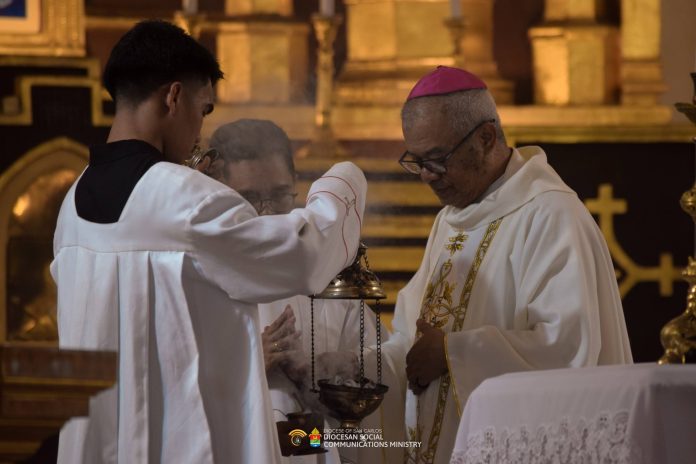
A leading Philippine Church official on Easter Sunday called for “resurrection justice,” urging structural reforms as global conflict and rising fuel costs deepen economic hardship for the poor.
In his April 5 message, Bishop Gerardo Alminaza of San Carlos, president of Caritas Philippines, pointed to a world shaped by war, inflation, and environmental decline.
The prelate warned that many communities continue to endure conditions closer to suffering than renewal. “We celebrate Easter in a world that still feels like Good Friday,” he said.
The message comes as tensions in the Middle East continue to push up global oil prices, with knock-on effects on fuel, food, and electricity costs in import-dependent countries like the Philippines.
“Families struggle with increasing costs of fuel, food, and electricity. Transport workers, farmers, and fisherfolk labor daily just to survive,” Alminaza said, describing the pressure on already vulnerable sectors.
He also warned that corruption and systemic injustice remain entrenched, calling them “tolerated evils” that continue to drain resources meant for the poor.
“Will we remain in the tomb of systemic injustice—or rise toward a new way of life?” he said.
While noting efforts to stabilize prices and secure energy supply, the bishop said these fall short of deeper change.
“But awareness is not yet transformation,” he said.
Drawing on the Resurrection, Alminaza said Easter demands more than remembrance, pressing for a shift in how societies are organized and governed.
“The Resurrection is not only a miracle to celebrate. It is a truth that must reshape how we live, govern, and care for one another,” he said.
He challenged systems that perpetuate inequality, echoing the Gospel question: “Why do you seek the living among the dead?”
“Why do we keep returning to systems that harm the poor? Why do we accept an economy where the vulnerable suffer the most?” he said.
Quoting Pope Francis’ apostolic exhortation, he stressed the need for collective action: “No one is saved alone.”
“We rise together—or we do not rise at all,” he said.
Alminaza called on the Church, government, businesses, and civil society to move beyond short-term responses, urging support for renewable energy, protection for workers affected by rising costs, and stronger accountability in governance.
“Easter calls us not only to rejoice—but to act,” he said.
He also urged communities to confront corruption and environmental destruction and to prioritize long-term solutions over temporary relief.
“Speak the truth—even when it is difficult,” he said.
Describing the Resurrection as both promise and mission, the bishop said the Easter message calls for building a more just and sustainable world.
“The empty tomb is not the end of the story. It is the beginning of the new world God is asking us to build,” he said.