Let me start with an experience from childhood in our little barangay in Oslob. In these rural places, people still celebrate fiestas, and everyone who comes is welcome — those we know and those we do not know. From the fiesta Mass, people simply go into houses and partake at the table.
My role in these fiestas was to stay outside the house and watch for guests who hesitated to come in. “Look for those who are ashamed to come in,” my father instructed me. “Since they do not know us,” he said, “some of them hide behind trees, hesitating to proceed. Call them. Invite them. Lead them to our table to eat. You should not eat until all of them have eaten. No one should go home without having eaten.”
I remember this experience on Holy Thursday because it led me to look more deeply into the meaning of the Eucharist in our everyday lives. There are those who are not included in our horizon of meaning. There are those on the margins. My father’s instruction taught me that the margins should be brought to the center, that everyone should have access to the table.
The Holy Thursday readings focus on the institution narratives of the Eucharist (“This is my body, my blood. Do this in memory of me”) from the Synoptic Gospels, and the washing of the feet (“If I have washed your feet, you also ought to wash one another’s feet”) from the Gospel of John.
Both are ideal narratives of the Eucharist, meant to exhort us to offer our lives and serve one another. But there is one Eucharistic narrative that is often overlooked — one that is conflictual but also more real. This is, in fact, the more ancient one. St. Paul recounts the institution narrative in the context of the “abuses of the Lord’s Supper” (1 Cor. 11:17-34).
The Eucharist is not just about the sacrifice of Jesus on the cross reenacted on our altars. It is also a sacrifice to break one’s bread at our everyday tables amid our divided lives. It may be helpful to revisit this Pauline text to grasp the real challenge the Eucharist poses to us.
“When you come together as a church,” St. Paul writes in rebuke to the Corinthian community, “I hear that there are divisions among you, and to some extent I believe it. Indeed, there have to be factions among you, for only so will it become clear who among you are genuine. When you come together, it is not really to eat the Lord’s supper. For when the time comes to eat, each of you proceeds to eat your own supper, and one goes hungry and another becomes drunk. What! Do you not have households to eat and drink in? Or do you show contempt for the church of God and humiliate those who have nothing? What should I say to you? Should I commend you? In this matter I do not commend you!”
First, Paul condemns the “divisions among you” that manifest in how the Lord’s Supper is celebrated. Those who have little eat on their own, and since there is little, some go hungry. Those who have more eat abundantly and even become drunk. This situation is a blasphemy, a “contempt for the church of God” because it humiliates the poor.
Second, when this happens, the Lord’s Supper is celebrated in an “unworthy manner.” “Examine yourselves,” he writes, “and only then eat of the bread and drink of the cup. For all who eat and drink without discerning the body eat and drink judgment against themselves.”
In this context, “unworthy” reception of the Eucharist does not refer to unrepented mortal sins, desecrated tabernacles, or improperly performed rituals. To receive the Eucharist “unworthily” means perpetuating social divisions even within our ritual celebrations.
Authentic Eucharistic communities need to foster equality, justice, and inclusion. The gap between those who have and those who have none should be bridged. Without this, it is not an exaggeration to say that our liturgical celebrations become a farce, even a blasphemy. God does not listen to them and does not accept our sacrifice.
The prophet Amos proclaims: “Take away from me the noise of your songs; I will not listen to the melody of your harps. But let justice roll down like water and righteousness like an ever-flowing stream” (Amos 5:24).
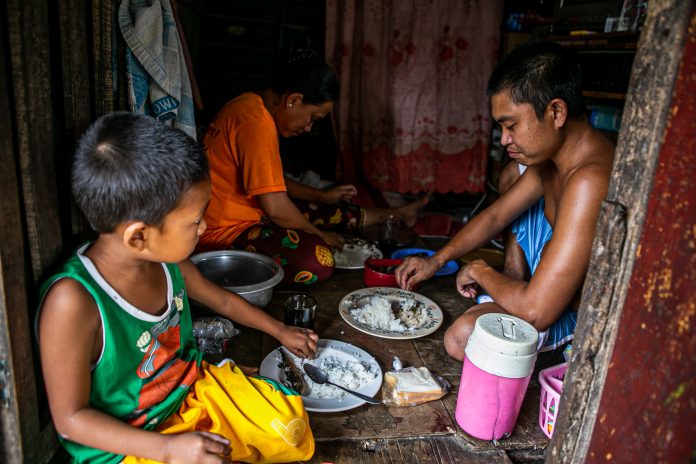
When I visit dioceses and parishes to give BEC lectures around the country, I ask people one basic question: “Do you feel a sense of equality in the Church?” The majority answer no. Their example is a common parish scene after the main fiesta Mass: bishops, priests, religious, and dignitaries seated at presidential tables and served sumptuous meals, while ordinary poor people sit under trees and are served simple barbecue and rice. This is an image of discrimination, not inclusion.
The same social divide is replicated outside our churches — in government units, educational institutions, civic organizations, and Philippine society in general. These images are familiar: corrupt politicians wallowing in millions of stolen money, while the poor struggle with floods and debt; large companies extracting natural resources while Indigenous communities are harassed.
Even if we ritually share in the “one loaf” in the Eucharist, even if we worship in the same church, even if we profess one faith, we are not truly one body. There is one world for those who have plenty, and another for those who have nothing.
St. John Chrysostom (349-407 AD) wrote these prophetic words:
“Do you wish to honor the Body of Christ? Do not honor him here in the church buildings with silks, only to neglect him outside when he is suffering from cold and from nakedness… Of what use is it to load the table of Christ? Feed the hungry and then come and decorate the table. You are making a golden chalice and you do not give a cup of cold water? The temple of your afflicted brother’s body is more precious than this temple.”
Father Daniel Franklin Pilario, C.M., is the President of Adamson University in Manila. He is a theologian, professor, and pastor of an urban poor community on the outskirts of the Philippine capital. He is also the Vincentian Chair for Social Justice at St. John’s University in New York.