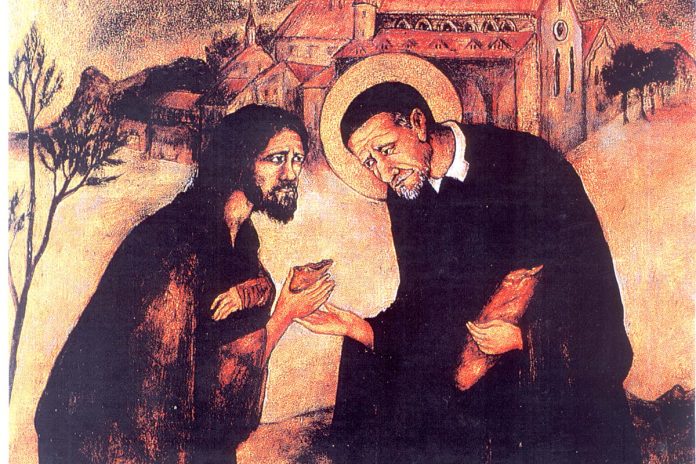
Starting the first week of January 2026, I will issue a weekly reflection on the life, mission, and spirituality of our patron saint, Vincent de Paul. It is his spiritual experience, life vision, and pastoral action that inspire us, his followers, and which become the source of our educational direction in our times.
These reflections are largely based on more scientific historical research by well-known Vincentian authors. Without going into nitty-gritty debates, I keep these fragments short and simple as an invitation for all of us to reflect on our lives and on how to live simply the Vincentian charism and mission in Adamson University.
My intention is simple: that the saint who inspires us did not live only 400 years ago nor was he elevated onto some pedestal unreachable to many. He was, first of all, an ordinary human being like us, whose everyday life, questions, doubts, and struggles are not far from ours. He speaks to you, to me, and to all of us in our time.
‘Strength Of Our Arms And The Sweat Of Our Brows’
Week 1
Vincent de Paul was born in 1581 in Pouy, a small village near the city of Dax, not far from the Pyrenees. At present, this place has been renamed Saint-Vincent-de-Paul in the Landes Department (40), Aquitaine region in southwest France. If you visit the place, a reconstructed house at Ranquine, where Vincent and his family grew up, is well preserved. This is now called Le Berceau (cradle) of St. Vincent.
His father was named Jean de Paul and his mother was Bertrand de Moras. Vincent had five siblings: Jean, Bernard, Dominique, Marie, and Marie Claudine. Vincent was the third child. Some of them married while others remained single. For instance, his sister Marie Claudine married, and it was her son who went to see Vincent in Paris in 1630. This nephew also testified during the beatification process of St. Vincent in 1706.
There were speculations that the family name “de Paul” sounded Spanish, especially when paired with his mother’s maiden name, Moras. The village of Pouy lies near the Spanish-French border, and migration in those times was common. But as historians tell us, Vincent was decidedly French.
Vincent de Paul came from a humble family. They were neither very rich nor comfortably well-off, nor were they very poor and destitute. They were farmers who owned a small piece of land to till. They needed to work daily, and through labor, in St. Vincent’s own words, they could “live decently and fairly comfortably according to their situation in life.”
In his old age, St. Vincent would recall this simple life:
“The girls come home from work exhausted, to take a brief rest. They are tired and worn out, wet through and covered in mud, but no sooner have they arrived than they have to set to work again if there is anything to be done; and if their mother and father tell them to go out again, they do so straight away, without thinking about the tiredness or the mud, and without stopping to think what they look like.”
Everyday life for peasants was very simple, and so was their daily table, as Vincent recalled:
“In the country districts where I come from, their diet consists of a grain called millet, which is cooked in an earthenware pot. At mealtime it is poured out onto plates, and all the household gather round to take their portion before they go off to work. Most people are often satisfied with soup and bread, even though their work is constant and exhausting.”
At one point, St. Vincent told his followers:
“God has given me such a high regard for simplicity that I call it my Gospel.”
And again:
“Let us love God, my brothers, let us love God, but let it be with the strength of our arms and the sweat of our brows.”
These words were not abstract maxims. They were products of real-life experience, born of a simple and practical man rooted in the land. His name is Vincent de Paul.
Father Daniel Franklin Pilario, C.M., is the President of Adamson University in Manila. He is a theologian, professor, and pastor of an urban poor community on the outskirts of the Philippine capital. He is also the Vincentian Chair for Social Justice at St. John’s University in New York.