
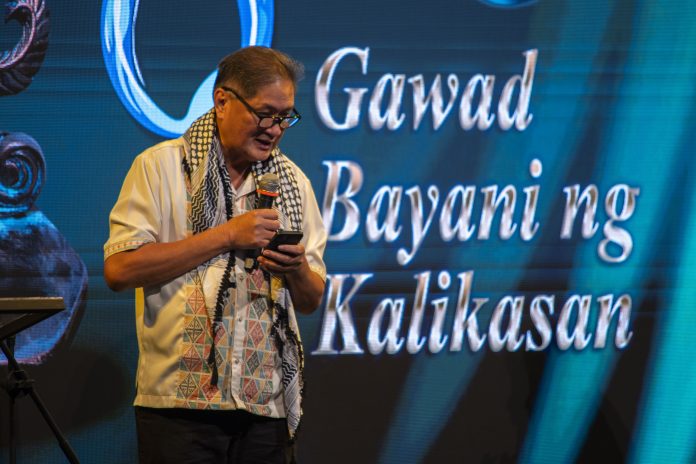
A leading human rights lawyer warned that emerging rifts within the Philippines’ anti-corruption movement are eroding its momentum and could carry long-term political consequences.
Antonio Gabriel “Tony” La Viña, a veteran legal scholar and rights activist, said the rivalry between the protest actions in Luneta and EDSA distracts from the shared goal of demanding accountability from the country’s leaders.
“It is heartbreaking to watch the anti-corruption movement fracture into acrimonious debates at the very moment when unity is most needed,” he said in a commentary posted on his social media account.
He said the disputes emerging after weeks of nationwide mobilizations revolve around “differences that are truly minimal.”
Recently, individuals associated with both rallies released statements questioning each other’s positions, a dispute that escalated after Cardinal Pablo Virgilio David remarked in his EDSA address that Luneta was not chosen as the main venue because protesters there have “a call that we do not yet agree with” and “we do not want violence and disorder”.
The comment drew mixed reactions from various groups, with some interpreting it as a dismissal of the Luneta action, further sharpening tensions within the broader anti-corruption movement.
La Viña, who joined both mass actions, said that despite the contrasting atmospheres of the two gatherings, their aspirations were aligned.
“What I saw with my own eyes was aspirations that were more similar than different,” he said.
He characterized Luneta as “young, vibrant, and grounded in the basic sectors,” where students, workers, urban poor communities, environmental advocates, transport groups, farmers, nurses, teachers, and indigenous peoples converged.
“Their message was unmistakable, and it declared that corruption is violence against the poor,” he wrote.
EDSA, meanwhile, brought together a larger presence of church communities and religious groups, but remained a broad coalition.
“The moral fervor was visible everywhere in EDSA, but it did not belong to any single sector,” he noted, adding that students, labor unions, and civil society organizations also marched.
“The shared understanding was that corruption corrodes institutions and steals from the nation’s future,” he said.
La Viña stressed that both rallies delivered the same demands. “In both Luneta and EDSA, people called on President Marcos to resign and demanded accountability at the highest levels of government.”
He added that speakers in both venues criticized former President Rodrigo Duterte and his “network of enablers” and condemned the “flood control corruption scandal, the brazen misuse of public funds, and the entrenched political culture that rewards impunity.”
He warned that the political beneficiary of the movement’s fragmentation is Vice President Sara Duterte. “Every argument between camps, every accusation of betrayal, and every moment wasted on internal feuds strengthens her political position,” he said.
La Viña urged supporters to reject rivalry and recognize that “no single group owns the struggle against corruption.”
The choice between Luneta and EDSA, he said, should never be framed as competition because “the rallying cry must always be Pilipinas.”