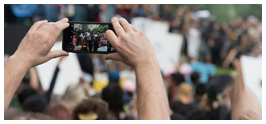
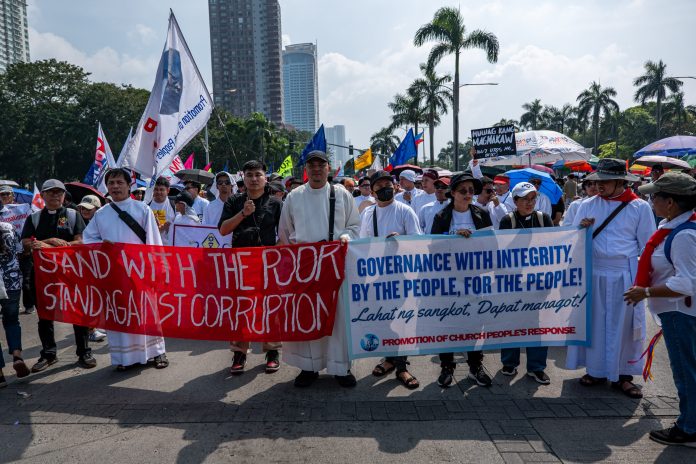
In the past weeks, Filipinos have poured into the streets again. From Luneta to EDSA, from flooded villages to the front steps of public offices, the cry has been the same: hold the powerful accountable.
The corruption scandals now gripping the country did not emerge in a vacuum. They are part of a pattern long familiar to communities that have endured the worst effects of failed governance.
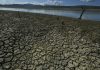
Billions of pesos meant for flood control, disaster preparedness, and public infrastructure have been traced to padded contracts, ghost projects, and a chain of favors that benefited officials while leaving towns underwater.
Families who lost their homes in the last floods do not need a Senate hearing to tell them what corruption looks like.
They see it in their empty relief packs, in their broken river walls, in the way their villages always seem to be the ones that never receive the funding on time.
Amid this national reckoning, the Catholic Church has added its voice to the clamor. Statements have been issued. Bishops have led prayers. Priests have joined street protests. The call for accountability is real. The moral urgency is echoed in homilies, pastoral letters, and public remarks.
But in conversations behind the scenes, the tone can be more cautious, more fragile.
I felt this tension acutely during a recent exchange with a priest friend. What began as friendly teasing, him asking why I covered Luneta instead of EDSA, where many Church leaders had gathered, turned into a quiet, honest conversation about the different faces of protest and the different risks people are willing to take.
I told him what I saw in Luneta:
a crowd that was largely poor and grassroots,
a simple stage,
performers unknown to the mainstream,
clergy who were more accustomed to social work than ceremonial roles,
and the presence of Christians from other denominations standing shoulder to shoulder with Catholic priests.
In EDSA, I said, the profile was different: more middle-class participants, more established speakers, and leading bishops visible at the forefront.
For me, the contrast was never just about geography. It was about power and comfort, and the uneven courage each group was willing to risk.
Then he said something that lingered long after the conversation ended:
“Let’s admit it — the call for accountability is soft because people within the Church itself are involved in corruption in one way or another.”
That line was not delivered with anger. It was said with resignation, even grief. Coming from a priest who loves the Church deeply, it carried the weight of a family secret whispered only to someone who already senses it.
He was naming something many Catholics feel but rarely articulate: the Church’s voice sometimes hesitates because parts of the Church have been entangled in the very systems it now condemns.
Not necessarily in spectacular scandals, but in quieter compromises, in mismanaged funds, political friendships, patronage networks, opaque transactions, or moral blind spots that have accumulated over decades. And when an institution is not fully clean, it becomes difficult to condemn dirt elsewhere without flinching.
If the institution refuses to admit or rectify its own failures, its moral voice will always ring hollow.
This is not a blanket condemnation of the clergy. There are many who live their vows with radical honesty, who accompany the poor with courage, who risk much more than the rest of us.
But institutions carry histories, and institutions carry wounds. And in moments like these, those wounds sometimes show.
Still, the Church’s moral voice remains essential. In a country where religious influence shapes conscience and narrative, it matters when bishops demand integrity, when priests stand with flood victims, when communities pray not just for healing but for justice. It matters when the Church sets aside fear and speaks truth to power.
But moral clarity cannot survive selective silence.
If the Church wants to reclaim its prophetic edge, it must first confront its own shadows.
Because accountability is not just for public officials. It must also be internal, honest, and transformative, a cleansing that allows the Church to stand before the poor without contradiction.
Perhaps this is why, when he asked why I chose Luneta, my answer came instinctively.
There, the language is direct.
The suffering is not buffered by privilege.
The demands are not filtered by political considerations or ecclesial anxieties.
The people in Luneta are those who have little to lose and everything to gain. Their outrage is born of lived experience, not theoretical debate.
In EDSA, the discourse is often framed in constitutional terms.
In Luneta, it is framed in hunger, loss, and survival.
Both are important. Both are valid. But one speaks with the fire of those who have been betrayed the most.
My formation, my journalism, and my faith have taught me to choose that fire, not because the masses are always right, but because God has always drawn near to them first.
To stand with the poor is not to romanticize poverty. It is to honor the truth that injustice is felt most clearly by those who carry its weight daily.
And so, in this season of public anger, as the country confronts scandal after scandal, I return to that conversation with the priest. I return to the honesty of his admission and the clarity of our shared frustration.
The Church must speak. But it must also listen, not inward, to its own fears, but outward, to the wounded communities who have suffered the consequences of corruption far longer than any official timeline suggests.
If the Church wishes to lead the nation toward accountability, it must do so with the courage of the poor, not the caution of the powerful.
It must walk not only in EDSA’s safe familiarity, but in Luneta’s raw, restless energy.
For it is there, among the masses, where the nation’s conscience beats the loudest. And it is there where the Church, if it truly seeks renewal, must choose to stand.
The real question is not why I chose EDSA or Luneta, but why protests are rising everywhere, and what drives Filipinos, despite political, theological, and social differences, to take to the streets at the same time.
Mark Saludes is the managing editor of LiCAS News. He is a Manila-based journalist reporting on human rights, social justice, environmental issues, and the role of faith communities across Asia.