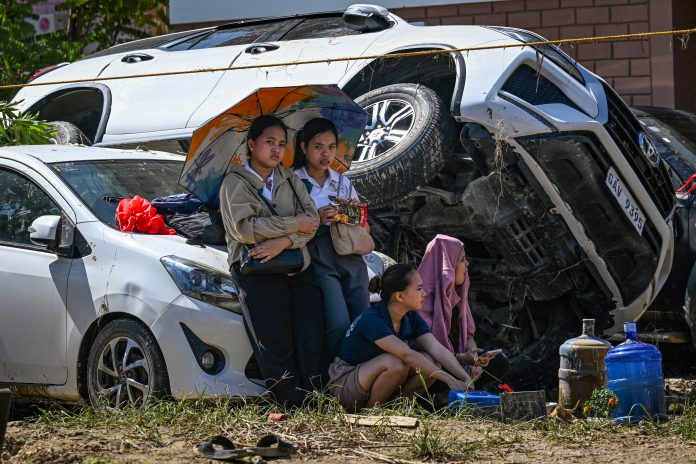
While the Philippines has been battered by tropical cyclones in recent months, the nation’s poor are suffering greater poverty than ever before. The most recent typhoon devastated the central Philippines, especially Cebu, and another is on its way.
But an even more destructive storm is raging: the human typhoon of corruption and dirty deals between politicians and contractors, where fake flood control projects allegedly siphoned off a trillion pesos.
The Philippines needs a moral revolution — an independent movement led by young, charismatic leaders with strong moral values and a dedication to justice and truth — to challenge this entrenched culture of corruption.
The unbridled corruption in the country has caused untold human suffering, property damage, and loss of crops. Politicians are investigating other politicians. Friends help friends cover up crimes against the people.
This is nothing new. Every year, there is an investigation into corrupt projects, and little comes from them. They are drawn out and forgotten, and the wrongdoers make another payoff and are exonerated.
The Philippines is in dire political inbreeding as one dynastic family succeeds another, and the oligarchy continues generation after generation. There seems to be no way to change the corrupt system where politicians steal billions of pesos and fund their “stay in power” through reelection campaigns.
The nation can never prosper or overcome the dire poverty of some 17.5 million Filipinos (according to government data). They suffer the worst effects of climate change, with increasingly intense typhoons and widespread floods.
The awakening of the national conscience — the hope of a new moral force composed of socially and environmentally educated, charismatic youth committed to justice, truth, and equality — remains far from reality.
The nation is ruled by powerful political families, and young independent leaders are blocked from ever rising to prominence.
The hope that the influential Church, with its 85 bishops, would lead efforts to create a more moral and just Philippines is dim. Only a handful of brave bishops, priests, and lay leaders have spoken out and taken action to challenge systemic corruption, especially during the previous regime.
Poverty is worsening due to climate change. In recent years, scientists at the University of the Philippines have shown that global warming is causing more intense and powerful typhoons with faster winds and slower movement, causing them to linger longer and bring greater damage. This is due to warmer ocean waters and a hotter atmosphere, which provide more energy and moisture for storms to form and intensify.
We have seen this most recently: a warmer atmosphere holds more moisture, leading to more intense rainfall and an increased risk of severe flooding and landslides during typhoons. Rising sea levels — a direct consequence of climate change — mean that in the coming years, much of Manila could be underwater.
All this stems from global warming and the world’s reliance on burning fossil fuels, coupled with the failure to quickly develop renewable sources of energy like solar, wind, and geothermal power. The Philippines has an abundance of these renewable energy sources, but development remains slow despite government incentives.
The 30th United Nations Climate Change Conference (COP30) will be held in Belém, Brazil, from November 10–21. Delegates will once again attempt to persuade national leaders to reduce carbon emissions and slow global warming.
However, in total contradiction to the purpose of the conference, the Brazilian government has cut down thousands of trees to make way for a new four-lane highway through the rainforest to reach the city of Belém.
They want to make it easier to travel for the 50,000 delegates expected to attend the climate summit. Many environmental defenders and conservationists are angry and outraged at the project’s negative environmental impact on the forests.
This is the contradiction: deforestation damages the ecosystem, the wildlife, and the lives of thousands of forest dwellers who depend on the forests for sustainable livelihoods.
Forests play a vital role in controlling climate change by cooling the planet and absorbing CO₂, which heats the globe. The Philippines has only three percent of its original rainforest left. The very purpose of COP30 is to preserve rainforests, not chop them down.
Yet this contradiction — the weakness of human nature — is what’s causing our planet to overheat, bringing more deadly typhoons and massive destruction.
The Church in the Philippines is also challenged to care for Creation and help mitigate the negative effects of climate change. Pope Francis, when he was alive, called for a global “ecological conversion” — a radical change in lifestyles, production, and consumption to save the planet.
His core message, detailed in his 2015 encyclical Laudato si’ and 2023 apostolic exhortation Laudate Deum, is that the environmental crisis is a moral and ethical issue, inextricably linked to social injustice and the “throwaway culture.”
He urged the “progressive replacement without delay” of highly polluting fossil fuels (coal, oil, and gas) with renewable energy sources — of which the Philippines has great potential.
In the coming week, we will witness debates and passionate speeches during COP30. But what is needed is direct action to stop burning fossil fuels — not more speeches. The multinational energy corporations are the villains in this story.
They are doing all they can to stop the transition to renewables. In the Philippines, energy corporations have filed for permits to build 20 more coal-fired power plants. They are currently on hold by the Department of Energy.
Unless there is serious action to prevent global warming from exceeding 1.5 degrees, the planet will continue to heat up, and the Philippines and many nations will endure more intense typhoons in the years ahead.
Note: Any original information, stories, or news articles posted on this site that are authored by the Preda Foundation and Father Shay Cullen may be shared, copied, or reproduced without further permission, in support of truth, freedom of expression, and the public’s right to know.
LiCAS News was granted permission to republish and adapt this article by Father Shay Cullen in the spirit of truth-telling and the pursuit of justice.
Irish missionary Father Shay Cullen, SSC, founded the Preda Foundation in Olongapo City in 1974 to promote human rights and the rights of children, especially victims of sexual abuse.
The views expressed in this article are those of the author and do not necessarily reflect the editorial stance of LiCAS News.