
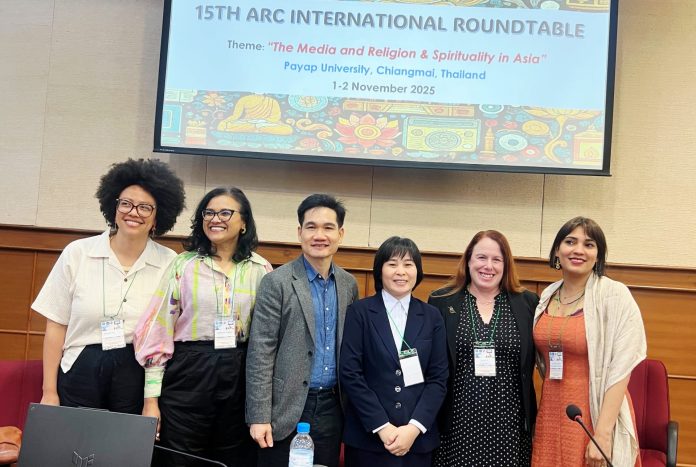
The 15th International Roundtable on “The Media and Religion & Spirituality in Asia” concluded on November 2, 2025, after two days of intense discussion at Payap University in northern Thailand.
The event brought together dozens of scholars and participants from a diverse range of institutions across Asia, Europe, the Americas, Africa, and Australia.
Organized by the Asian Research Center for Religion and Social Communication (ARC) in partnership with the Department of Peace Studies, International College, Payap University, the roundtable focused on the profound impact of artificial intelligence and digital technology on faith, communication, and human morality.
Screen as both temple and classroom
In his welcome, Rev. Dr. Kenneth Dobson of Payap University highlighted the conference’s timely focus on how AI and digital technology are “emerging issues” that “impact not only how we communicate and how we learn.”
Fr. Anthony Le Duc, SVD, Executive Director of ARC, described the partnership as a symbol of the conference’s essence: “the meeting of faith and dialogue, tradition and innovation, research and lived experience.”
Fr. Le Duc emphasized that the boundary between the sacred and the digital is now blurred, where “the screen has become both temple and classroom, a site for devotion, dissent, and discovery.”
The research presented covered a wide spectrum, from “digital evangelization in the Philippines” and “algorithmic reciprocity in the Bhagavad Gita” to “AI and Asian spirituality” and the use of media in “Buddhist peace education in conflict Myanmar.”
Keynote explores ‘charismatic technologies’
The keynote address, “Charismatic Technologies and Religious Affordances: Cross-Religious Reflections on AI and GPTs and the Asian Context,” was delivered by Dr. Heidi Campbell, a world-renowned scholar in digital religion from Texas A&M University, U.S.A.
Dr. Campbell’s address explored how AI and digital platforms are reshaping religious practices. She introduced the concept of “religious affordances,” defining them as the possibilities for action that technology offers, depending on the user’s goals.
She traced the evolution from traditional digital media to AI, which she defined by its capacity for automation, information creation, and prompt-based generation.
Critiquing the uncritical promotion of AI, Dr. Campbell argued that Generative Pre-trained Transformers (GPTs) are not yet true AI.
Her research, which analyzed approximately 100 religious apps across Buddhist, Christian, and Muslim traditions, revealed three key design strategies: replication, mediation, and transformation.
Her study found that Buddhist apps often emphasized spiritual teachings, Christian apps focused on theological depth and prayer, and Muslim apps prioritized information access.
Dr. Campbell concluded by advocating for religious communities to co-develop AI platforms that are unbiased and community-oriented, viewing religious AI as “charismatic technologies” that offer personalized spiritual engagement and multilingual access to sacred texts. She cautioned against the risk of AI replacing the communal aspects of faith.
Panel: Public scholarship for social justice
A dynamic panel discussion titled “RELIGION, MEDIA, AND PUBLIC SCHOLARSHIP FOR SOCIAL JUSTICE” featured scholars from the Desmond Tutu Centre for Religion and Social Justice at the University of the Western Cape, South Africa: Dr. Lee-Shae Scharnick-Udemas, Dr. Sarojini Nadar, and Dr. Thandi Gamedze.
The panelists called for harnessing media platforms for intersectional critique and liberative theological engagement. Dr. Lee-Shae Scharnick-Udemas framed media and religion as “co-constructors of public meaning” and argued for media literacy as a “theological imperative.”
She said, “Knowledge must not only interpret the world—it must also participate in its transformation.”
Dr. Sarojini Nadar reflected on her use of public scholarship—including opinion pieces, radio, and podcasts—to challenge gender-based violence and religious patriarchy.
She cited Archbishop Tutu’s guidance on choosing a topic: “What is peeving you off? What keeps you awake at night?” Dr. Nadar stressed that public scholarship is about “accountability to the communities we speak from.”
Dr. Thandi Gamedze shared a unique example of using traditional media for education with “Freedom Theology South Africa,” a bingo-inspired game narrating the Church’s resistance to apartheid, highlighting the pedagogical power of games in fostering historical memory.
The roundtable served as a powerful reminder that the study of media and religion in Asia is “central to understanding how Asian societies negotiate meaning, identity, and morality in this age of connectivity,” as noted by Fr. Le Duc.
The discussions posed critical questions for the future: “Can artificial intelligence and emerging technologies deepen, rather than diminish, our moral and spiritual consciousness? And how might media become a force for peace, inclusion, and ecological justice, rather than division and manipulation?”