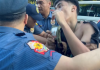
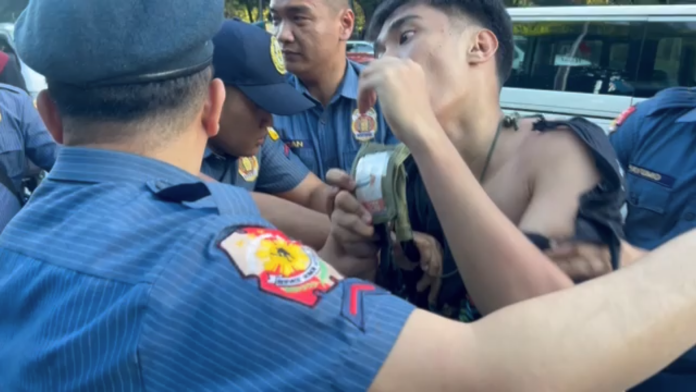
The Commission on Human Rights (CHR) has opened a motu proprio investigation into allegations that Quezon City police used excessive force against Bulatlat reporter Aaron Ernest Cruz.
The CHR said its National Capital Region Office conducted a Quick Response Operation after Cruz reportedly sustained bruises during an attempted arrest and later underwent a medical examination.
The probe comes as the Presidential Task Force on Media Security (PTFoMS) and the National Police Commission (NAPOLCOM) also investigate the incident, while Amnesty International condemned the alleged use of excessive force against the journalist.
CHR investigators gathered initial accounts from witnesses and protest organizers and requested operational records from the Quezon City Police District.
The commission said it is coordinating with concerned parties to secure formal statements and medical records and assist affected individuals in filing complaints.
It is also looking into reports of harm and harassment involving student journalists during the protest.
The CHR cited National Police Commission Resolution No. 2025-0472, which approved the Philippine National Police’s Rule on Media Relations, Safety of Journalists and Media Practitioners, and Enhancing Freedom of Expression and Access to Public Information.
Section 7(3) prohibits the use of force against journalists, particularly during high-pressure situations.
“This principle should be upheld even during the dissolution or dispersion of the demonstrations or persecution and detention of demonstrators, acts of brutality or arbitrary detention of access, detention, or arrest of journalists,” the rule reads.
The CHR said journalists must be protected because their work allows the public to access information and make informed decisions on issues affecting their lives and communities.
It also reminded law enforcement authorities that maintaining public order must remain consistent with the rights to freedom of expression, peaceful assembly and press freedom.
The commission said allegations of excessive force must be independently investigated and those found responsible held accountable.
In a separate statement, PTFOMS said it coordinated with NAPOLCOM after learning of the case.
“The PTFOMS maintains a zero-tolerance policy toward violence, harassment, or intimidation against media practitioners performing their professional duties. Journalism is a cornerstone of our democracy, and the safety of those who gather and disseminate information is of paramount importance,” the task force said.
PTFOMS said NAPOLCOM deployed investigators to establish the facts and conduct a thorough and impartial investigation into the actions of QCPD personnel involved.
“The PTFOMS remains committed to protecting press freedom and ensuring that violations of media workers’ rights are addressed in accordance with the law,” it said.
Amnesty International also condemned what it described as excessive force and harassment by QCPD personnel against Cruz while he was covering the protest.
“The physical assault and arbitrary arrest is a direct attack on press freedom. Journalists play a critical role in documenting protests and mobilizations. The use of deliberate state-enforced intimidation during peaceful protest is designed to silence dissent and independent reporting,” Amnesty International said.
The group said the incident violated international human rights standards, including the U.N. Basic Principles on the Use of Force and Firearms by Law Enforcement Officials, which require force to be used only when strictly necessary and proportionate.
Amnesty also said the incident breached domestic safeguards prohibiting police aggression against media workers during protests and mobilizations.
Cruz was covering a farmers’ protest outside the Department of Agrarian Reform when the confrontation with police occurred. Media groups earlier reported that he was surrounded and pulled by officers despite identifying himself as a journalist.