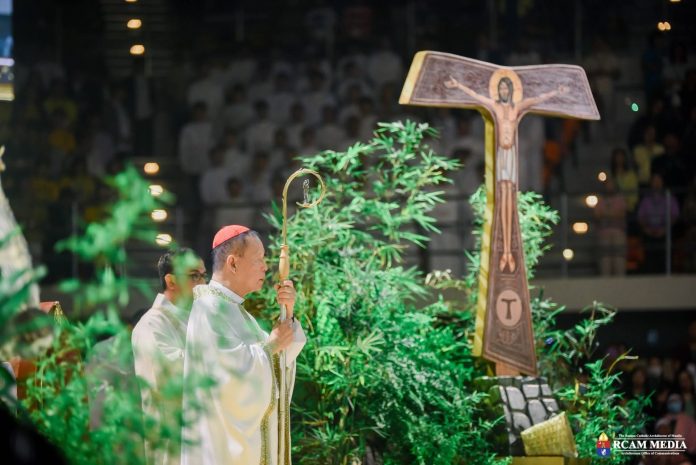
Cardinal Jose Advincula of Manila urged Catholics to accompany people patiently rather than pressure them to change and said genuine friendship must make room for growth, failure, and healing.
In his homily during the opening Mass of the 12th Philippine Conference on New Evangelization on July 24, Advincula said that, in true friendship, “love never forces; but simply accompanies.”
The conference opened at the University of Santo Tomas Quadricentennial Pavilion under the theme “Sangkay,” the Waray-Binisaya word for friend.
Drawing from the Gospel account of the wedding at Cana, the cardinal proposed three virtues for Christian friendship: hinay-hinay, or gentleness; kanunay, or steadfastness; and buligay, or mutual sharing.
Advincula said Mary showed gentle care when she noticed that the wedding hosts had run out of wine. Rather than force Jesus to act, “she simply presented the need” and trusted God’s timing.
“Mary’s care is gentle because it respects the pace of God’s work and the readiness of people to cooperate,” he said.
The prelate said impatience can strain relationships when people expect others to forgive, recover, understand, or change quickly.
Parents can become frustrated with their children, while children may lose patience with aging parents, he said. Friends may also expect one another to recover too quickly from hurt or failure.
“Ang totoong kaibigan ay marunong maghintay, dahil ang paghihintay ay pagmamahal din” (“A true friend knows how to wait, because waiting is also an act of love”), Advincula said. “Gradualness is a language of love.”
He urged Catholics to accompany rather than control their friends, encourage rather than pressure them, and trust that God continues to work in every person.
Advincula also warned against abandoning relationships, communities, or spiritual commitments when enthusiasm fades.
Every relationship and vocation, he said, eventually reaches a point when “we run out of wine” — when excitement disappears, and daily life becomes ordinary.
“In friendships, constant conversations give way to occasional messages,” he said, while the joy of a retreat or conversion experience can give way to the ordinary rhythm of daily prayer.
The cardinal said people often look for another source of excitement because they “mistake intensity for love.”
“But love is not found in intensity, but in fidelity, in constancy amid the ordinary,” he said.
Advincula pointed to the water that Jesus transformed into wine at Cana as a sign that faithfulness is often expressed through ordinary acts.
Catholics, he said, continue to pray even when prayer feels dry, attend Mass when they do not feel inspired, forgive while the hurt remains, and serve even when their work goes unnoticed.
“Friendship is not built on intense moments of dramatic emotions, but on steadfast trust,” he said.
The cardinal also called for relationships based on mutual support rather than one-sided dependence.
The Waray word buligay, he said, means more than helping another person. It means helping one another.
“There are moments when we carry others, and there are moments when others carry us,” Advincula said.
He said the miracle at Cana unfolded through the participation of Mary, the servants, the steward, the guests, and the bride and groom.
“Each one shared in the service and mission of Jesus. No one does everything alone,” he said.
Advincula urged Catholics to share their time, talents, faith, and experience while remaining willing to receive help from others.
“Ang tunay na pagmamahal ay marunong tumulong at marunong ding tumanggap ng tulong” (“True love knows how to help and also how to accept help”), he said.
The cardinal said a Church rooted in friendship must become a community where burdens are shared.
“In a Church that is built on the mutuality of friendship, no one walks alone,” he said.
Advincula closed by urging participants to care for others without rushing their growth, remain faithful in ordinary moments, and share in the mission of Jesus.