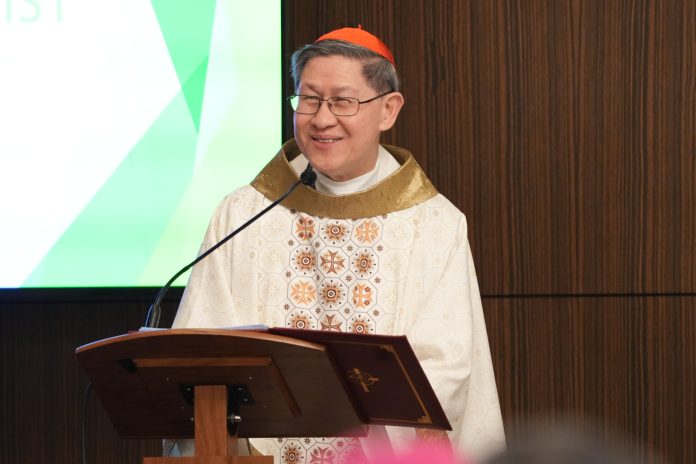
Cardinal Luis Antonio Tagle urged the Church in Asia to stay beside those who struggle to keep pace and warned that synodality cannot leave behind people who fall or can no longer continue on their own.
Tagle made the appeal July 22 at the 12th Plenary Assembly of the Federation of Asian Bishops’ Conferences at Hotel Mulia in Jakarta.
The pro-prefect of the Dicastery for Evangelization invited bishops and delegates to look more closely at the expression often used to describe synodality.
“We say synodality means walking together,” Tagle said, asking participants whether the Church had “studied well the phenomenon of walking.”
The Filipino prelate compared the Church’s synodal journey to a child learning to walk.
Before taking their first steps, children must crawl, build muscle strength, develop balance, and coordinate their movements. They also need encouragement and a safe environment where they can fall without fear.
Tagle said walking requires “skills, balance, coordination, the capacity to stand up,” and asked what spiritual strength, trust, and mutual support the Church needs to journey together.
He then spoke about his parents, who are both 96 years old. His father remains mentally alert but can no longer walk, while his mother is still mobile but needs assistance.
Tagle asked, “How do you walk with someone who cannot walk?” and answered: “You stay.”
Accompaniment, he added, may mean remaining physically close and assuring a person that they are not alone.
“You touch the hand. You whisper to his ears, and he is assured he is not alone,” Tagle said.
His reflection presented synodality as more than moving forward at the same pace. It also requires remaining with those who struggle, those who have fallen behind, and those who can no longer continue on their own.
Tagle warned that a synodal Church cannot measure success only through efficiency or progress. It must also be marked by patience, attentiveness, and compassionate accompaniment.
He also pointed to people’s growing absorption in their cellphones, which can leave them unaware of those around them. Such individualism, he said, runs against synodality’s call to listen, encounter others, and adjust one’s pace for them.
The day of prayer and recollection formed part of the assembly’s theme, “Synodal Conversion and the Mission to Be Bridges and Bridge-Builders in Asia.”
Tagle told participants that the Church’s mission as a bridge-builder must begin with Christ rather than with strategies, structures, or pastoral plans.
Referring to Jacob’s dream in the Gospel passage chosen for the assembly, he described Jesus as “the bridge in whom God and humanity—and I would say creation—are held together.”
Tagle also cautioned against pastoral approaches that place Church leaders above the people they serve.
He rejected the common expression of adapting preaching to the “level” of the faithful, saying such language suggests superiority.
“That’s not incarnation. That’s not kenosis,” Tagle said.
Christ’s coming into the world, he explained, was not an act of condescension but an expression of love for “his own.”
Before drawing up strategies on how the Church can become a bridge-builder, Tagle urged participants to “look at Jesus, touch him, see him, behold him, and learn from him.”
Delegates later joined a Conversation in the Spirit, a synodal process centered on prayer, silence, and attentive listening.
Christina Kheng, a member of the FABC Commission for Synodality who facilitated the session, described the process as “communal prayer” rather than a discussion or debate.
Participants shared the fruits of their personal prayer without interruption before reflecting on how they had been moved by listening to others. They later identified common insights that emerged from the group.
The session invited delegates to consider the challenges and opportunities they had encountered in becoming bridges, and what they hoped to learn from Jesus about serving as bridges for mission and communion.