
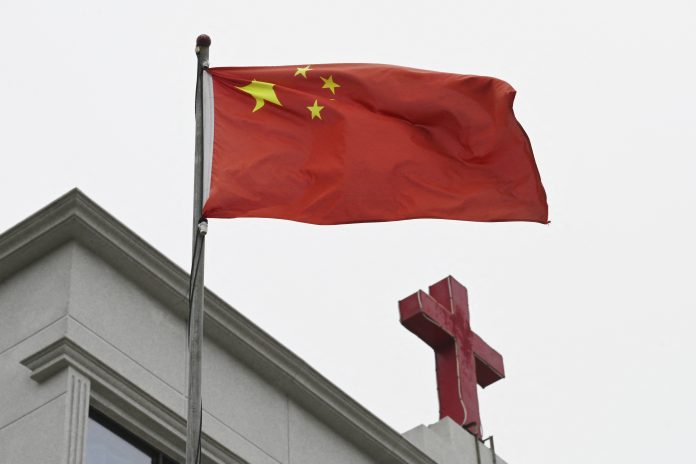
China is now viewed more favorably than the United States in most of the 36 countries surveyed by the Pew Research Center, which reflects a reversal in global public opinion driven by improving perceptions of Beijing and declining views of Washington.
The survey of 42,151 adults, conducted from Feb. 8 to May 13, found that China has overtaken the United States in favorability across much of Europe, the Asia-Pacific, and the Middle East.
The findings contrast with previous years, when the United States generally received more positive ratings than China.
“Views of China have improved in recent years while opinions of the U.S. have worsened, to the point where China is now seen more positively than the U.S. in most of 36 countries surveyed,” the report said.
The United States was viewed more positively than China in only six countries: India, Israel, Japan, Nigeria, the Philippines and South Korea.
The reversal reflects shifting attitudes toward both countries. In Canada, for example, 57% of respondents viewed the United States favorably in 2023, compared with 14% who expressed a positive opinion of China.
By 2025, favorability toward the two countries had reached parity. This year, 44% viewed China favorably, while 33% said the same of the United States.
The changing perceptions also extended to the two countries’ leaders.
“During the first two years of Trump’s second term, ratings of the U.S. president worsened significantly. While many people still lack confidence in Xi, positive views of him have become more widespread, and more overall now say they have confidence in Xi than in Trump,” the report said.
Neither Chinese President Xi Jinping nor U.S. President Donald Trump received majority confidence ratings in most countries surveyed. Xi nevertheless received higher confidence ratings than Trump across much of Europe, while Trump remained ahead in India, Japan and the Philippines.
In South Korea, confidence in the two leaders was nearly equal after Trump held a much wider advantage a year earlier.
The survey also found that the United States continued to be viewed more favorably than China on respect for personal freedoms, although that advantage has narrowed considerably.
“Our data has consistently shown a gap, with people more likely to say the U.S. government respects its people’s freedoms than to say the same of the Chinese government,” the report said.
“But this gap is shrinking, driven largely by the fact that people in nearly every country surveyed have become less likely to say the U.S. government respects its people’s personal freedoms since we last asked this question in 2021.”
The decline was particularly pronounced in several Western countries. In Sweden, the share of respondents who said the U.S. government respects personal freedoms fell from 61% in 2021 to 27% this year. Pew reported similar declines of at least 25 percentage points in Canada, France, Germany, Italy, the Netherlands, South Korea, and Spain.
Researchers also examined perceptions of U.S. and Chinese foreign policy in 17 middle-income countries across Latin America, sub-Saharan Africa, the Middle East, and the Asia-Pacific, where both powers have expanded their diplomatic and economic engagement.
Respondents generally viewed the United States as more likely to interfere in the affairs of other countries, while China was more often seen as a reliable partner.
“A median of 75% say that the U.S. interferes in the affairs of other countries a great deal or a fair amount, while 45% say the same of China,” the report said. “In nearly every country surveyed, more people see the U.S. as an interferer than China.”
The findings also highlighted regional differences. In Pakistan, 84% of respondents described China as a reliable partner, compared with 36% for the United States. In contrast, 81% of Filipinos viewed the United States as a reliable partner, while 42% said the same of China.