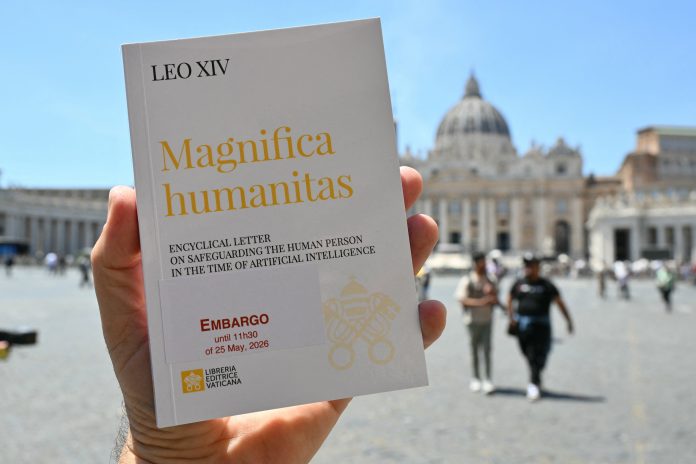
The Asian Research Center for Religion and Social Communication (ARC) at St. John’s University in Bangkok hosted an international online roundtable on July 4 to discuss Pope Leo XIV’s encyclical on safeguarding the human person in the age of artificial intelligence.
The discussion on Magnifica Humanitas was moderated by Fr. Anthony Le Duc, executive director of ARC. It brought together four speakers from around the world to reflect on the document released on May 15, 2026—the 135th anniversary of Rerum Novarum.
Fr. Anthony cited Pope Leo’s words that human beings are “a desire, not an algorithm” and noted that Magnifica Humanitas addresses AI not as a technical problem but as an urgent anthropological and moral challenge.
The encyclical warns against delegating life-and-death decisions to machines, the deceptive anthropomorphization of chatbots, and the reduction of persons to data. It calls instead for responsibility, cooperation, and digital literacy ordered to the common good.
Dr. Sebastian Periannan, a pastor in Thanjavur, India, and a member of ARC’s editorial board, described the encyclical as a major development in Catholic Social Teaching.
He outlined nine contributions, beginning with a reaffirmation of imago Dei: AI can process information but can never possess conscience, freedom, or self-giving love.
Dr. Sebastian stressed the encyclical’s critique of the “technocratic paradigm,” in which efficiency and profit dominate.
Echoing Rerum Novarum, it addresses a new industrial revolution, urging protection for workers through retraining and policies that uphold dignity. It also confronts the concentration of data power in corporations, calls for an “ecology of communication” to counter misinformation, and extends Laudato Si’ by noting AI’s environmental costs.
For the Church, he said, the encyclical is a call to pastoral action: integrate AI ethics into seminaries and schools, form clergy in digital discernment, defend the poor from automation, and model transparent, accountable AI use.
“The future of AI depends not primarily on technological capability but on moral wisdom,” he said.
Dr. Albertina Navas, a Peruvian communication strategist and former head of Digital Platforms for CELAM, approached the encyclical from a professional perspective. She demonstrated how AI platforms are “not neutral” because of limitations in their training and design.
Sharing an experiment in which she asked AI to generate “Pope Leo in Chiclayo,” she received instead an image of Pope Francis surrounded by Andean dress—a “hallucination” that reflected cultural bias. In another test on abuse in the Church, she received the biased response: “all priests are abusers.”
Dr. Navas warned that AI cannot replace empathy, creativity, or ethical discernment. She noted the rise of loneliness online and the need for Catholic communicators to respond with genuine human presence.
She proposed a roadmap: learn by testing platforms, apply knowledge critically, analyze impacts, and teach audiences to discern.
She also highlighted Catholic-specific tools such as magisterium.ai as a step toward specialized, values-based platforms.
Quoting Harvard Business Review, she cautioned: “AI won’t replace humans, but humans with AI will replace humans without AI.”
The human person, she insisted, “must always remain the final ethical filter.”
Dr. Peter Rachada Monthienvichienchai, secretary general of SIGNIS and executive director of LiCAS.news, reflected personally on the encyclical’s opening line: the choice between “a new Tower of Babel” and “the city where God and humanity dwell together.”
For him, the encyclical was a “rallying cry” that formalized his own discomfort with AI-generated greetings and social media metrics.
He drew attention to the phrase “architecture of visibility.” The Church, he argued, must ask not simply “how many clicks” but “what kind of relationship” media builds.
He questioned the economic model of AI, which “saves manpower” but destroys networks and community. He also noted the mismatch between quarterly corporate cycles and the Church’s 2,000-year horizon.
Citing the line, “humanity flourishes not despite limitations but often through them,” Dr. Peter pointed to the heroic work of religious sisters as the Church’s model.
Rather than asking AI to replace human accompaniment, he suggested the Church’s “wish list” should ask: What can technology do to connect people to real support, community, and friendship?
Fr. Kasmir Nema, SVD, general coordinator for communications at the SVD Generalate in Rome, read the encyclical as both priest and journalist. He titled his reflection “Babel or Nehemiah.”
Babel, he explained, is self-assertion: one language, one direction, no reference to God, sacrificing the weak for efficiency.
Nehemiah, in contrast, surveys the ruins first and assigns every group a section of the wall to rebuild together.
“Nehemiah’s project rebuilds relationships before rebuilding with stones,” he said.
Fr. Kasmir noted that Magnifica Humanitas is the Church’s first encyclical-level treatment of AI, building on the 2024 note Antiqua et Nova. Crucially, two full chapters lay a theological foundation on dignity, the common good, subsidiarity, and solidarity before addressing AI directly.
He identified the encyclical’s core danger in n. 112: when efficiency becomes the measure of value, persons are seen as “projects to be optimized” rather than beings called to communion.
Against this, the Pope affirms that limits, illness, vulnerability, and suffering are part of what makes us human.
The speakers agreed that Magnifica Humanitas is not a condemnation but a constructive invitation. It does not offer engineering solutions, but it shapes the ethical imagination that must guide policymakers, educators, and developers.
The task ahead for the Church, the panelists said, is to ensure that artificial intelligence serves a “civilization of love” rather than a new Babel of control.