The Philippines ranked among Southeast Asia’s worst-performing countries in protecting people from state abuse, with a new international human rights assessment giving the country the region’s lowest score for freedom from arbitrary arrest.
The Human Rights Measurement Initiative (HRMI) released its first civil and political rights assessment of the Philippines on Thursday. It gave the country a Safety from the State score of 4.6 out of 10, indicating that many people are not adequately protected from arbitrary arrest, torture and ill-treatment, forced disappearance, and extrajudicial killing.
The country’s score for freedom from arbitrary arrest stood at 3.1 out of 10. HRMI classified the result as “very bad” and said it was the lowest recorded among Southeast Asian countries included in its survey.
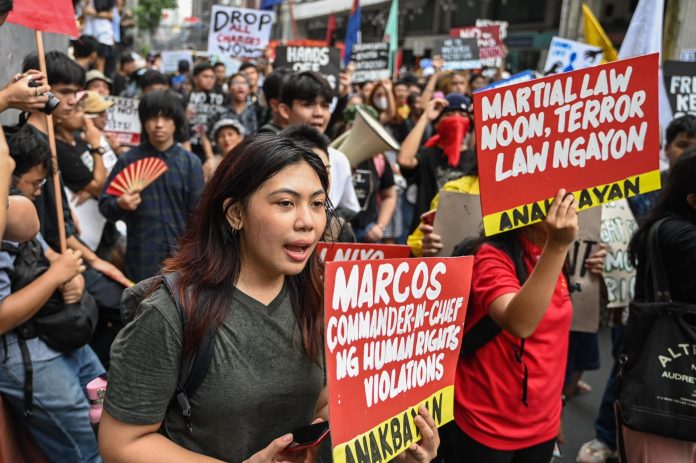
Experts consulted for the assessment identified people suspected of terrorism, protesters, people engaged in nonviolent political activity, activists, human rights defenders, Indigenous peoples, and labor rights advocates as among those most vulnerable to violations of their safety and security by state actors.
“These findings provide an important benchmark for understanding the state of civil and political rights in the Philippines. The exceptionally low score for freedom from arbitrary arrest should be a wake-up call. Everyone should be able to exercise their rights without fear of unjust detention or retaliation,” said Keshia Mahmood, HRMI’s Southeast Asia engagement lead.
The report also assessed civil liberties, giving the Philippines an “Empowerment” score of 5.4 out of 10. The measure covers freedoms of expression, assembly, association, religion and belief, and democratic participation.
Freedom of assembly and association received the country’s lowest score in that category, at 4.3 out of 10. Freedom of opinion and expression followed at 5.4 out of 10.
HRMI said journalists, LGBTQIA+ people, students, and women and girls were among those facing heightened risks of restrictions on their rights and freedoms.
The assessment also found the Philippines falling short on economic and social rights despite its available resources. The country achieved only 74.9% of what should be possible on HRMI’s Quality of Life metric, which measures the rights to food, education, health, housing, and work.
Among Southeast Asian countries, the Philippines ranked as the region’s third-lowest performer on that measure, ahead of only Laos and Timor-Leste.
The country’s weakest scores were for the right to education, at 66.1%, and the right to food, at 65.9%. Both fell within HRMI’s “very bad” range. The report also found that the country’s education score has declined since 2017.
“While the Philippines has the resources to achieve better outcomes, our data show it is currently not fully meeting its economic and social rights obligations under international human rights law,” said HRMI Co-Executive Director Thalia Kehoe Rowden.
“Combined with the civil and political rights findings, these new data paint a troubling picture of the challenges many people continue to face. Meaningful reforms are needed to ensure that everyone in the Philippines can live safely, freely, and with dignity,” Rowden added.
The report identified street children and homeless youth, Indigenous peoples, and people with low social or economic status as among those most at risk of being denied economic and social rights.