The years 1600 to 1617 were crucial years of St. Vincent’s life. One author, Jose Maria Roman, called these years “searching and being found” — years after his ordination to the priesthood leading to the events in Folleville and Chatillon, which we have narrated in earlier articles.
These were difficult years. Vincent was lost, confused, enslaved, scorned, and tried. But once God led him to the poor through the events of his life, he became determined.
The next years of his life were years of “growth” (1618–1633), and the services he started and the groups he organized have endured to this day. In this section, let me share about the “popular missions.”
The founding event was the “stampede to the confessional” that happened in Folleville on the feast of the Conversion of St. Paul on January 25, 1617. We shared this story earlier — “The First Mission.”
After this peak experience, St. Vincent organized a group of priests whose mission was to give missions to the rural areas of France, where most priests did not want to go. There was no Congregation of the Mission yet; it was organized later. The first groups of missionaries were diocesan priests inspired by Vincent to give missions. They lived together in community. They became very well known, and people began calling them the “priests of the mission.” In 1625, they were formally organized as the Congregation of the Mission and took January 25 as their foundation date.
“As soon as he returned to Paris in 1618,” according to Pierre Coste, “Vincent drew up a plan to evangelize the de Gondi lands. Folleville had already been evangelized the previous year. In early 1618 he began with Villepreux, then Joigny, Montmirail, and surrounding villages… Madame de Gondi also played her part: with abundant alms and by visiting the sick and poor, she contributed to the success of those first missions.”
Due to the neglect of the Church — both economic and religious — of poor people in the countryside of France, Vincent’s response was to dedicate the lives of his missionaries to them. Most priests wanted to live and work among the rich in Paris. The option for the Congregation of the Mission was to work in rural areas because it is there that people were most neglected.
In his old age, Vincent reflected: “I remember that in the past, when I returned from a mission, it seemed to me that when I got back to Paris, the gates of the city were going to fall upon me and crush me. Seldom did I return from a mission without that idea coming into my mind. The reason for this was that I used to make this reflection: ‘You are entering Paris and behold, other villages are waiting to receive from you what you have just given to this village or that! If you had not been there, it is probable that such and such persons, dying in the state in which you found them, might have been lost and condemned. They are waiting for you to go and do the same thing for them as you have just done for their neighbors.’”
What did they do in the missions? How did an actual popular mission look during the time of St. Vincent?
The first task was preaching. In general, the missionaries gave exhortations and homilies during early morning Mass at 6 a.m. We have to imagine that these country people were mostly farmers, so activities were scheduled early to allow them to go to their farms. Catechism was given to children in the afternoon, and catechism for adults was held around 6 in the evening when the farmers had returned home.
Since their audience consisted of simple folk, Vincent advised that sermons should not use lofty words but a familiar tone accessible to farmers. “I have told you several times,” he told his missionaries, “that our Lord blesses the sermons which were preached using a familiar and common tone, because he himself taught and preached in this way.”
He called it the “little method,” a simple way of developing a theme: why, what, how? Why is the theme or virtue necessary (motives)? What is it about (nature)? How do we live it in our lives (means)? It is direct and avoids unnecessary or flattering words.
Four hundred years later, Pope Francis echoes this when he speaks about homilies: “The homily can be an intense and happy experience of the Spirit, a consoling encounter with God’s word, a constant source of renewal and growth…” They should “find a way to let the word take flesh in a particular situation…” Homilies should be “brief” and avoid sounding “like a lecture or a class” (Evangelii Gaudium, 135–138).
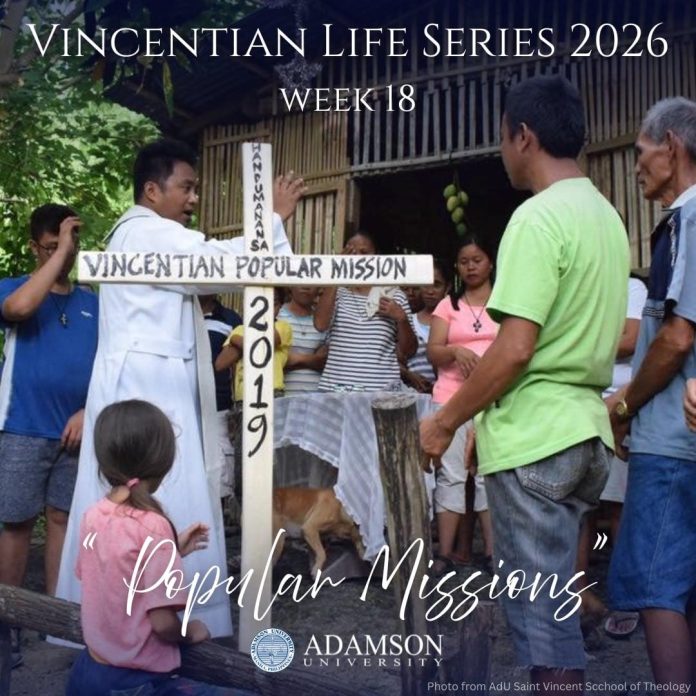
At the end of the six- or ten-week mission, depending on the needs of the place, solemn activities were celebrated, such as first Communion for children or general confession and Communion for adults. These symbolic celebrations remained in the memory of the people. Before the departure of the missionaries, “the whole parish went in procession to a place where a great cross was erected, as a memorial of the fruits of the mission.”
We are now centuries removed from St. Vincent’s time, but the work of mission and re-evangelization remains a pastoral priority of the contemporary Church. It may take new forms adapted to our situation, but the work begun by St. Vincent is still necessary.
Catholic Christians who have been baptized long ago need a rekindling of their faith. In places like the Philippines, where the Catholic population is large but the faith is often weakly practiced, there is a need to awaken faith among ordinary people. Many religious congregations, such as the Redemptorists, dedicate themselves to what is called “popular missions.”
The Vincentians in the Philippines have a permanent mission team whose work is to re-enliven the faith. One such experience can be found here. Cf. https://famvin.org/…/vincentian-popular-mission-in…/
Adamson University also shares in the same mission. Cf. https://web.facebook.com/reel/2404336010027703
The long-term objective of popular missions is not only re-evangelization but also organizing parishes into Basic Christian, Human, and Ecological Communities. The formation of Basic Ecclesial Communities has been the vision of the Philippine Church since PCP II.
Recently, the challenge of the new evangelization has been to form Basic Human Communities composed not only of Catholics but also inclusive groups from marginalized sectors, in the spirit of synodality and interreligious dialogue; and Basic Ecological Communities that care for our common home as an integral part of community organizing in the spirit of Laudato Si’.
What Pope Francis writes in Evangelii Gaudium strikes at the heart of Vincentian spirituality. St. Vincent de Paul speaks through him in our time.
“My mission of being in the heart of the people,” Pope Francis writes, “is not just a part of my life or a badge I can take off; it is not an ‘extra’… Instead, it is something I cannot uproot from my being without destroying my very self. I am a mission on this earth” (EG 273).
Father Daniel Franklin Pilario, C.M., is the President of Adamson University in Manila. He is a theologian, professor, and pastor of an urban poor community on the outskirts of the Philippine capital. He is also the Vincentian Chair for Social Justice at St. John’s University in New York.