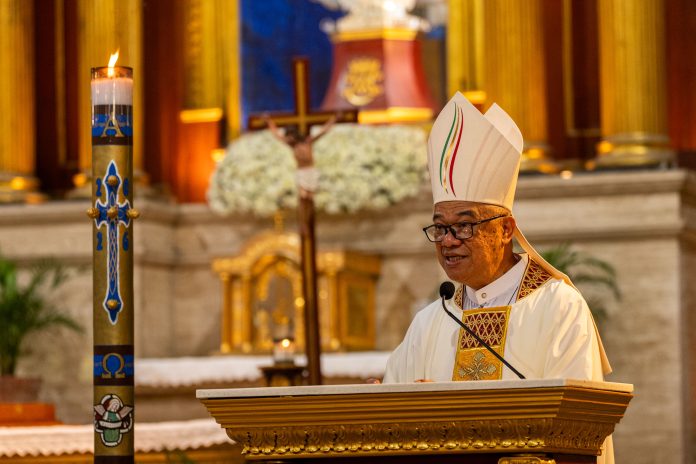
Bishop Gerardo Alminaza of San Carlos on April 11 urged the Church to confront its growing distance from the poor, warning that silence in the face of injustice and war risks normalizing suffering and eroding its moral credibility.
Speaking during a Mass for Peace at Malate Church, Alminaza challenged both clergy and lay faithful to examine how desensitization to violence, poverty, and global conflict has taken root even within the Church.
“As we hear the call of Pope Leo — ‘let us make heard the cry for peace that springs from the heart’ — I would like to ask us: Is there still a cry within us?” he said, questioning whether people are “still shocked that war is happening” or have “become used to the pain.”
The bishop said many Filipinos treat war as distant, but stressed that its consequences are already felt on the ground.
“The truth is, war is not really far away. It is not only happening in other countries,” he said, pointing to the daily struggles of workers. “It is felt by the driver who can barely bring anything home, by the fisherman whose income has shrunk, by the family that no longer knows how to stretch the food on the table.”
He underscored the moral clarity of the issue, stating plainly: “War is wrong. War is illegal.” Yet he questioned the continued silence. “If we know that, why do we remain silent?”
Alminaza framed this silence within what he called “tolerated evils,” describing it as a condition in which people recognize injustice but gradually accept it.
“These are things we know are wrong, but we accept them,” he said. “And when you accept what is wrong, little by little, you stop resisting.”
The bishop said the problem is not only societal but also internal, urging the Church to begin with self-examination rather than pointing outward.
“This is not only a problem of the world. It is also our problem. A problem of the Church,” he said, adding that “we have distanced ourselves from the poor — not intentionally, not suddenly — but it happens.”
He said this growing gap is often the result of changing lifestyles and perspectives within Church leadership.
“As time goes on … we become comfortable. Our world becomes different. And without realizing it, we no longer taste the hardship of the people,” he said.
Such disconnection, he warned, weakens the Church’s witness and relevance.
“Sometimes we become good at speaking, good at preaching, but lacking in listening, lacking in presence,” he said, noting that faith can become “performative … it sounds good, but it is not felt.”
Alminaza said this gap may help explain why some sectors gravitate toward strongman leaders.
“It is not surprising why some cling to leaders like Duterte and Trump — not because they are right, but because people feel that someone is listening to them, that someone is speaking for them,” he said.
He cited the killings of the poor during the Philippines’ war on drugs, where “thousands of the poor were killed … lives treated as if they had no value,” as well as global patterns of division fueled by fear and anger.
He also pointed to the ongoing Middle East conflicts, describing “a war of aggression — the attacks of the United States and Israel against Iran, the continued bombing of Lebanon and Palestine,” where “those who suffer first are not the powerful, but civilians, children, and defenseless families.”
“This is not a simple matter of politics,” he said. “This is concrete violence, concrete loss, concrete wounds of humanity.”
Turning back to the local context, the bishop questioned whether the Church remains present among those on the margins.
He also challenged decision-makers to examine who is excluded from power, saying that “the poor, the environment, and the next generation” are often missing from the table.
Alminaza said peace requires more than prayer, calling for concrete action and systemic change. He invoked the concept of hayuma, or “mending the broken, together,” to describe the collective task ahead.
“The truth is — it is not only lives that are broken. The system itself is torn,” he said. “And when there is a tear, the poor fall through, the environment is destroyed, and the future is lost.”
He ended with a call for commitment beyond words.
“In the end, the peace we seek is not only prayed for. It is fought for. It is lived,” he said. “And let us not allow what is wrong to become normal.”