
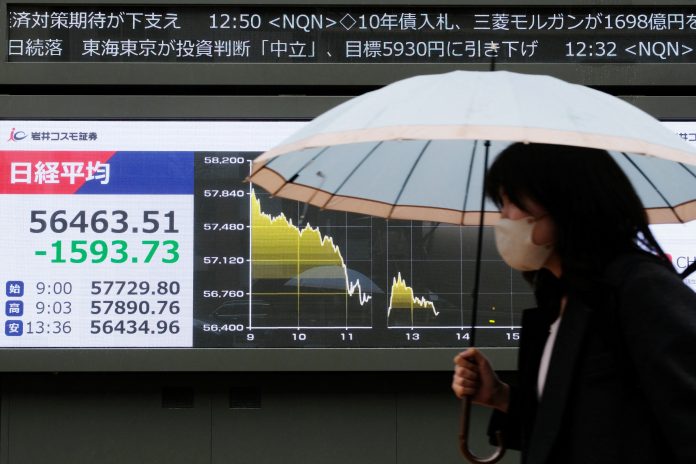
Most Asian stocks fell Friday as the escalating war in the Middle East rattled global markets and pushed oil prices sharply higher, stoking fears of renewed inflation and economic uncertainty.
After a volatile week on global trading floors, investors entered the weekend facing mounting concerns about the impact of the United States-Israel war on Iran and Tehran’s retaliatory attacks across the Gulf region, according to Agence France-Presse.
Equities worldwide have been under pressure since the conflict began, with crude prices surging by about a fifth since Friday last week, the day before the attacks started.
The spike has intensified fears that higher energy costs could drive inflation back up and weigh on the global economy.
While markets briefly recovered earlier in the week, analysts warned the outlook remains fragile if the conflict continues.
“It is too soon to suggest that stocks have bottomed,” wrote IG chief market analyst Chris Beauchamp.
“Unless the war ends soon, and if anything a more intense conflict seems more likely, markets will struggle. Volatility remains elevated, which means we should expect plenty of two-way price action, but a continued decline for the moment seems likely, even with short-term bounces along the way.”
Signs of a prolonged conflict added to investor unease. Iranian Foreign Minister Abbas Araghchi warned Thursday that the Islamic republic was neither seeking a ceasefire nor negotiations with the United States.
Asian markets largely tracked losses on Wall Street, where the three major indexes ended lower despite late rallies.
In Asia, Seoul’s Kospi fell 1.6 percent after suffering steep losses earlier in the week. Sydney, Singapore, Wellington, Manila, and Jakarta also declined, while Tokyo, Hong Kong, Shanghai, and Taipei posted modest gains.
Investor concerns have been fueled in part by fears that rising crude prices could force central banks to reconsider plans to cut interest rates.
The widening geopolitical crisis has also drawn concern from the Holy See.
Cardinal Pietro Parolin, the Vatican’s secretary of state, warned this week that the escalation of hostilities risks undermining international law and deepening global instability.
“This erosion of international law is truly worrying: justice has given way to force; the force of law has been replaced by the law of force,” Parolin said in an interview with Vatican News.
The prelate cautioned that attempts to justify attacks as preventive measures could have far-reaching consequences for global stability.
“If states were to be recognized as having a right to ‘preventive war,’ according to their own criteria and without a supranational legal framework, the whole world would risk being set ablaze,” he said, urging renewed commitment to diplomacy and multilateral institutions to resolve conflicts peacefully.
The war has also disrupted global energy flows. While Iran has not officially closed the Strait of Hormuz, shipping through the key waterway has nearly stopped. About a fifth of the world’s crude supply normally passes through the strait. — with reporting from Agence France-Presse