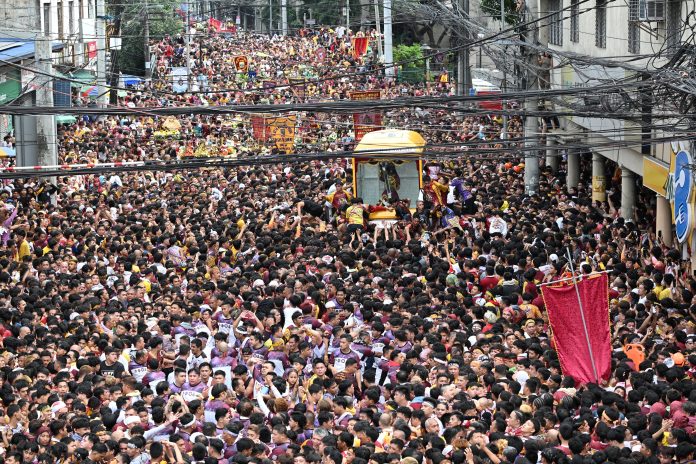
The annual Traslacion, the grand procession of the image of Nuestro Padre Jesus Nazareno, ended Saturday morning after more than 30 hours, marking the longest procession in the history of the Philippines’ largest Catholic devotion, church authorities said.
The image of the Jesus Nazarene, a life-sized statue of Jesus Christ carrying the cross, returned to the Minor Basilica and National Shrine of Jesus Nazareno in Quiapo Church at around 10:49 a.m. on Jan. 10, more than a day after the procession began at the Quirino Grandstand before dawn on Friday.
According to the Quiapo Church Command Post of the Archdiocese of Manila, the andas, or wheeled carriage bearing the image, rolled out of the Quirino Grandstand at 3:58 a.m. on Jan. 9 and completed the 5.8-kilometer route after 30 hours, 50 minutes, and one second, making Traslacion 2026 the longest on record.
“Viva! Viva!” devotees shouted as the image reached the basilica doors, clapping, waving towels, and cheering after the prolonged procession through Manila’s major roads.
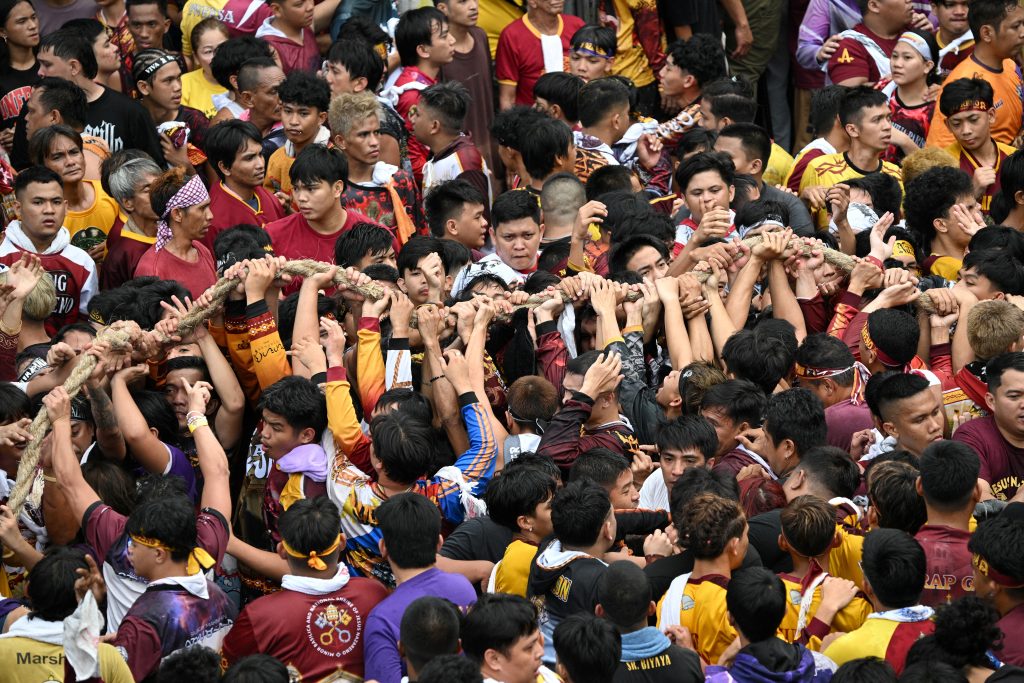
Quiapo Church spokesperson Fr. Robert Arellano said the 2026 Feast of the Jesus Nazareno was historic not only for having the longest Traslacion, but also for recording the highest attendance, with more than nine million devotees joining the celebration across the Philippine capital.
Appeals for safety amid exhaustion
As the procession stretched beyond 24 hours, Quiapo Church rector and parish priest Fr. Ramon Jade Licuanan appealed to the faithful to pray for safety and restraint, citing exhaustion among medical teams and volunteers.
“I would like to ask and appeal to everyone, please say a little prayer that the number of casualties will no longer increase, that the carriage will return here to the church, and most especially that our fellow devotees will return safely to their families, to their homes,” Licuanan said.
The appeal followed a brief period of tension after church authorities announced that the andas would temporarily remain at the Minor Basilica of San Sebastian due to safety concerns.
Despite the announcement, Hijos del Nazareno, male lay volunteers tasked with assisting the procession, and other devotees resumed pulling the carriage toward Quiapo.
Licuanan later said the decision was made following recommendations from authorities, including the Manila city government, the Department of Health, the Armed Forces of the Philippines, and other stakeholders.
“We were informed this morning by the Department of Health that our resources, in terms of people, doctors, and all the medical professionals and volunteers, are already quite exhausted. I mean, it is easy to understand; it’s been more than 24 hours already. And I had to take the courage to take the microphone,” he said.
While affirming the devotion of the faithful, Licuanan stressed the need to protect physical well-being.
“It’s a very beautiful spiritual exercise. You are able to express your faith in God and your devotion to God. But keep in mind, God is also concerned about the welfare of our body, our physical body. That, too, is a gift from the Lord,” he said.
Millions join record-long procession
Authorities released varying estimates of crowd size. Initial reports placed participation at around five million, while the Manila Public Information Office later estimated 7.33 million devotees as of Saturday morning.
The Quiapo Church Command Post later reported a total of 9,640,290 participants, surpassing last year’s figure of 8.12 million.
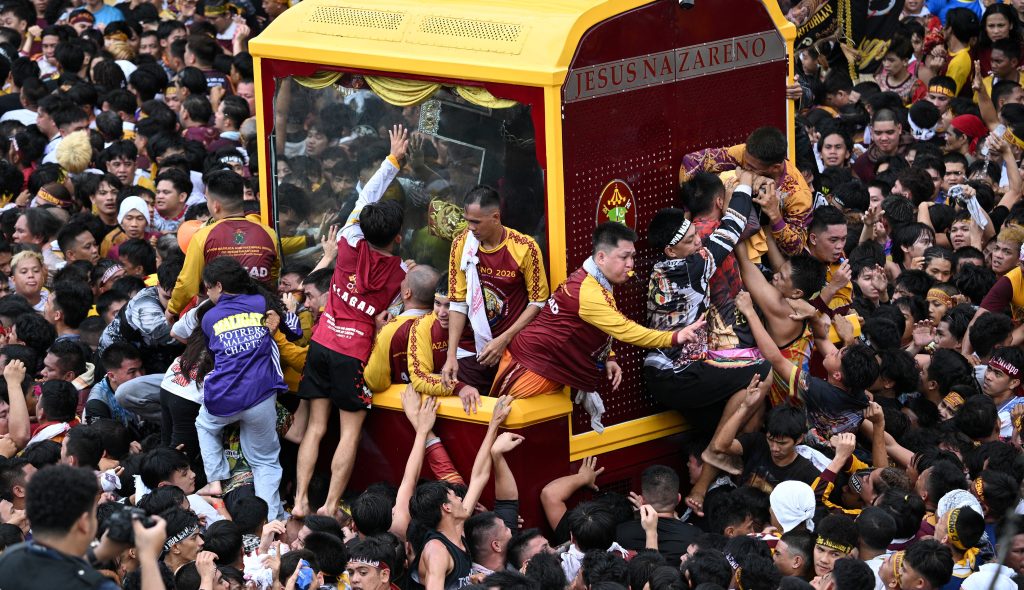
Church officials said the extended duration was driven by the sheer volume of devotees along the route and repeated attempts by some participants to climb onto the andas, affecting its balance and slowing its pace.
The procession was briefly halted at several points, including a stop at San Sebastian Church around 4:30 a.m., before resuming shortly after 5 a.m. Along Quezon Boulevard, the thick rope used to haul the carriage was torn and had to be replaced to allow the procession to continue safely.
Medical cases and deaths reported
Thousands sought medical attention during the procession, most for cuts and abrasions, according to health authorities. Others suffered dizziness, blood pressure fluctuations, headaches, breathing difficulties, muscle spasms, chest pains, seizures, vomiting, fainting, strokes, and asthma attacks.
Arellano said church officials recorded at least 1,700 medical cases.
“For the record, these are the confirmed records at this point in time. We have 1,700 cases, two of which have been confirmed as death cases,” he said.
Separate reports from hospitals and media organizations later indicated additional fatalities. The Department of Health confirmed deaths during the event, including a tabloid photojournalist who collapsed while covering the Traslacion at the Quirino Grandstand.
The Jose R. Reyes Memorial Medical Center said two individuals were declared dead on arrival despite resuscitation efforts, while another died of a heart attack earlier during the festivities.
Church officials said the photographer’s death was not directly related to the procession.
Arellano said authorities were still verifying details surrounding the reported deaths and injuries.
Causes of delay, no crimes reported
Arellano said one of the primary causes of delay was the continued attempt by devotees to climb onto the andas despite repeated warnings.
“In this instance, despite the appeals of the Catholic Church and reminders on social media that climbing onto the carriage is prohibited, we still had devotees who did not heed our call. This also became one of the factors that slowed down the Traslacion,” he said.
Despite the massive crowd, Arellano said no crimes were recorded during the event.
“Generally, we have a zero-crime rate. We did not record any crime. There may have been some minor pushing, which is normal during the Traslacion, but as for crimes, we have no reported incidents,” he said.
Evaluation for future celebrations
Traslacion 2026 was the first Nazareno feast under Licuanan, who was appointed rector and parish priest of Quiapo Church on Jan. 29, 2025, succeeding Fr. Rufino “Jun” Sescon, now bishop of Balanga.
Church officials said changes would be introduced in future celebrations based on lessons learned this year.
“We are going to have an immediate evaluation. As we always say, every year is a new experience, and every year we learn. That is why, even now, we are already recording our experiences this year so they can serve as tools for the celebrations in the coming years,” Arellano said.
The Traslacion reenacts the 1787 transfer of the image of Jesus Nazareno from Bagumbayan, now Luneta, to Quiapo Church. Known as the Black Nazarene for its darkened wood, the image remains one of the most powerful symbols of popular Catholic faith in the Philippines.
The charred life-sized image of the suffering Christ carrying the cross originated in Mexico in the early 17th century and was brought to Manila by Augustinian Recollect missionaries in 1606.
The image became the center of a deep popular devotion in the Philippines, especially among the poor, who associate it with suffering, perseverance, and hope amid hardship.