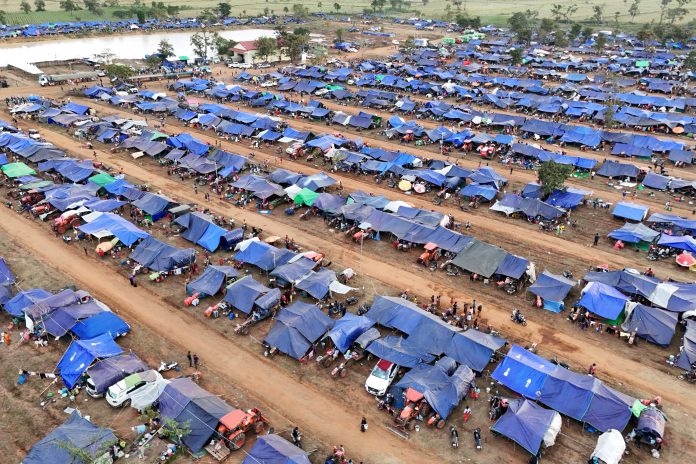
Many displaced families along the Thai-Cambodian border have begun leaving evacuation shelters and returning to their homes as tensions ease.
However, authorities continue to warn that the situation remains fragile and humanitarian needs persist on both sides of the frontier.
Bishop Stephen Boonlert Promsena of Ubon Ratchathani confirmed to LiCAS News that Catholic evacuees under his pastoral care have largely been able to leave temporary shelters.
“All our people who were staying at the shelters have now returned home,” Bishop Boonlert said. “Those who have not returned yet are staying with relatives for a while longer.”
The bishop said the Church’s response is now shifting from emergency shelter to accompaniment and healing, as communities begin to recover from the trauma of displacement and violence.
“On January 12, I will accompany the team from the Social Development Center of our diocese to several parishes near the border in Ubon Ratchathani province,” he told LiCAS News.
The prelate said that his diocese will “offer pastoral support and deliver relief supplies to parishioners affected by the border clashes,” adding that visits to parishes in Si Sa Ket province will continue on Jan. 13.
According to the bishop, relief assistance continues to arrive through Caritas Thailand, religious congregations, and lay Catholic organizations, reflecting what he described as “a concrete expression of Christian solidarity with those who suffer.”
Fragile ceasefire, lingering risks
Despite a ceasefire that came into effect on December 27, 2025, tensions between Thailand and Cambodia remain elevated following renewed clashes last month, which again triggered large-scale displacement along the border.
Thai military authorities have confirmed that several affected communities and farmlands have been cleared of unexploded ordnance fired during five days of intense fighting in late December.
However, provincial officials caution that conditions vary widely from village to village.
Local authorities said the number of civilians remaining in evacuation shelters is constantly changing, as families move between shelters, host communities, and their homes.
While many have begun returning, a significant number of people remain displaced or dependent on temporary accommodation.
Thai authorities continue to urge residents not to return to areas that have not been officially declared safe, citing the presence of unexploded ordnance and unresolved security concerns in some locations. Several villages remain inaccessible.
As of last week, officials warned that more than 180,000 Thai civilians who were previously evacuated should not yet return home, despite the easing of hostilities.
At the height of the conflict, more than 40,000 civilians from 86 villages were evacuated into shelters and, at one point, the total number of evacuees across seven Thai provinces exceeded 360,000 people.
Cambodia reports large-scale returns
On the Cambodian side, Foreign Affairs and International Cooperation Minister Prak Sokhonn told foreign diplomats on Wednesday that Phnom Penh’s priorities remain “the preservation of the ceasefire, the safe and dignified return of displaced civilians, and the peaceful settlement of disputes through established mechanisms.”
Cambodian authorities reported that approximately 460,000 displaced people had returned to their homes as of January 7, while 176,760 people remained in evacuation shelters.
Shared suffering, shared responsibility
The conflict has inflicted serious humanitarian and economic consequences on border communities, where thousands of families were forced to flee their homes, disrupting livelihoods, education, and daily life.
Church leaders and humanitarian workers have stressed that beyond physical reconstruction, displaced communities require sustained pastoral care to address trauma, fear, and uncertainty, especially among children, the elderly, and the poor.
“The Church cannot look away from the suffering of any people,” a diocesan social worker involved in relief efforts told LiCAS News. “This is about human dignity and fraternity, regardless of nationality.”
Travel advisories and border closures
While most foreign embassies in Bangkok have stated that Thailand remains safe for visitors in 2026, they continue to advise avoiding areas near the Cambodian border due to ongoing military tensions and the fragile ceasefire.
All land border crossings between Thailand and Cambodia remain closed, requiring air travel for cross-border movement.
Travelers are advised to closely monitor official government and embassy advisories for updates.