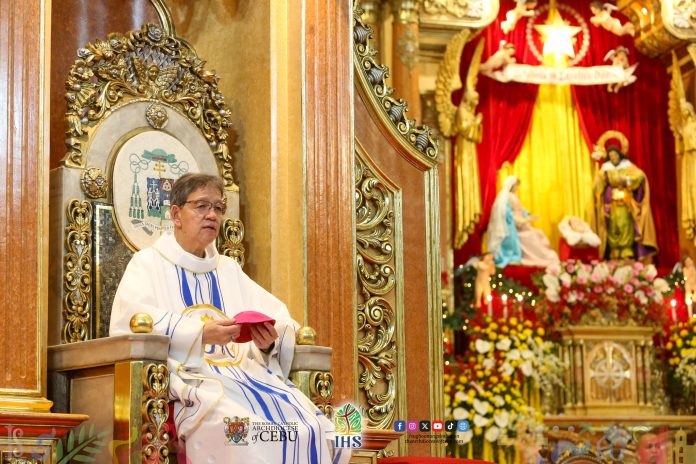
A top church official in the central Philippines challenged corruption, persistent poverty, and forced migration, saying that these realities are moral failures in leadership and governance.
In his Epiphany homily, Archbishop Alberto Uy of Cebu said the Star that guided the Magi should not be reduced to a decorative symbol but understood as a light that demands truth, accountability, and ethical direction, especially during periods of national difficulty.
“The Star of the Epiphany is not just something beautiful we admire in the sky. It is a light meant to guide our steps, especially when the road is dark,” Uy said.
The prelate noted that Filipinos continue to search for direction and hope “after storms, during difficult times, and in moments of uncertainty.”
Reflecting on the Gospel account of the Magi and King Herod, the archbishop said the presence of light becomes threatening when it exposes wrongdoing.
“When the Star is mentioned inside the palace, Herod becomes afraid. Why? Because light always exposes darkness,” he said.
Uy directly linked this image to the Philippine situation, arguing that corruption persists because leaders resist transparency.
“In our country, corruption survives because many leaders are afraid of the light: they fear the truth, they fear accountability, they fear losing their privilege,” he said.
He said the impact of such leadership failures is felt most by ordinary citizens. “That is why money meant for the poor disappears. That is why projects are left unfinished. That is why people feel frustrated and tired,” Uy said.
Rejecting claims that poverty stems from a lack of faith or ability, the archbishop said the country’s struggles are rooted in self-centered leadership.
“Let us be honest: the Philippines is not poor because Filipinos lack talent or faith. Our country suffers because too many leaders think first of themselves,” he said.
He warned that leadership focused on self-interest ultimately resists moral accountability. “The Star reminds us of a painful truth: when leadership is centered on self, even God becomes a threat,” Uy said.
The prelate said Epiphany calls both leaders and citizens “to choose openness over secrecy, service over power, and truth over what is easy or convenient.”
The archbishop also addressed the migration of Filipino workers, contrasting the Magi’s journey with the experience of millions who leave home out of necessity.
“The Magi were willing to leave home to follow the light. But many Filipinos leave home today not because they want to, but because they have to,” he said.
Uy pointed to the social cost of overseas work, saying millions of Filipinos become overseas workers because decent opportunities are scarce at home, forcing parents and children to live apart in arrangements he described as neither normal nor consistent with God’s will.
Raising a broader challenge to policymakers, he asked, “Why must Filipinos search for light far away when our land is rich and our people are capable?”
Uy also emphasized that the Star in the Gospel narrative does not lead to centers of power but to the margins. “The Star does not stop in Herod’s palace. It stops over a simple home. God chooses to be found among the poor,” he said.
He described poverty as the result of injustice rather than divine intent. “Poverty is not God’s will. It is often the result of unjust systems and corrupt decisions,” Uy said.
He said that faith today requires solidarity with the marginalized. “If we want to find Christ today, we must look where the poor are—and stand with them.”
Uy pointed to the Magi’s decision to return home by another route as a call to national conversion. “Meeting Christ must change our direction,” he said.
For the country, he said, this change means “rejecting corruption, choosing leaders with integrity, refusing to accept injustice as normal, and teaching the young to dream honestly.”
“The Star of the Epiphany is still shining over the Philippines today,” Uy said. “The question is not whether the Star is there—but who is willing to follow it.”