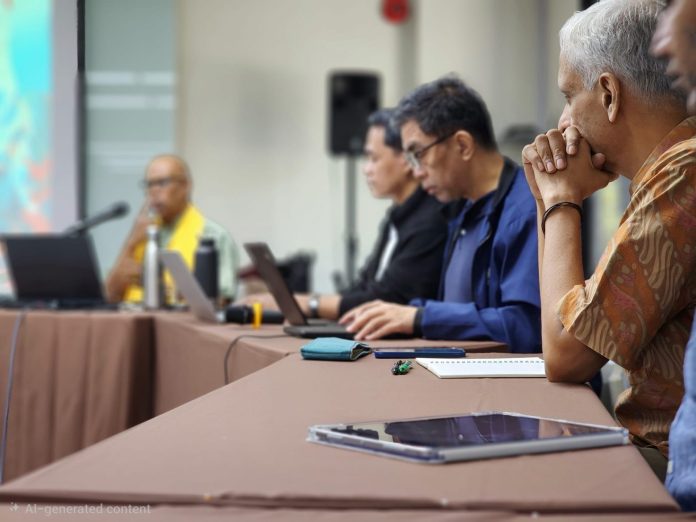
Church leaders, theologians, and Indigenous Peoples’ rights advocates from across Asia gathered in Thailand this month for a regional conference examining inculturation, synodality, and integral ecology within the life of the Church.
The Conference on Inculturation, Synodality and Integral Ecology was held from Dec. 8 to 12, 2025, at the Don Bosco Home in Bangkok, bringing together participants from Southeast Asia, South Asia, and the wider Asia-Pacific region.
The gathering, organized by ROOTS Asia, the Catholic Network of Indigenous Peoples of Asia, featured presentations exploring how local cultures, Indigenous wisdom, and ecological concerns can shape synodal practices in the Church.
Among the key sessions were “Towards a Malaysian Synodal Paradigm” by Charles Bertille of Malaysia, “Rice-merit Network in Thailand” by Fr. Michael Bistis of Saengtham College, and “Top Down Inculturation” by Fr. Vincent Wilson of India.
A central focus of the conference was the relationship between synodality and ecological justice, particularly among Indigenous communities.
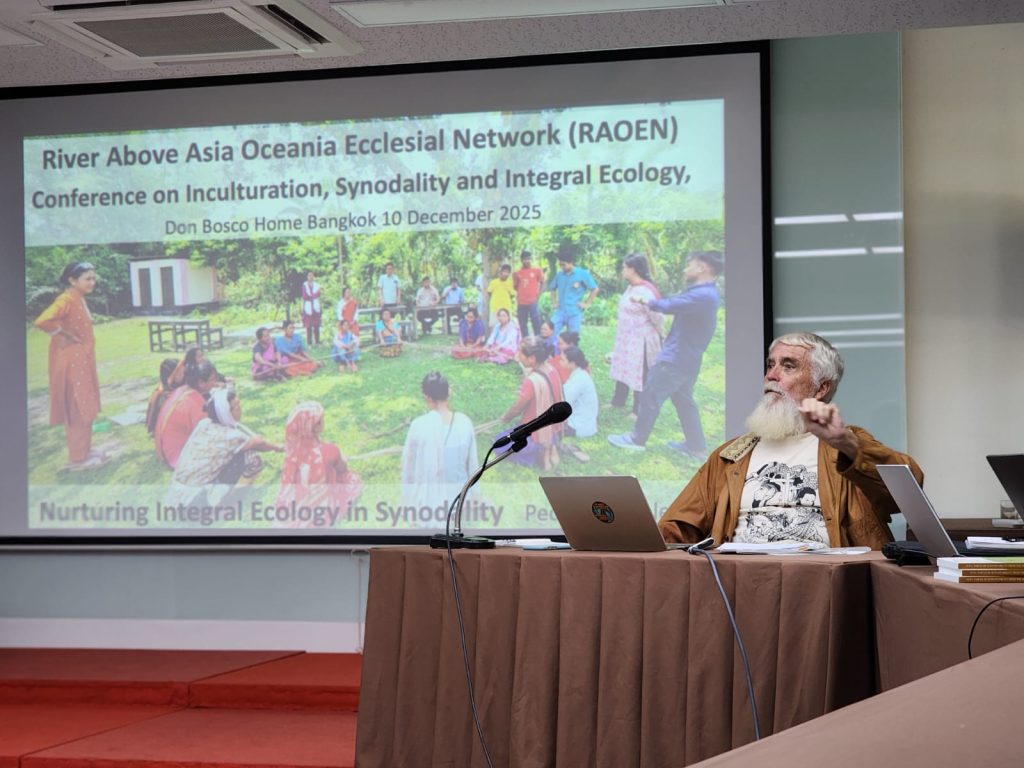
Fr. Pedro Walpole, representing the River Above Asia Oceania Ecclesial Network (RAOEN), spoke on “Nurturing Integral Ecology in Synodality,” highlighting the vulnerability of Indigenous territories to climate disruption.
“Most indigenous communities are struggling with the impact of climate change and the degradation of their ecological basis for livelihood. There is an urgent need to understand and include their responses of hope to this existential threat,” Fr. Walpole said.
He also introduced the concept of a “biome-based ecclesial network,” explaining that biomes are interconnected territories that create regional climate systems and sustain Indigenous communities.
As these systems face growing threats, he said, closer regional networking is necessary.
The conference also gave particular attention to Indigenous experiences of hope and faith.
Dr. Emiliano Q. Ibera III of the St. Vincent School of Theology at Adamson University presented “Ayta Sense of Jubilee: The Ayta as People of Hope,” reflecting on Indigenous spirituality in the context of the Church’s jubilee journey.
In his remarks, Dr. Ibera, who heads the coordinating team of ROOTS, emphasized the communal strength formed during the gathering.
“I am sincerely grateful for your presence and participation in the conference. Beyond the ideas that we have shared is the joy of being together and being concerned with the essential things we have to be preoccupied with. There is a strength that is formed as we come together and share many things,” he said.
Dr. Ibera also encouraged participants who are not yet part of ROOTS to consider joining the network, noting that affiliation requires sustained engagement with Indigenous communities and ongoing commitment to inculturation, synodality, and integral ecology.
The conference is part of ROOTS’ continuing efforts to promote synodality and Indigenous wisdom in dialogue with the universal Church.
The network emerged from the Circle of Sacred Rice, which last met in Nepal, and has recently conducted a Training of Trainers program coordinated by Fr. Albeiro at Don Bosco Kep in Cambodia.
Participants were formally welcomed on Dec. 11 by Archbishop Francis Xavier Vira Arpondratana of Bangkok at the mission office near Assumption Cathedral.
The gathering was also attended by Dr. Benedict Alo D’Rozario, President of Caritas Asia, underscoring the link between synodal reflection, Indigenous concerns, and the Church’s social mission across the region.