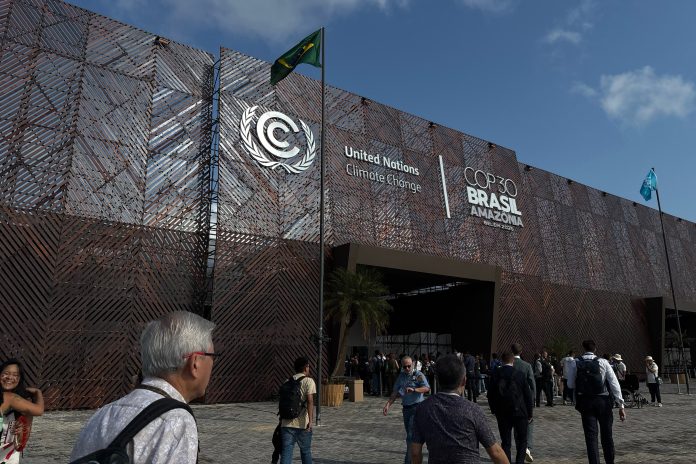
COP30 negotiators in Belém, Brazil, opened the summit with a stark warning that a surge of climate disinformation is threatening to derail global efforts to address the climate emergency.
They said the spread of false narratives is undermining public trust and placing vulnerable communities at greater risk.
President Luiz Inácio Lula da Silva underscored the urgency at the opening session, calling for a united stand against climate denial as countries enter a decisive phase of negotiations.
He said COP30 must deliver “a new defeat for climate denialists,” according to a report by UN News.
Twelve nations, including Brazil, Canada, France, Germany, and Spain, signed the first Declaration on Information Integrity on Climate Change, an international commitment to counter false climate narratives and strengthen protections for environmental journalists, scientists, and researchers who face rising harassment for defending evidence-based reporting.
The declaration forms part of the Global Initiative for Information Integrity on Climate Change, launched by Brazil in partnership with the UN Department of Global Communications and UNESCO. João Brant, Brazil’s Secretary for Digital Policies, said the goal is to “create a wave of truth.”
‘Disinformation… puts lives at risk’
Frederico Assis, COP30’s Special Envoy for Information Integrity, warned that climate lies are reaching deep into political discourse.
“Disinformation, driven by obscurantist worldviews, fuels political extremism and puts lives at risk,” he told UN News.
He added that “disinformation can affect and compromise every part of the COP process – process diplomatic negotiations, the action agenda, or mobilization and summits. All our efforts will be at risk if we fail to tackle disinformation properly, which stems from denialism.”
Assis highlighted how algorithms amplify “conspiratorial and manipulative” content, often supported by actors deploying “sophisticated tactics to spread false messages.”
His mandate, he said, is to keep the threat visible and mobilize political, religious and social leaders, civil society, and the media to respond.
Investigating who fuels climate lies
Information integrity appears on the official COP agenda for the first time. UNESCO’s Guilherme Canela said the milestone reflects a long-delayed acknowledgment of how disinformation shapes public perception.
“We still know very little about what’s behind this. For example, who funds these posts, and why do they spread faster than other types of content? How does that happen?” he said. “If we don’t understand these mechanisms, it’s very difficult to design effective strategies to combat this phenomenon.”
He said the initiative’s core purpose is “to finance, especially in the Global South, investigative journalism and research projects to uncover what’s really happening.”
The accompanying Global Fund for Information Integrity on Climate Change has already received 447 proposals from nearly 100 countries.
Backed initially by $1 million from Brazil, nearly two-thirds of the selected projects come from developing nations. Canela called it “very rewarding” to see the issue “embraced so strongly at COP30.”
Tactics that ‘change their disguise’
Maria Clara Moraes, a UN Verified Champion and co-founder of the Marias Verdes platform, said the scale and sophistication of climate disinformation campaigns continue to evolve.
She warned that the campaigns are “backed by powerful forces, particularly the fossil fuel industry,” and that their narratives “change their disguise.” Among the most harmful, she said, is the claim that the climate crisis is too advanced to fix.
“There are several types of disinformation. One of the most powerful is saying that it’s too late – that nothing can be done, or that these events like COP30 don’t make a difference. That’s also disinformation,” she said.
“Saying, ‘This isn’t working, it’s too slow, too complex, too frustrating.’ But yes – it’s important. We must constantly reaffirm the value of multilateralism and the importance of spaces like this one,” she added.
Young people driving ‘micro-revolutions’
Despite the challenges, Moraes said younger generations are taking the lead in producing climate content rooted in science and sustainability. Their engagement, she said, is shifting public awareness and building momentum for change.
According to her, young people are “a great source of hope and optimism.” She encouraged communities to create “micro-revolutions” through everyday choices that reinforce climate action and help drive systemic transformation.