
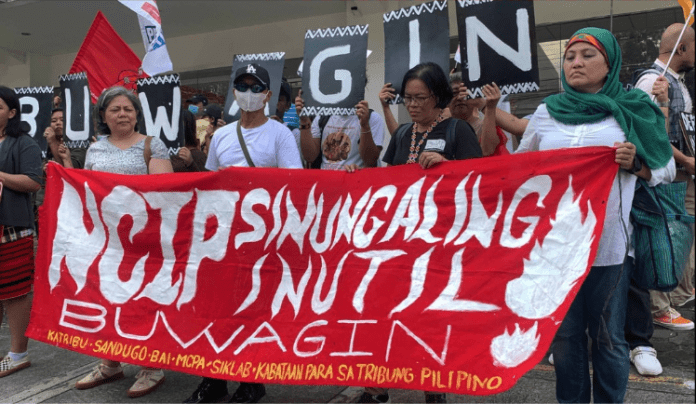
A national Indigenous alliance has called for the repeal of the Indigenous Peoples’ Rights Act (IPRA) and the abolition of the National Commission on Indigenous Peoples (NCIP), saying both have failed to protect ancestral domains from mining and other extractive projects.
In a statement marking IPRA’s 27th anniversary, Katribu said the law and the agency created under it “have become instruments for repression, deception, dispossession, and corporate plunder of ancestral lands.”
The group cited continuing resistance from Indigenous communities in Dupax del Norte, Mankayan, Itogon, Palawan, Mindoro, and Tampakan, where residents are defending their territories against large-scale mining, renewable energy projects, and plantations.
“These are the same communities seeking accountability from the NCIP, raising complaints of violated Free, Prior, and Informed Consent (FPIC) processes, and questioning the law itself for being ineffective and even counterproductive in protecting Indigenous rights,” Katribu said.
The group said Indigenous peoples, farmers, and small-scale miners in Northern Luzon have built barricades and filed legal cases against Woggle Corporation, Crescent Mining, and Itogon Suyoc Resources, Inc. (ISRI).
“Through barricades, rallies, and legal pushbacks, the militant residents of these communities made it clear that corporate plunder has no place in our lands, not when it means the loss of life, livelihood, and ancestral territory,” the statement read.
Katribu said police were deployed to the barricade in Dupax del Norte on October 17 after a Nueva Vizcaya court ordered the arrest of protesters.
It added that on October 1, armed security guards of Sangilo Mines, operated by ISRI, “violently ransacked the pocket mines of local miners in Itogon, leaving local miners injured.”
“Time and again, the NCIP has sided with corporations, issuing permits and certifications that facilitate land-grabbing and resource plunder,” the group said. “In the long history of mining and so-called ‘development’ projects in Indigenous lands, the NCIP has always been at the scene of the crime.”
Katribu said the NCIP “acts not as a protector of Indigenous rights, but as a facilitator for the entry of these projects.”
The group commended Indigenous communities for continuing to defend their ancestral lands.
“No amount of manipulation, intimidation, or violence from anti-people laws, institutions, and agencies will outweigh the concrete need of the people to survive and to protect their ancestral lands,” it said.