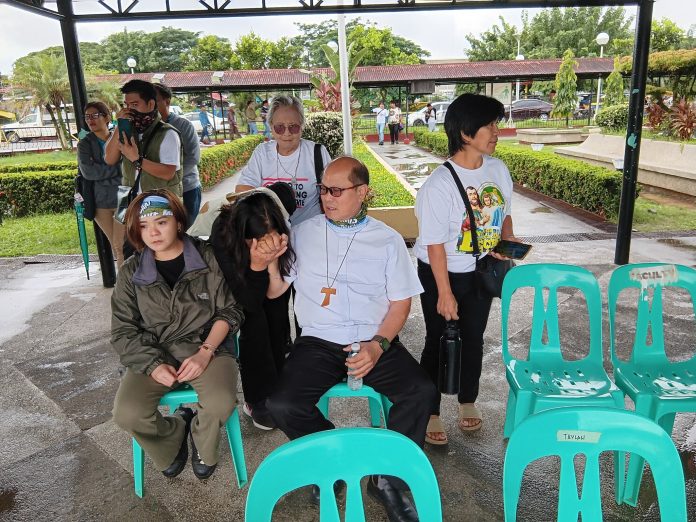
A Catholic bishop has urged local officials to speak out against what he described as police violence toward residents defending the environment in Bitnong village, Dupax del Sur, in the northern Philippine province of Nueva Viscaya.
Bishop Elmer Mangalinao of Bayombong appealed to the province’s elected officials to take a stand for justice and the environment.
“We need your voice now against the violence committed by the police against those defending the environment in Barangay Bitnong, Dupax del Sur,” he said.
Mangalinao said the people need public officials who will stand for justice, for creation, and for the people.
The bishop’s call comes as residents from five villages —Bitnong, Inaban, Munguia, Parai, and Oyao—continue to oppose the mining exploration of Woggle Corporation.
The affected communities are within the 3,102-hectare area covered by Exploration Permit No. 00030-II, issued by the Mines and Geosciences Bureau (MGB) on August 4, 2025.
Locals have been holding protests, citing a lack of proper consultation, threats to their farms and water sources, and potential damage to their ancestral lands.
“We are doing our best to stop the exploration because it will cause destruction to life, land, culture, and tradition of the villages,” Mangalinao told LiCAS News.
He lamented that Philippine laws appear to favor mining corporations, noting that the company has long operated in their area and is now targeting another site within the Cagayan Valley watershed.
The Order of Friars Minor (OFM) in the Philippines released a statement expressing “fraternal solidarity” with the residents of Dupax del Norte who are defending their land and cultural heritage from “the harmful exploration activities of Woggle Corporation.”
“Our presence in this local Church is not administrative, but pastoral and incarnational — we breathe the same air, walk the same soil, and share in the hopes and wounds of the people entrusted to our care. Because we live among them, we cannot be indifferent,” the Franciscans said.
They affirmed the pastoral guidance of Bishop Mangalinao, saying his call “reminds us that the land is not merely territory but identity, memory, and covenant.”
“To harm this land is to harm the families we serve, the young people we accompany, and the communities whose journey we share,” the statement added.
The religious superiors said projects that “disregard human dignity and communal discernment are not only environmentally destructive” but “they are morally and spiritually unjust.”
The friars said their mission in the diocese calls them to go beyond prayer by accompanying the people in their struggles—listening, journeying with them, and standing in their defense when needed.
They stressed that they are not distant observers but members of the same community, sharing in its burdens and hopes. For them, the fight to protect the land is not separate from their ministry but a living expression of the Gospel.
Nueva Vizcaya, known for its rich farmlands and mountain watersheds, has long been a flashpoint in the Philippines’ struggle between mining interests and environmental protection.
For decades, Indigenous and farming communities have fought to preserve their ancestral domains from extractive operations that threaten their way of life.