The Holy See warned world leaders at the United Nations General Assembly that deepening inequality is fueling division and instability.
The Vatican urged nations to act decisively to correct what it called “many imbalances and injustices” undermining peace.
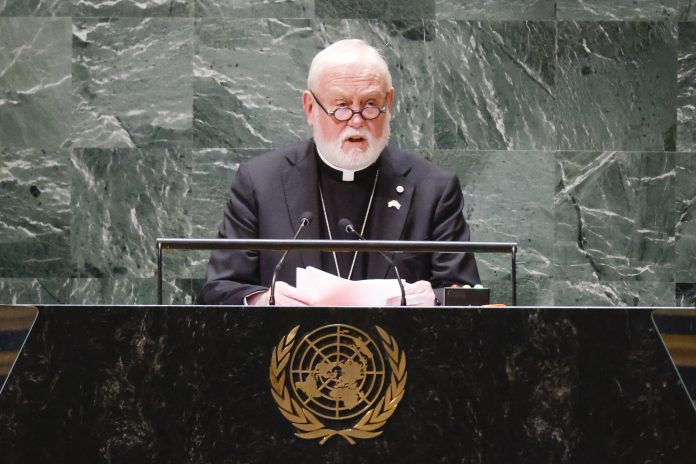
Delivering the Vatican’s address to the 80th United Nations General Assembly, Archbishop Paul Richard Gallagher said that “working for peace requires acting justly” and called for a global reset that puts human dignity at the center.
“Every effort should be made to overcome the global inequalities – between opulence and destitution –at are carving deep divides between continents, countries, and even within individual societies,” said Gallagher, the Holy See Secretary for Relations with States and International Organizations.
The Vatican stressed that hunger remains a scandal in a world of abundance. Gallagher quoted Pope Leo XIV, who lamented that “the continuing tragedy of widespread hunger and malnutrition, which persists in many countries today, is sadder and more shameful when we realize that, although the earth is capable of producing enough food for all human beings, and despite international commitments to food security, it is unfortunate that so many of the world’s poor still lack their daily bread.”
The archbishop said food security will not be solved by production alone, adding that the key to overcoming hunger “lies in sharing rather than in greedily hoarding.”
“Producing food is not enough: it is also important to ensure that food systems are sustainable and provide healthy and affordable diets for all,” he said.
The Holy See also pressed for debt cancellation for countries trapped in poverty, linking it to what it described as a mounting “ecological debt” between rich and poor nations.
Gallagher appealed to “the most affluent nations […] to acknowledge the gravity of so many of their past decisions and determine to forgive the debts of countries that will never be able to repay them. More than a question of generosity, this is a matter of justice.”
The Vatican’s message tied justice to other urgent global issues. Gallagher urged redirection of military spending toward development, calling nuclear weapons “an illegal means of warfare.”
He said peace must be built not on power but on dialogue and reconciliation, warning that “never before has it been more urgent than it is now for us to become peacemakers working for the common good, for what is good for all and not just for the few.”
The archbishop also linked justice to dignity in work and family life. He called for fair wages and humane labor conditions, defended the right to life “from conception to its natural end,” and condemned surrogate motherhood as a violation of both women and children.
On the climate crisis, Gallagher warned that “extreme natural phenomena caused by climate changes provoked by human activity are growing in intensity and frequency.”
He said the poor and Indigenous communities are hit hardest. “When justice and peace are trampled underfoot, those who are most hurt are the poor, the marginalized and the excluded. The suffering of indigenous communities is emblematic in this regard.”
He also raised migration as a justice issue, urging governments to uphold the dignity of migrants and refugees, ensure safe legal pathways, and confront the scourge of human trafficking.
On emerging technologies, Gallagher said artificial intelligence poses “new challenges for the defence of human dignity, justice and labour,” insisting that AI must never supplant human moral judgment.
The Vatican diplomat called for reform and renewal of the UN system itself, saying its credibility depends on recommitment to the Charter’s founding mission.
“This effort, in which all of us are called to take part, can begin to eliminate the root causes of all conflicts and every destructive urge for conquest,” Gallagher said.