Catholic bishops, clergy and religious leaders in the Philippines called for stronger safeguarding and accountability in Church institutions, saying the protection of people must take precedence over institutional reputation.
“The protection of persons must always take precedence over institutional reputation,” participants in the 2026 Convention on Mutual Relations said in a final statement issued Oct. 22.
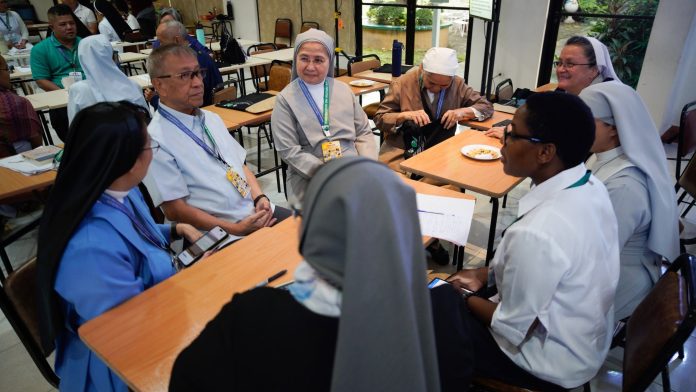
The three-day gathering at the Manresa Retreat House in Quezon City brought together vicars for the clergy, vicars and delegates for consecrated life, local and major superiors, representatives of secular institutes, and diocesan associations of consecrated persons.
The convention was organized by the Catholic Bishops’ Conference of the Philippines’ Episcopal Commission on Mutual Relations and the Conference of Major Superiors in the Philippines under the theme “One Mission, One Humanity.”
Participants committed to a culture of safeguarding, transparency and accountability, including the protection of vulnerable people, compassionate pastoral accompaniment of those who have experienced abuse, and appropriate action against perpetrators.
They called for “effective safeguarding policies, accountability, accessible reporting mechanisms, compassionate pastoral accompaniment of persons who have experienced abuse, and appropriate action concerning perpetrators in accordance with ecclesiastical and civil law.”
The statement also acknowledged experiences of clericalism, exclusion and unequal treatment within Church structures.
“Authentic mutual relations require dialogue, consultation, transparency, and shared pastoral responsibility,” the participants said.
They called for clear and equitable pastoral agreements covering assignments, institutional responsibilities, finances, compensation, medical benefits and social protection.
The statement stressed that consecrated persons should be treated as partners in the Church’s mission rather than merely as personnel in diocesan institutions.
“Consecrated persons are genuine partners in the Church’s mission, not merely personnel for diocesan institutions. Mutual relations must move beyond courtesy toward genuine ecclesial partnership,” the statement said.
Participants also committed to respecting the distinct identities, ecclesial authority and legitimate autonomy of diocesan clergy and institutes of consecrated life while addressing clericalism, exclusion and discrimination.
On technology, the statement said artificial intelligence and digital communication must serve human dignity, ethical responsibility and authentic relationships.
Church leaders also pledged deeper engagement in peacebuilding, reconciliation, social justice, human rights and integral ecology, particularly in solidarity with poor people, migrants, displaced persons and other vulnerable communities.
“Our prophetic witness must begin within the Church itself. We cannot proclaim reconciliation without dialogue, advocate justice without fairness, or defend human dignity without mutual respect,” the statement said.
Participants called for concrete diocesan and regional action plans, sustained coordination among the concerned CBCP commissions, the Conference of Major Superiors in the Philippines and representatives of consecrated life, along with periodic assessment of their shared commitments.
“The renewal of mutual relations calls us to conversion: from competition to collaboration, from privilege to service, from suspicion to trust, and from institutional self-interest to our common mission,” they said.