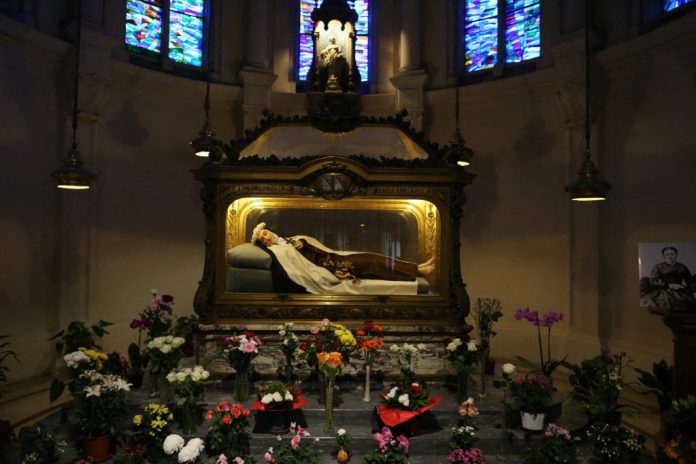
There is a particular kind of exhaustion that comes from believing your life doesn’t matter unless it is visible. Scroll through any feed today and you will find it everywhere—the quiet conviction that goodness needs an audience, that sacrifice without recognition is sacrifice wasted. Thérèse Martin, a young nun who died in obscurity in a small convent in Lisieux over a century ago, offers a quiet rebuttal to all of that. She never traveled far. She never led a movement. And yet her life has outlasted the noise of a thousand louder ones.
The Radical Ordinary
Thérèse entered Carmel at fifteen, an age when most people are still figuring out who they want to become. She died at twenty-four, having spent her short adult life behind convent walls, doing laundry, praying, and enduring the friction of communal living with women she didn’t always like.
Nothing about her biography reads as extraordinary. That is precisely the point.
What she offered the world wasn’t a doctrine or a movement—it was a method. She called it her “Little Way,” and its logic still unsettles people who expect holiness to look like heroism. Instead of grand penances, she picked up pins for people who annoyed her. Instead of public martyrdom, she smiled at a sister she privately couldn’t stand. Her spiritual genius was locating the sacred inside the mundane, insisting that love proven in small, unwitnessed acts carries the same weight as love proven on a cross.
This matters enormously now, in a culture that has quietly convinced us that impact is measured by reach. We have absorbed the idea that a life well-lived needs metrics—followers, likes, and a platform. Thérèse never had any of that, nor would she have wanted it. Fame came after her death, through her writing, almost despite her.
Obscurity as a Kind of Freedom
There is something quietly liberating in Thérèse’s insistence that hidden sacrifice matters most. If greatness requires an audience, most of us are excluded from ever being great. But if greatness lives in the pin picked up for love, in patience extended to someone exhausting, in a meal cooked without thanks—then it is available to everyone, all the time, regardless of platform or position.
This isn’t a call to resignation. It is not “stay small and be quiet.” It is sharper than that: a challenge to stop outsourcing the meaning of your life to whoever happens to be watching. Thérèse wrote that she preferred the monotony of obscure sacrifice to all ecstasy—not because monotony is pleasant, but because she had discovered that love doesn’t need spectacle to be real. It may be more real without one, since there is no audience left to perform for and no ego left to feed.
The Argument Hiding Inside Her Gentleness
Here is where Thérèse becomes more than a comforting figure—where she actually takes a side in a theological argument that has divided Christians for centuries. How much of salvation is God’s doing, and how much is ours? Traditions have split violently over that question, some emphasizing relentless effort and self-discipline, others emphasizing grace so total that human striving starts to look almost beside the point.
Thérèse refuses the choice. Her “Little Way” is not effort-lite spirituality for people too tired for the real thing. It demands daily, deliberate acts of will—choosing patience with someone who won’t change, choosing warmth toward a person who has never once been warm back. That is not passivity. But she locates the power behind it entirely outside herself. The trust comes first; the small act is simply where that trust becomes visible to anyone, including her. She called herself “the Little Flower” not to sound delicate, but because a flower’s only real work is opening toward the light—it doesn’t manufacture the sun. Effort, in her framework, isn’t what earns grace. It is what grace looks like once it is let in.
This is a genuinely different answer than “try harder” or “let go and let God.” It is closer to letting go than acting—not to earn love, but because you have already been handed more of it than you know what to do with.
Why She Still Speaks
Thérèse of Lisieux is sometimes softened into greeting-card sentimentality—flowers, gentle smiles, easy comfort. That version misses the more demanding figure underneath: someone who chose, deliberately and repeatedly, to find meaning in what nobody else would notice and who quietly settled an argument theologians are still having, without ever raising her voice to do it.
She isn’t asking us to abandon ambition or vanish from view. She is asking something harder to hear in a culture built on visibility: that the pin picked up for love was never wasted, even if no one ever knows it happened—and that you were never the one holding it up in the first place.
John Singarayar, a member of the Society of the Divine Word, India–Mumbai Province, holds a doctorate in anthropology. He is the author of several books and a regular contributor to academic conferences and publications. His work focuses on sociology, anthropology, theology, philosophy, ecology, artificial intelligence, leadership, management, tribal studies, spirituality, and mission.