Thailand’s growing housing crisis came into sharp focus last week as more than 200 representatives of vulnerable communities gathered in Bangkok to submit a proposal calling for housing to be recognized as a fundamental human right rather than a privilege reserved for those with financial means.
The delegation, representing the People’s Movement for Land and Housing Rights, submitted a letter on May 7 to Thailand’s Ministry of Social Development and Human Security outlining the “National Housing Agenda 2026,” a policy framework aimed at securing dignified and affordable housing for low-income citizens, the urban poor, and homeless people across the country.
Receiving the proposal, Minister Nikorn Somklang acknowledged the urgency of the crisis and said the government would work to integrate relevant agencies to shift assistance efforts “from charity to long-term life security” for vulnerable populations nationwide.
The movement’s proposals focus on structural reform, including capping home loan interest rates at no more than 2 percent, increasing state housing subsidies to 160,000 baht per unit to reflect actual construction costs, and allocating unused state land for affordable housing projects.
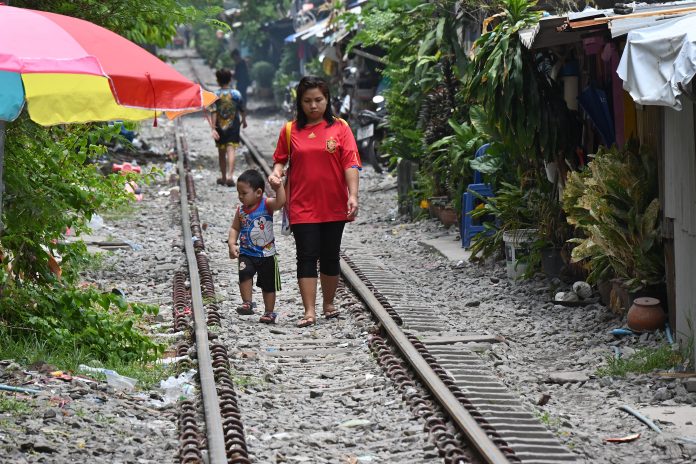
Participants in the movement included residents from railway and canal-side communities, urban poor networks, and homeless advocacy groups, many of whom shared painful stories of displacement and economic insecurity.
Among them was Somwang, a former construction worker who described the humiliation and hardship he endured after losing his livelihood.
“Life was very hard when I was homeless. I slept on hard sidewalks, dirty and disheveled,” he told LiCAS News. “Sometimes people would give me money as if I were a beggar.”
He recalled struggling even to access basic sanitation.
“Using the toilet meant asking permission from others. Showering was difficult, so I often bathed in canals during high tide,” he said. “I only had one or two sets of clothes.”
Somwang said years of physically demanding labor eventually took a toll on his body.
“I worked hard all my life as a construction worker, but when I turned 58, my body could no longer keep up,” he said. “My employer began replacing older workers with younger people. Eventually, I lost my job and became homeless.”
His story reflects the broader vulnerability faced by thousands of aging laborers in Thailand’s informal sector, many of whom lack social protection, savings, or secure housing.
While government agencies consider long-term policy reforms, faith-based organizations and local churches have continued responding directly to the needs of homeless and marginalized communities through grassroots social ministries.
Although Catholics make up less than 1 percent of Thailand’s predominantly Buddhist population, the Catholic Church has maintained a visible presence in social outreach, particularly among marginalized communities, migrants, and people living in poverty.
Before, during, and after the COVID-19 pandemic, many parishes across the country mobilized emergency assistance programs for families devastated by economic shutdowns and unemployment.
Among the best-known initiatives is the “One Hand Meal for One Baht” project in Bangkok’s Khlong Toei district, operated by the Sisters of the Sacred Heart of Jesus of Bangkok, which provides affordable meals for hundreds of slum residents each day.
The Congregation of the Most Holy Redeemer, widely known for its social mission work, has also played a major role in assisting homeless people, refugees, children with disabilities, and orphans through partnerships with the Human Development Foundation Mercy Centre.
The Holy Redeemer Church has likewise become a refuge for migrants, the homeless, and other vulnerable groups in the capital.
In Samut Sakhon province, the St. Anna Catholic Center for Migrants provides humanitarian aid, education, and healthcare support to migrant workers from Myanmar and Cambodia. At the same time, missionaries in northern Thailand continue to serve isolated mountain communities lacking healthcare and essential services.
Other Catholic initiatives include Caritas Thailand, which oversees educational and child welfare programs for disadvantaged youth, and the Camillian Social Center, known for supporting children orphaned or abandoned because of HIV-related illness.
Advocates say such grassroots efforts, while significant, cannot replace comprehensive national housing policies.
For Thailand’s homeless and urban poor, the demand raised last week was not merely about buildings or land ownership, but about restoring dignity, stability, and the basic right to live securely in society.