This Earth Day, as the world pauses to reflect on what we are leaving behind for future generations, Mindoro is living through a crisis that makes the question urgent and local.
The province has been in or near a power emergency for most of April, with confirmed Red Alert declarations running from mid-month through April 20. On April 20, the grid ran nearly seven megawatts short during the afternoon peak. The Oriental Mindoro Electric Cooperative Inc. (ORMECO) has issued repeated advisories warning of brownouts running from 11 a.m. to 10 p.m. Fuel stocks at diesel plants ran dry. On April 16, an emergency shutdown of a major generating unit knocked out an entire distribution feeder serving Calapan City and Baco. And this week, ORMECO disclosed that generation costs surged by nearly 18 percent in April alone, driven by heavy reliance on the most expensive emergency power sources available.
This is happening during one of the hottest periods of the year. PAGASA has recorded danger-level heat indices in parts of Mindoro this April, reaching 42 degrees Celsius, levels at which prolonged exposure risks heat cramps, exhaustion, and heat stroke. Mindoreños are enduring dangerous heat with no electricity to run a fan.
This is not a new story for Mindoro. Every summer, as heat rises and demand climbs, the same cycle returns: thin reserves, brownout rotations, emergency advisories. We have come to treat it as a seasonal inconvenience rather than what it actually is: a symptom of a fundamentally broken energy system.
The root of the problem is dependence. Mindoro’s grid relies heavily on diesel and bunker fuel plants, sources that are expensive by nature and doubly so now, as the Middle East conflict drives global oil prices upward with no stable ceiling in sight. When fuel prices spike, electricity costs in isolated grids like ours spike with them. When a generating unit breaks down, or fuel deliveries are delayed, as both did in March and April, there is little margin to absorb the loss.
Some will point out that renewable energy also faltered during this crisis: wind and hydro output dropped as summer heat reduced both wind speed and water flow. This is true, and it deserves an honest answer. The problem was not renewable energy. The problem was a grid that was never designed around diversification. A resilient energy system does not bet everything on one source, but instead harnesses the diversified power of renewable energy, be it solar, wind, hydro, or storage. Renewable energy, with the right systems in place, is predictable and reliable. For example, solar energy peaks when the sun is hottest, and wind picks up in the late afternoon and evening, precisely when Mindoro’s demand is highest. Together, they cover each other’s gaps.
Mindoro has more than enough natural endowment to build exactly that kind of system. What it lacks is the political will and the investment to get there.
Pandang Gitab ng Mindoro, a scoping study on Mindoro’s power landscape by the Center for Energy, Ecology, and Development (CEED) published last year, estimated that Mindoro holds a potential of over 34 gigawatts in solar and wind capacity alone, hundreds of times more than the island’s projected peak demand. We are sitting on an abundance of clean energy while paying some of the highest electricity rates among off-grid areas in Luzon. That is not misfortune. That is a policy failure.
This is not merely a technical debate. It is, above all, a matter of justice. Who bears the burden? It is not the power companies negotiating long-term supply agreements behind closed doors. It is the tricycle driver whose earnings shrink when fuel costs climb. It is the student trying to study during a brownout in the summer heat. It is the small business owner for whom every unplanned outage is a day’s revenue lost. Electricity is not a luxury. It is the baseline of a dignified life, and too many Mindoreños are being denied it.
The response to this injustice is already being built. And it is being built from the ground up.
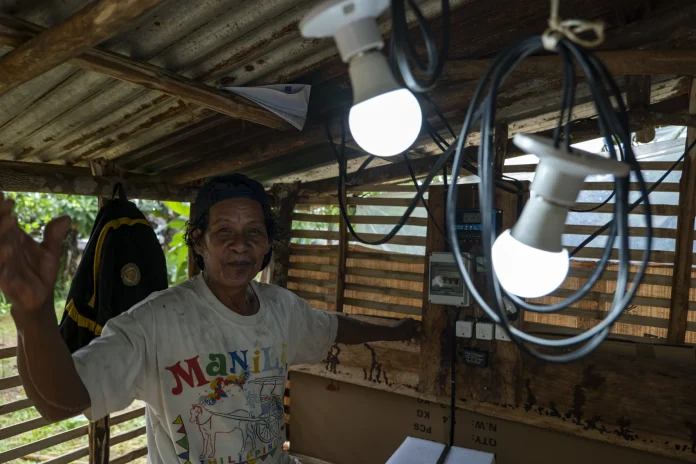
In remote Mangyan communities in Mindoro, solar systems installed with the support of civil society partners are already providing reliable electricity to families that have lived without it for generations. These are not pilot projects waiting to be scaled. They are proof, already working, that decentralized renewable energy can reach the communities our current grid never could.
The Catholic Church in Oriental Mindoro has begun its own journey in the same direction. As part of the 75th anniversary of the Diocese of Calapan, our bishop, Most Rev. Moises Cuevas, has called for the solarization of parishes, Catholic schools, and Church institutions throughout the province. This is not a gesture. It is a direct response to the call of Laudato Si’, Pope Francis’ encyclical on our care for creation, which asks us not only to speak about ecological conversion but to live it in the choices we make about energy.
Even the Oriental Mindoro Electric Cooperative is taking steps in that direction, with a 15-megawatt solar power plant being developed in Bansud, projected to be operational by 2027. But meeting the minimum requirements of the law is only a beginning. The law requires only a 1 percent annual incremental increase in off-grid renewable energy generation. What Mindoro needs is not the floor, but genuine institutional commitment to a full transition.
REnew Mindoro, a campaign led by the Diocese together with CEED and local sectoral organizations, is mobilizing the partnerships and investments needed to move this island toward a diversified, community-centered renewable energy system. On April 30, the REnew Mindoro Investments Summit will convene financing agencies, energy developers, local government units, and community stakeholders to turn this vision into committed action. It will be followed by the REnew Mindoro Fair on May 1 to 3 at Xentro Mall Calapan, where households, small businesses, and institutions can directly engage with solar technology providers and financing options.
The path is not without difficulty. Existing power supply agreements lock Mindoro into years of continued dependence on fossil fuels. Political decisions on energy remain largely insulated from the communities most affected by them. The crisis has grown so severe that ORMECO’s own general manager has been compelled to issue a public statement on rates, an acknowledgment that the current system is failing the very consumers it is supposed to serve. And the transition to a fully diversified renewable system will require sustained investment, not just good intentions.
But on this Earth Day, the question before us is not whether Mindoro can transition to clean energy. The question is whether we will allow the same fragile, expensive, and unjust system to define another generation of Mindoreños, or whether we will finally build the energy future this island deserves.
We have the resources. We have the technology. And in the communities already living by solar light, we have the proof that another path is possible.
What we must now build together is an energy system that is truly mura, maaasahan, at malinis for every Mindoreño, on every day of the year. Not just when the sun is shining and the wind is blowing, but one built wise enough to hold both.
Fr. Edwin A. Gariguez is the executive director of the Diocesan Social Action Center, Diocese of Calapan, and a co-convenor of REnew Mindoro.